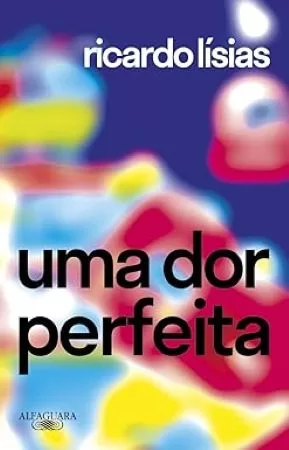
LÍSIAS, Ricardo. Uma dor perfeita. Rio de Janeiro: Alfaguara. 2022.
Raíssa Abreu Gomes
Illustrated by Catalina Chervin
Translated by Shaina Thelen
A stay in an Intensive Care Unit is the kind of traumatic experience that no one wants to remember. Ricardo Lísias (São Paulo, SP, 1975), however, had reasons to approach his illness from a different angle. He was suffering the consequences of Covid-19, the disease that, at that time, was taking the lives of almost four thousand Brazilians daily, many of whom did not receive hospital care. Aware of the privilege of being treated in an elite hospital amid a public health crisis, and accustomed to exploring the limits of language in the face of death, Lísias recorded everything he could. These notes would provide the author with the foundation for composing Uma dor perfeita (A Perfect Pain).
The novel, a literary reworking of what the author experienced, follows the two weeks Lísias spent in the Covid-19 ICU of a private hospital in São Paulo in March 2021. This was at the most critical moment of the coronavirus pandemic in Brazil, when only healthcare professionals and some of the elderly and immunocompromised had received the first dose of the vaccine. The author suffered a collapsed lung and came close to being intubated. As he recovered, his editor and friend suggested he reorganize his memories from those days into a book.
Confronting existential questions in extreme situations is nothing new in the work of Lísias, whose literary production is marked by a mixture of genres and the blurring of boundaries between fiction and reality. The writer emerged on the literary scene in the early 2000s and quickly drew the attention of prominent critics, such as Leyla Perrone-Moisés, who declared in 2007 that Lísias was “one of the best Brazilian writers to emerge in recent years.” His novel O céu dos suicidas (The Sky of Suicides, Alfaguara, 2012) explores, for example, the anguish of a young narrator faced with a friend’s decision to take his own life. The novel, considered the best of the year by the Associação Paulista de Críticos de Arte (APCA), was inspired by the author’s own experiences. Divórcio (Divorce, Alfaguara, 2013), meanwhile, fictionally reconstructs the writer’s own experience of separation. Madness, violence, loneliness, and the complexity of human relationships—as well as literature itself—are themes that make his work stand out on the national scene, representing contemporary issues. Lísias was a finalist for the Jabuti Prize with Anna O. e outras novelas (Anna O. and Other Novellas, Globo, 2007), and for the São Paulo de Literatura Prize for O livro dos mandarins (The Book of Mandarins, Alfaguara, 2009). He was also among the twenty writers selected in 2012 by the British literary magazine Granta for the anthology The Best of Young Brazilian Novelists, with the short story “Tólia.”
To structure Uma dor perfeita, the writer Ricardo Lísias needed to return to the bedside of the patient Ricardo and push his limits to transform him into a narrator. It is through the interplay, or negotiation, between these two metaliterary voices—writer and narrator—that the chess player Lísias brings forth his autofiction. Yet the game must be interrupted repeatedly by the narrator, sometimes by shortness of breath, sometimes by fainting or hallucinations. All of these disruptions are incorporated into the narrative, immersing the reader into the nightmarish atmosphere of the Covid-19 ICU, marked by the scarcity of natural light, the constant beeping of monitoring equipment, and the coughing and groaning of patients.
The style of text follows the patient’s state of health, ranging from introspective prose during moments of relative sanity to the disarray of experimental verse during moments of fever and pain. Ricardo’s leg muscles were, in his own words, “eaten away by the virus,” causing a perfect pain. The title of the book comes from the expression “perfect storm,” meaning the “worst possible scenario.” An indescribable pain that, according to him, “had no connection whatsoever with language. No account will be able to capture it precisely enough.” But if the narrator’s conscious language could not express this pain, which was pure essence, his unconscious seems to have found a way to contain it. In his delirium, he imagined a thin, transparent film enveloping his legs, which remained immobile and separate from his body. They could even, perhaps, be given to someone else.
Once the worst symptoms had passed, the narrative shifts to the outside world. Conscious, Ricardo observed and noted all the movements of the ICU, much like a healthcare professional monitoring a patient’s progress: the brief and eagerly awaited visits from doctors, the agile movements and concealed tears of the nurses, the phone conversations of his fellow patients. The narrator recounts that the workers in the ICU did not like to accompany patients being taken for intubation. “Since they can’t receive visitors and there’s no one else around them, many ask to hug us. It sucks,” explains a nurse nicknamed “my health minister.” Like Lísias’s character, healthcare professionals were the ones who felt the impacts of the Covid-19 pandemic most acutely. Besides living with the daily fear of contamination, the loss of colleagues, and the physical and emotional exhaustion, in Brazil they also had to deal with the lack of even the most basic working conditions, as there was a shortage of personal protective equipment in public hospitals.
When recalling his own phone calls with his family, the narrator speaks of the fear and shame he felt when facing his wife’s “stone eyes,” a shame that permeates the entire narrative—for having allowed himself to get infected, for the elite treatment he received, for the fragility of his exposed body. “I must have done something wrong,” he tells himself. His son’s face, in turn, appeared blurred on the phone screen, without defined contours, as if fading from his horizon of possibilities. An image that evokes another absence is that of his own father, who disappeared after a soccer game and was seen for the last time between the opening and closing doors of the subway.
It is also worth highlighting the emphasis the narrator places on the hypocrisy of transforming a catastrophe into a work of literature. This discomfort is projected onto the figure of a rat, a metaphorical character that devours the patient’s entrails until nearly the end of the book. “I will only be rid of you, rat, when I see, from a distance, my blood invading my kidneys,” says Ricardo. Once again, the author uses metaliterature to emphasize the artificial nature of the literary text in relation to reality, which becomes clear when the rat is finally asked to leave. “No, pretentious rat, this is a book. The dead are out there. The time has come to make it perfectly clear: the pact with the devil is a creation, therefore, I undo it.”
It is interesting to note that the image of the rat was widely used during the pandemic as a reference to the then-president Jair Bolsonaro—more specifically, to his neglect in managing the crisis. In addition to promoting misinformation, encouraging the use of medications without proven efficacy, and discouraging the use of preventative masks, the former president’s administration was accused of deliberately delaying the purchase of vaccines and of financially benefitting from their acquisition. Ricardo Lísias analyzed the Bolsonaro years in the essay-novels Diário da catástrofe brasileira – Ano 1 (Diary of the Brazilian Catastrophe – Year 1) and Ano 2 (Year 2), published by Record in 2020 and 2021, respectively.
Many authors have written about the Covid-19 pandemic, which caused the death of at least 5.5 million people worldwide, according to official figures from the World Health Organization (WHO)—nearly 700,000 in Brazil. It was a period of isolation, loneliness, and uncertainty about the future, and also gave rise to several dystopian works, such as O riso dos ratos (The Laughter of Rats) by Joca Reiners Terron (Todavia, 2021), and O último gozo do mundo (The Last Pleasure of the World) by Bernardo Carvalho (Companhia das Letras, 2021). In their own way, all of these works reflect their authors’ need to respond to what truly seemed to be the end of the world.
Uma dor perfeita bears witness to the horror and hopelessness of those days with striking rawness. In attempting to rework the experience of illness through writing, Lísias demonstrates that, despite all the limitations of art in the face of tragedy—and with all the pacts with the devil available to the rats of the moment—a book remains the most ethical thing a writer can do: an imperfect memory of the perfect pain. A book that, like a film, envelops and contains this pain so that it can be shared, so that it is not forgotten.
Further Reading
PERRONE-MOISÉS, Leyla (2007). Posfácio. In: LÍSIAS, Ricardo. Ana O. e outras novelas. São Paulo: Globo. p. 195-205.
RUIVO, Julia Barbedo (2022). Diante da fratura do real: o realismo e o contemporâneo em Ricardo Lísias. Dissertação (Mestrado em Estudos da Linguagem) – Universidade Federal de Ouro Preto, Mariana. Disponível em: https://repositorio.ufop.br/server/api/core/bitstreams/f3827a73-d45b-4fae-abd8-b966a3fb7dae/content. Acesso em: 26 maio 2024.
SCAMPARINI, Júlia (2013). Presença do autor: autoficções de Ricardo Lísias e de Lúcia Murat. Itinerários – Revista de Literatura. Araraquara, n. 36, p. 277-286. Disponível em: https://periodicos.fclar.unesp.br/itinerarios/article/view/5694/4723. Acesso em: 26 maio 2024.
SUT, Felipe Garzon (2022). Palavra que agride, palavra que convoca: Ricardo Lísias e o nome próprio entre desastre e acontecimento. Dissertação (Mestrado em Estudos de Literatura) – Universidade do Estado do Rio de Janeiro, Rio de Janeiro. Disponível em: https://www.bdtd.uerj.br:8443/handle/1/18472. Acesso em: 26 maio 2024.
Iconography