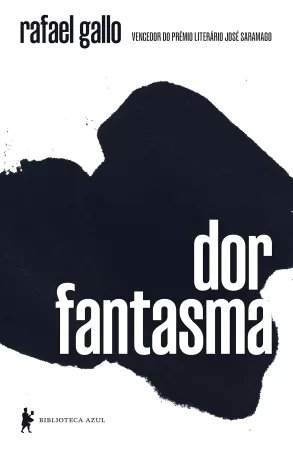
GALLO, Rafael. Dor fantasma. São Paulo: Biblioteca Azul, 2023.
Mariana Marise Fernandes Leite
Illustrated by Léo Tavares
Translated by Kennedy Moen
Dor fantasma (Phantom Pain) is the second novel by writer Rafael Gallo (São Paulo, SP, 1981). The author, who currently lives in Portugal, is also a music producer, composer, musician, and professor. This work, which directly connects literature and music, won him the José Saramago award in 2022. Before this, despite his brief literary career, he had already received recognition for his first novel, Rebentar (Sprout), earning him the São Paulo de Literatura Prize in 2016; with his short story collection Réveillon e outros dias (New Year’s Eve and Other Days), he won the Sesc de Literatura Prize in 2012.
Although his two novels have received notable recognition, there is a key difference between them. This is what the author points out in an interview by Iara Biderman for the Quatro cinco um magazine in 2023: his first novel is about the mother figure, while the second is about the father figure and the patriarchy.
Rebentar is the story of a mother who is coping with the pain of her son’s disappearance five years earlier. Dor fantasma, in turn, is the story of a pianist and piano teacher who orients all aspects of his life around what he believes to be the only correct way to live: following tradition, a mirror of what he believes to be perfection. In his role as a father, the protagonist of this novel finds pain in the existence of his son, who for him is the embodiment of something that will never reach the coveted perfection he sought. For the reader, in agreement with Inês Pedrosa’s interpretation, the relationship between this father and son is the embodiment of the emotional illiteracy of men, resulting from the patriarchal structure that sustains familial relations even today.
Dor fantasma’s protagonist is Rômulo Castelo, a pianist who pursues the flawless execution of Rondeau Fantastique, composed by Franz Liszt. This—his primary obsession—stems from a desire sparked in childhood by his father, the conductor George Castelo, who had told him that there was no living performer capable of playing Liszt’s piece perfectly.
Rômulo Castelo’s story is told in four parts: “Coda,” “Exposition,” “Development,” and “Cadenza.” As Luiz Paulo Faccioli details in his text about the book, the first three sections of the novel are names of the parts of a sonata, a compositional structure in classical music, likely influenced by Gallo’s musical background. The final part, “Cadenza,” is another term taken from music which indicates “the moment in a concerto reserved for the soloist so they can exert their virtuosity.”
In these four parts, we first observe Castelo, a renowned professor and pianist, about to embark on an international tour featuring a concert that includes his long-awaited performance of Liszt’s composition. This same man has a stable position at a university, lives with his wife and son in an urban area, and is responsible for the care of his father in a nursing home.
Blinded by perfection and encouraged since childhood towards rigor and tradition to achieve his musical goals, the pianist embeds intensity in all aspects of his life: his students must execute pieces to perfection; his co-workers must strive to execute the pieces as perfectly as when they were first immortalized, as he does; his role in his family as a man should be that of a husband and father who provides material support so that his wife can fulfill her role as a spouse and take care of their son, who, in turn, should follow his image and likeness and pursue a promising future. Consequently, students, colleagues, and family members, with their flaws, sentimentalism, and weaknesses, are not relevant to Castelo. Even his son—born with a disability—is, to him, an eternal deviation from the path, condemned to never attain his father’s greatness.
Rômulo Castelo’s path towards the perfect execution of Rondeau Fantastique is, however, interrupted by a devastating incident: as he leaves the university, the pianist is struck by a motorcycle. As a result, the man suffers various minor injuries and one that would become the starting point for his decline: the damaging of his right hand and its inevitable amputation.
This occurrence, which is also the basis of getting to know the novel’s protagonist beyond his obsession with music, brings the reader of Dor fantasma to the second and third parts: “Exposition” and “Development.” The pianist, now an amputee, feels the “phantom pain,” the pain an amputee experiencing post-traumatic stress feels in the missing limb. This pain gradually reveals to the reader an irredeemable protagonist who, stripped of his musical ability, is an incurably stubborn adult who projects an image of himself with such rectitude that it could never be attained by another human who crosses his path.
Meticulously narrating the protagonist and his egocentric view of himself and the world, Dor fantasma’s narrator presents the reader with innumerable possibilities for this man’s redemption throughout “Exposition” and “Development,” which, in such a romanticized text, would easily be thrilling outcomes for an uncompromising pianist. However, an inflexible protagonist, who never deviates from the projection of his self-image, responds to these innumerable possibilities. This dynamic establishes before the reader a human being with an air of repulsion.
Castelo is a character so thoroughly scrutinized by his narrator and so identifiable to his reader that he calls to mind the paradox of the fictional character presented by Antonio Candido: “In fact, how can fiction be? How can what does not exist, exist?” This is because, even if a sense of repulsion might take hold of Gallo’s reader upon encountering this fictional character, this same fictional being is easily identifiable in numerous men who inhabit reality: Rômulo is the absent husband and father who financially sustains his family; he is the traditionalist professor who pushes his students towards perfection; he is the pianist who pursues perfect musical execution; he is the individual incapable of dealing with insufficiency, weakness, other people’s sentimentalism, and family drama. He is, ultimately, what is repulsive in humans. Therefore, Dor fantasma is an interesting example of what Candido identifies as the concretization of “a certain type of relationship between the living being and the fictional being, manifested through the character, who is the [novel’s] concretization of this.”
Thus, the “phantom pain”—the title of the book—presents itself not only as the pain of its protagonist in the face of the absent limb, but also, to a certain extent, as the reader’s pain in the face of social phantoms, of absences, that manifest themselves through the protagonist in the most diverse forms and reach the reader as the narrative unfolds.
Regarding the novel’s narrative rhythm, its structure seems to take the reader to a concert, just like the one the protagonist aspires to: the protagonist introduces himself; before him lies a plot twist that leads to the story’s climax and, little by little, with every outburst from the protagonist, every chance for redemption broken, a conclusion reveals itself, presented to the reader in “Cadenza,” announcing the final solo of the one whose story is being told.
Tags: drama familiar, espaço urbano
Further Reading
CANDIDO, Antonio (2007). O personagem do romance. In: CANDIDO, Antonio [et al.]. A personagem de ficção. 11. ed. São Paulo: Perspectiva. p. 51-80.
FACCIOLI, Luiz Paulo (2023). Um romance em forma-sonata. Rascunho: o jornal da literatura no Brasil, Porto Alegre, n. 278, jun. Disponível em: https://rascunho.com.br/ensaios-e-resenhas/um-romance-em-forma-sonata. Acesso em: 4 ago. 2024.
GALLO, Rafael (2023). Rafael Gallo: escritor paulista lança romance vencedor do prêmio Saramago sobre a derrocada de um artista e a masculinidade catastrófica. [Entrevista concedida a] Iara Biderman. Quatro cinco um, São Paulo, n. 67, jun. Disponível em: https://quatrocincoum.com.br/entrevistas/fichamento/rafael-gallo. Acesso em: 4 ago. 2024.
RAFAEL GALLO. [Site institucional]. Disponível em: https://www.rafaelgallo.com.br. Acesso em: 4 ago. 2024.
VENCEDOR do Prêmio José Saramago, Rafael Gallo fala do romance Dor fantasma (2023). TV Senado. Disponível em: https://www12.senado.leg.br/tv/programas/leituras/2023/05/vencedor-do-premio-jose-saramago-rafael-gallo-fala-do-romance-dor-fantasma. Acesso em: 4 ago. 2024.
Iconography