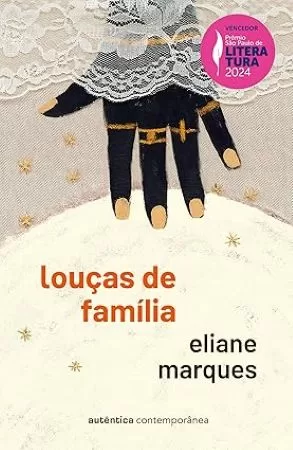
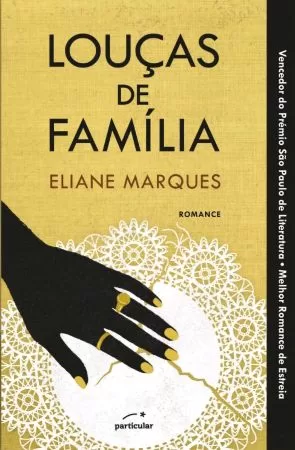
MARQUES. Eliane. Louças de Família. Belo Horizonte: Autêntica, 2023.
Ludimila Moreira Menezes
Illustrated by Mariângela Albuquerque
Translated by Leila Santos
The author Eliane Marques (Sant’Ana do Livramento, RS, 1970) holds a master’s degree in Public Law, undergraduate degrees in Pedagogy and Law, and serves as an External Control Auditor at the Court of Accounts of the State of Rio Grande do Sul. The novelist is also a poet, translator, and psychoanalyst. Her book of poems e se alguém o pano (And If Someone the Cloth, Après Coup, 2015), won the Açorianos Prize in 2016. As a poet, she also wrote Relicário (Reliquary, Grupo Cero, 2009), and O poço das marianas (The Well of the Marianas), winner of the Minuano Literary Prize in 2021, published by Orisun Oro, a small press she co-founded. Additionally, she worked as a screenwriter, executive producer, and director for the documentary “Wole Soyinka – A forja de Ogum” and collaborated on poems for the dance performance “Smabaracutu” by the Canoas Dance Collective, among other multimedia projects.
The novel Louças de família (Family Dishes), published in 2023 by Autêntica Contemporânea, invests in constructing a confessional language through the voice of Cuandu, a Black narrator grappling with her psychoanalytic process and constantly working through the traumas, grief, and violence she and her ancestors experienced. With a genealogical scope and an Afrocentric perspective, the novel imaginatively reconstructs the experiences and subjectivities and the corporeal and metaphysical identities of the Black women who are Cuandu’s relatives. Louças de família allows the reader to journey through geographical and emotional architectures historically denied space, intimacy, and dignity through a multi-voiced syntax. In this novel, Black men and women’s place in the world gains concreteness through a poetic and analytical gaze.
Throughout the narrative, which goes beyond the representation of a Black family built on selflessness, struggle, and the romanticization of suffering, Cuandu’s angry and poetic impetus gives concrete form to the exploitative and precarious worlds of enslaved and underpaid labor undertaken by her close and distant relatives. Amid mnemonic invocations of Brazil’s slaveholding colonial past, the novel advances through layered expressions of class consciousness and anti-racist struggle. It employs an avant-garde linguistic style, weaving together Spanish, Indigenous languages, and Yoruba. Through this, the story unfolds through sensory experimentation and the recuperation of Afro-Brazilian worldviews, treated as both mythology and narrative resource, in order to deepen and complicate the affections and memories of the self and of one’s Black ancestors. Another avant-garde element in Marques’s text is the power of orality as a unifier of images, thoughts, and feelings, bringing to the forefront a polyphonic legacy of distinct cultural heritages constantly subjected to epistemicide (systemic destruction of knowledge systems) by the elite and the pact of white supremacy.
Cuandu’s impulse to map childhoods and stories, especially those of her aunts, grandparents, and mother, across the dense simultaneity of past and present, gains momentum in the face of Aunt Eluma’s death. Eluma was an aunt who professed her faith to the Orixás, worked for years in a Candomblé terreiro (religious center), and later converted to evangelical Christianity. Eluma’s will, which opens the novel, is an inventory of bills to pay, a dismal epigram of a life of precarious work as a domestic servant and church member, “another clothing installment she paid in January with a sister from the church; the clothes total R$256.00, but of the 7 items at R$64.00 each, 4 are missing, electricity is R$46.00 + water, half hers, half Maria Antônia’s–, R$167.00. If it is possible to help me, all help is welcome.”
It is through the impacts of the microcosms of various worlds of work, be it domestic (family homes) or in slaughterhouses, streams (where washerwomen work), and warehouses in the “a small town that cannot decide between the name of a saint, Ana, or Freedom,” on the border between Brazil and Uruguay, that both the impulse for historical memory and the desire for the rupture from the subalternized workforce become the driving forces of the novel. It is worth noting that the novel does not offer a historiographical overview of the exploitation of female workers and descendants of enslaved people; Marques develops an ethical approach interested in the complexity, resistance, dilemmas, and imaginative triumphs of these characters. In addition to the creative force of imagining the pains, vulnerabilities, and complexities of themselves and their ancestors, the narrator rewrites and magnifies experiences, possibilities, and the future of this community of workers of both genders.
Like a polyphonic choir, the narrator draws on stories retold by close relatives and her own experiences with her aunt Eluma to create a text that alternates and compares imaginaries of the last century with modern symbols of Black subjectivities. These voices emerge in a mixture of accents and languages that resonate with the remaining structures of a slave-owning Brazil and a syncretism in which traces of colonialism, negotiation, and strategies of survival and resistance are compounded in an elitist city on the border of Uruguay in Rio Grande do Sul.
The novel unfolds through successive, dramatic tensions shaped by Cuandu’s class and racial consciousness, as well as by memories stirred either by anger or by nostalgia for the caring bonds between women. Cuandu constructs a dialectical narrative arc for herself that creates friction between the past and its racist reverberations in the present, outlining a desire for a future that redefines her presence as a refusal (and a courageous implosion), via gestures and language, of pacts with her ancestors of self-pity and condescension.
Another driving force for the narrative’s intertwining of memory, emotions, and impulses is the incessant poetic and psychoanalytic play of language constantly manipulated by the narrator and protagonist, Cuandu, which makes it possible for the feminine voice of a Black woman from the interior of Rio Grande do Sul to gain influence, strength, and a calling to continue shaping her futures and her voice.
Further Reading
AUGUSTO, Ronald. (2023). O processo da ficção, segundo Eliane Marques. Disponível em: http://www.letras.ufmg.br/literafro/resenhas/ficcao/1804-eliane-marques-loucas-de-familia. Acesso em: 10 jun. 2024.
MONTENEGRO, Tercia. Os despedaçamentos. Jornal Rascunho. Edição 280, ago. 2023.
Iconography