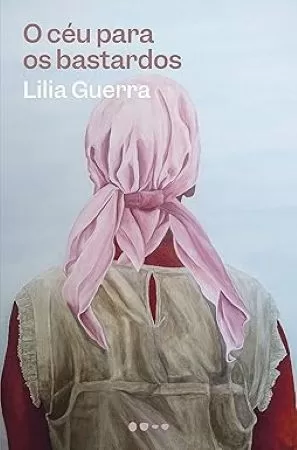
GUERRA, Lilia. O céu para os bastardos. São Paulo: Todavia, 2023.
Juliana Berlim
Illustrated by Catalina Chervin
Translated by Leila Santos
The novel O céu para os bastardos (Heaven for Bastards), by Lilia Guerra (São Paulo, SP, 1976), had its first edition published by the São Paulo-based publisher Todavia in the second half of 2023, around August or September. In his critical commentary published in the São Paulo Review, Bruno Inácio (n.d.) notes: “O céu para os bastardos is also marked by an advanced literary technique, capable of constructing striking dialogues, memorable scenes, and characters who become companions and accomplices of the reader.” He further emphasizes the characters: “Some of them have already appeared in the author’s excellent previous works, published by Editora Patuá. The protagonist Sá Narinha, for example, provided a testimony in the novel Rua do larguinho e outros descaminhos, published in 2018.”
The technical mastery of the work in particular catches the reader’s attention. Polyphony is established in the opening scene, with a group of girls talking among themselves about trivialities. The characters introduced in the flashback are not immediately identifiable, but similar dialogues between the young women will be repeated, marking a circular movement in the construction of affective memory that is established between the reader and the characters Bigu, Cassiana, and Regina, also known as Regininha. These three represent a connection to the daily life of the generation after that of the protagonist, Maria Expedicionária, better known in her community as Sá Narinha, or even as Xispê, as her young employer calls her at her job as a domestic worker. These multiple women, alive in Sá Narinha, who is the prevalent persona and main narrator, are guided and presented to the reader via memory. This includes individual memory and, metonymically, collective memory, the memory of the Fim-do-Mundo (End of the World) neighborhood.
The lexical choice of “Fim-do-Mundo” alludes to a geographical condition recurrent in Brazilian megacities: the distance between the centers of large cities and the residential neighborhoods where the majority of the country’s working class lives. Instead of explicitly locating the narrative in the city of São Paulo and its surroundings (it is inferred to be São Paulo due to the presence of Italian and Japanese secondary characters, who emerge as secondary characters in the plot), the author expands her narrative scope, allowing the readers, especially those who live in large urban centers, to perceive the similarity between the fictional space and the Brazilian urban landscape. There are no other place-name references throughout the book, because the novel aims, above all, to recount daily life in the emotional space inhabited by the narrator Sá Narinha.
As Bruno Inácio (n.d.) points out, Guerra’s literary project is focused on constructing an affective portrait of the Brazilian periphery, based, as mentioned, on the São Paulo megalopolis. For those who grew up in or frequented peripheral or suburban neighborhoods, the characters sound very familiar. For example, the reader is introduced to portraits of the greengrocer, the bar owner, the everyday pool player, the illegal lottery ticket seller, the door-to-door cosmetics saleswoman, and religious figures of all kinds—ordinary people, characters to whom the reader becomes attached because they are constructed as empathetic figures, despite any moral flaws presented. To be precise, the wide range of lower-class characters are not inherently evil; on the contrary, they are generally presented as beings with a certain moral superiority. Except for a few cases of confirmed criminals, most of the characters are people with minor transgressions, tricksters in a big city that abandons and devours them as second-class citizens of a country with one of the greatest income inequalities in the world.
The domestic worker is the epitome of colonial social relations that were not overcome during the Republican period. How could they be, if employer-employee relations in the national domestic sphere are guided by “affection”? At the time of the discussion about the Constitutional Amendment Proposal for Domestic Workers, the debate revolved around the cordial relations between employers and domestic workers, which included, and still include, the image of the domestic worker as a “member of the family.” By this logic, the servant does not need a decent wage (or a wage increase), severance pay, paid vacations days, the right to occasional absences, a formal employment contract, and other hard-won achievements of twentieth-century workers because she is “part of the family.” This supposed family member is, as is well known, nevertheless treated as untrustworthy, a thief, a liar, manipulative, abusive, and a target of all sorts of pejorative labels. In Guerra’s novel, this classic relationship between mistress and domestic worker serves as a motif to reveal both the fragility of this arrangement and the vile personality of the mistress, most notably through the theft of the family jewels. The grandmother’s earrings disappeared and, for decades, the domestic servants were accused of the theft, called “rats,” and shouted at. The conflict is resolved, like so many other plotlines in the novel, closer to the end of the narrative, with a surprising revelation that runs counter to the expectation created by Mrs. Gerda, Sá Narinha’s employer.
However, with much greater subtlety, the social disparity between the protagonist and her upper-middle-class employers becomes apparent with the arrival of her employer, a writer. Sá Narinha begins to browse through the library of the intellectual, who recognizes her love of reading and grants her access to his books. In the moment of intimacy that Maria Expedicionária believed has been formed between herself and this man as fellow readers, she confesses her dream of becoming a writer (the story the reader follows results from notes in a small notebook, which the heroine carries everywhere). The man, attentive, listens and, quite condescendingly, tries to gently dissuade her from this goal, because, in his words, there were many mediocre writers in the world, but few people who could iron a shirt as well as Sá Narinha.
Whether explicit or veiled, the prejudice against domestic workers and the discouragement of their pursuing activities outside the domestic sphere is so apparent to the protagonist (and by extension, the reader too) that she abandons the positive image she had of her employer. She begins to detest him, much like the servant in Pearl S. Buck’s novel The Good Earth (1981), the plot of which is partially introduced after the dialogue described above. This is a classic case of stereotyping and a narrow world view for a highly educated individual immersed in the hyper-connected, erudite reality of late-stage 21st-century capitalism. Regrettably this is the frequent social construction of Black people, who are dismissed simply for being black.
In Home (2012), Toni Morrison implicitly conveys her protagonists’ Black identity through the construction of the setting, without explicit racial designation. Similarly, Guerra does not inform the reader about the ethnic-racial background of her characters, but, from the Brazilian context, it is understood that “Fim-do-Mundo” is composed for the most part of Black and racially mixed inhabitants. This large mass of mixed-race and underemployed people represents the continuation of the labor of their ancestors, many of whom were enslaved and worked in the lower echelons of Brazilian society of yesteryear. The novel does not yet reflect the social changes in peripheral regions, especially after the public policies of the 1990s and 2000s, which sought to integrate this segment of the population into formal educational spaces previously little occupied by them. Therefore, Guerra’s portrayal of reality is a representation of a world in transition, which is slowly slipping away—the sign of death permeates the entire narrative, as a metaphor for a human landscape in agony. .
This world, like samba, experiences agony, but does not die, continually reinventing itself under new conditions and atmospheres. New ways of being and existing, new communities, a new world in which a child is not rejected from social interaction for not having their father’s name on their birth certificate (a significant portion of Brazilian society does not have a legally recognized father on their birth certificate, a fact that points to the elitism of Brazilian society and its major institutions and ideological apparatuses, such as the Catholic Church). A world in which one does not need to go to heaven to enjoy delights, a world where a person is no longer labeled as illegitimate. This world, in fact, is closer than it is far.
Further Reading
BUCK, Pearl S. (1981). A boa terra. Trad. de Oscar Mendes. São Paulo: Abril Cultural.
INÁCIO, Bruno (s.d.). “O céu para os bastardos”, de Lilia Guerra: as muitas vivências do Fim-do-Mundo. São Paulo Review, São Paulo, n.p. Disponível em: http://saopauloreview.com.br/o-ceu-para-os-bastardos-de-lilia-guerra-as-muitas-vivencias-do-fim-do-mundo/. Acesso em: 26 maio 2024.
MORRISON, Toni (2016). Voltar para casa. Trad. de José Rubens Siqueira. São Paulo: Companhia das Letras.
Iconography