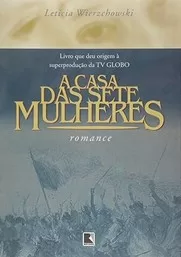
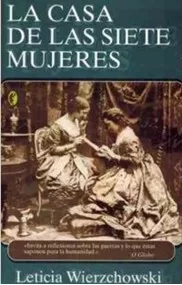
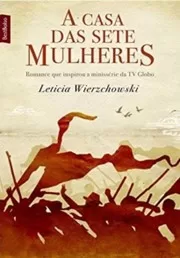
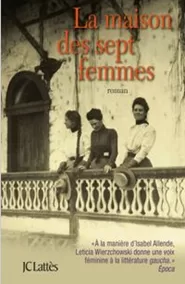
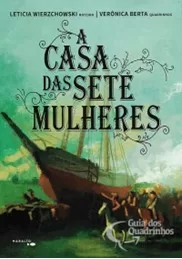
WIERZCHOWSKI, Leticia. A casa das sete mulheres. Rio de Janeiro: Record, 2003.
Sheila Jacob
Illustrated by Dona Dora
Translated by Shaina Thelen
A casa das sete mulheres (The House of the Seven Women) is a historical novel set in the South Region of Brazil during the Guerra dos Farrapos (Ragamuffin War), which took place between 1835 and 1845. Written by Rio Grande do Sul native Leticia Wierzchowski (Porto Alegre, RS, 1972), and published in 2002, the story was adapted into a miniseries by Rede Globo one year after its release. The series was broadcast in more than forty countries, making the book a major publishing success. The novel is part of a trilogy, which also includes Um farol no pampa (A Lighthouse in the Pampas), from 2004, and Travessia (Crossing), from 2017. In addition to these three titles, Wierzchowski has more than thirty published works, including children’s and young adult books. In 2023, Maralto published a comic book version of the novel, adapted by the author and Verônica Berta.
According to the author, the idea for the book came after reading the 1985 novel Os varões assinalados (The Distinguished Men) by Tabajara Ruas, which portrays the Farroupilha uprising through an epic approach—as announced by the title—focusing on the battles and featuring the men and generals of that period, such as Bento Gonçalves da Silva and Antônio de Souza Netto. At one point in the work, the “house of the seven women” is mentioned, a reference to the Estância da Barra, on the banks of the Camaquã River, where Bento Gonçalves’s sisters, wife, daughters, and nieces took shelter for a decade. It was from this mention that the author chose to narrate the war not from the traditional male point of view, but from a marginal, historically silenced perspective, and through a romanticized lens: that of the women confined, doomed to wait for news and pray for the return of their relatives. This perspective echoes the figure of Penelope awaiting the return of Ulysses, an analogy explicitly referenced in the novel: “Yes, men always leave, to their wars, to their labors, to conquer new lands, to open the tombs and bury the dead. It is the women who stay behind, the women who wait.”
After a sort of prologue, which contextualizes the plot and presents the main justifications for the outbreak of the so-called “Farroupilha Revolution in the Continent of São Pedro do Rio Grande,” the first voice that emerges is that of Manuela, a niece of Bento Gonçalves, whose first-person entries in her notebooks alternate with the voice of an omniscient narrator. In her diaries she presents her particular perspective on that collective experience, recounting her premonitions, narrating historical events, and evaluating the happenings that she witnesses, from a distance, thanks to the visits and letters that arrive at the place where she was secluded with her family. “I remained, like a ghost, to tell a story of heroes, of death and of love, in a land that had always lived on heroes, death, and love. In a land of silences, where the glint of daggers shimmered on firelit nights. Where the women wove their cloths as if weaving their own lives,” as recorded in “Manuela’s Notebooks”, Pelotas, June 4, 1900.
Manuela begins her accounts with the arrival of the year 1835, quickly introducing the family members who will be followed throughout the upcoming pages: her mother, Maria Manuela; her aunts, Antônia, Ana Joaquina, and Caetana, the latter being Bento Gonçalves’s Uruguayan wife; her sisters, Rosário and Mariana, the two fictional characters in the story who, along with Manuela, complete the group of “seven women.” There is also her brother Antônio; her cousins Pedro, José, Joaquim, Bento Filho, and Caetano; as well as younger cousins, household employees, and enslaved Black people who serve the family, though these are not very prominent in the plot. According to the narrator, there was at that moment a tense atmosphere of dissatisfaction with the Empire, mainly due to the high taxes imposed by the government on domestic cured beef, which reduced the profits of the landowners in the country’s South. The narrative begins, then, with an omen of blood and death, in contrast to the festive night on which the New Year was welcomed. “How can they not see it?,” the young woman asks, foreseeing the season of suffering and losses in that dawning year.
In the opening scene, the family’s arrival at Estância da Barra portrays a slaveholding, patriarchal, and profoundly unequal Brazil by mentioning the family’s opulence and their relationship with the Black people they exploited. It shows how the first men who mobilized against the central government belonged to the wealthy classes and initially had an interest in protecting their own privileges. “That same afternoon (September 19, 1835), the seven women of the family arrived for a long stay, laden with their extensive baggage, along with their trusted Black maids and wet nurses, for coming along with them, in happy confusion, were the four small children of Bento Gonçalves and Caetana, with Ana Joaquina, the youngest of them all, about to turn one year old around that time, and still nursing at the breast of the Black woman Xica.” Later, over time, other demands were added to the cause, such as republican and abolitionist aspirations.
Throughout the text, there is a certain naturalization of the relationship between the masters and the enslaved characters, especially when it comes to the sexual violence and machismo historially present in the relationship with younger girls, blurring the idealized image of the Farroupilha hero that many narratives seek to uphold. In the opening pages, for example, one reads: “He found Bento Gonçalves sitting on the veranda, drinking mate. […] He had just seen a cabocla (person of mixed indigenous Brazilian and European ancestry) who worked in the house walk by, a girl no more than fifteen or sixteen years old, and he was thinking how appetizing that kind of young flesh was, of a virgin girl, smelling of something new.” Further on, the observation: “Bento Gonçalves da Silva was not eternal, was not a god, nor did he possess any semblance of divinity—he was, like us, mortal, suffering, deluded by life.”
The work is structured around extensive documentary research, full of references to historical events that temporarily suspend the focus on what was happening in that “collective and feminine life,” typical of elite members of the time, within the “house of the seven women.” The many battles that historically make up the Guerra dos Farrapos are narrated, such as the siege of Porto Alegre; the proclamation of the Rio Grande Republic in 1836, also known as the Republic of Piratini; the imprisonment and escape of Bento Gonçalves; the capture of Laguna (SC) and the establishment of the Juliana Republic; the final battle of Porongos, “the last great tragedy of that war;” and the death of the Lanceiros Negros (Black Spearmen), a group of enslaved Black soldiers who joined the rebels thanks to a promise of freedom that was never fulfilled.
The arrival of Giuseppe Garibaldi is also narrated in the book, with a focus on Manuela’s passion for him, a feeling always referenced in her intimate accounts and one that would accompany her until the end of her life. According to crônicas of the time and historical records, she became known in Pelotas as the “bride of Garibaldi,” even after the Italian had married Anita, the Brazilian woman who actively took part in the battles alongside the rebels and about whom, in a letter from José to his mother Dona Ana, it is said that “she fought greatly, as bravely as a man. Her exceptional courage is already spoken of in the streets.”
The victories and small gains of the republicans were followed by significant defeats and losses—both of fighters and of the support of the populations inhabiting the places taken by the rebels—as observed by Dona Ana: “Sometimes, however, it seemed to her that they were building castles on sand. With a breath of breeze, everything would fall apart beyond repair.” Manuela goes so far as to ask: “Why did they fight and why did they die? I will never know. And no regime under the sky will ever justify this war to me.” Six years after the revolt began, the young woman again questions: “What had all those years been worth? The Continent was impoverished, so many of its people had died, others perished in destitution, and the war remained like a storm cloud over everyone’s heads.”
Beyond the battlefields, small events interrupt the monotony of the women’s waiting: the arrival of messengers and the surprise visit of family members; music played on the piano and parties that temporarily suspend the atmosphere of war; the birth of Perpétua’s daughters; and various romantic relationships that begin and others that come to fruition, such as the relationship between Mariana and one of the farmhands, named João Gutierrez, by whom she becomes pregnant, earning her mother’s contempt as a consequence. One of the most interesting subplots, which lends a tone of magical realism to the story, is the recurring spectral visits paid to Rosário by a young Uruguayan named Steban, in the farm’s library. He is a kind of ghost, or hallucination, with whom the young woman falls in love. Wounded on the forehead, the figure always appears terrified and disappears whenever the name of Bento Gonçalves is mentioned, suggesting that he was one of Gonçalves’s victims from years ago, during the Cisplatine War. These recurring apparitions, like the novel as a whole, blur the lines between reality and imagination.
A casa das sete mulheres, like its sequels, allows readers—especially those who are not from the South Region of Brazil—to learn about important chapters in the country’s history through a fictional narrative that fills in the gaps left by documentary sources with aesthetic creation and literary language.
Further Reading
LACERDA, Denise Pérez (2006). Do imaginário o real: a história (re) contada em A casa das sete mulheres. Dissertação (Mestrado em História da Literatura) – Fundação Universidade do Rio Grande do Sul (FURG), Porto Alegre.
MAESTRI, Mário (2004). As Sete Mulheres e as Negras sem Rosto: Ficção, História e Trivialidade. Cadernos IHU Ideias, São Leopoldo, ano 2, n. 17, p. 1-24. Disponível em: https://www.ihu.unisinos.br/images/stories/cadernos/ideias/017cadernosihuideias.pdf. Acesso em: 24 out. 2024.
RUAS, Tabajara (1985). Os varões assinalados. Porto Alegre: L&PM.
WIERZCHOWSKI, Leticia; BERTA, Verônica (2023). A casa das sete mulheres. São Paulo: Maralto.
ZATI, Jhonatan (2021). Literatura e história em A casa das sete mulheres, de Leticia Wierzchowski. Revista Fórum Identidades, Itabaiana, v. 33, n. 1, p. 101-112. Disponível em: https://periodicos.ufs.br/forumidentidades/article/view/15498. Acesso em: 24 out. 2024.
Iconography