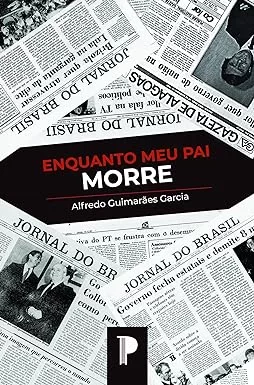
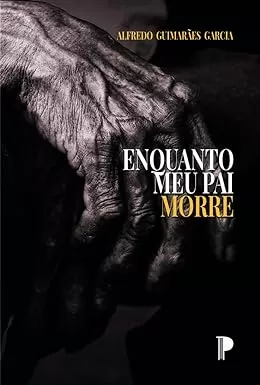
GARCIA, Alfredo Guimarães. Enquanto meu pai morre. Bragança: Pará.grafo, 2019.
Angela Rodriguez Mooney
Illustrated by Espírito Objeto
Translated by Kennedy Moen
The 2019 novel Enquanto meu pai morre (While My Father Dies) is the first from the Pará writer Alfredo Guimarães Garcia (Bragança, PA, 1961). It narrates the story of Joaquim, a middle-aged man who returns to Benquerença, in the state of Pará, after more than a decade in exile overseas. It was the 1964 military coup that led him to abandon his birthplace and venture to Cuba, Buenos Aires, Paris, Barcelona, Santiago de Chile, and Zaragoza, among other cities. Despite the political amnesty in Brazil permitting the return of many political exiles in 1979, Joaquim would only return in 1989 to be with his father, who was near death. This reunion is shot through with anxieties and feelings of estrangement regarding a country marked by consumer modernities and jingles from Luiz Inácio Lula da Silva and Fernando Collor de Mello’s political campaigns in the first democratic presidential election after the dictatorship.
Enquanto meu pai morre is organized into 13 chapters, in which the narrator revisits memories related to events and people with whom he reconnects during his return who were important in his past (“Return,” “Joaquim,” “Joshua,” “Nágila,” etc.). Three of these chapters—“First Dream,” “Second Dream,” and “Third Dream”—present a narrative different from the others, lending a lyrical cohesion to the work and defining a path of birth, infancy, and death.
From “Return,” the first chapter, we witness Joaquim attempting to articulate personal and collective stories based on remnants and reminiscences of the past. This work of remembrance is developed in the text in a fragmented manner; memories from childhood and youth are interspersed with poems, songs, and candidates’ jingles. Intertextuality, which manifests explicitly in the narrative, is the most memorable formal element of the text. The entire narrative is constructed around texts that seek to illustrate past events. Thus, verses from Fernando Pessoa, Carlos Drummond de Andrade, Walt Whitman, Manuel Bandeira, and songs from Caetano Veloso and Orlando Silva, among others, appear as devices to explain the protagonist’s sensations and values in the face of the challenges he, and his society, experienced during the 1960s and 1970s. For example, when describing the motives that led him to exile himself during the dictatorship, Joaquim mentions the impossibility of coexistence in the hypocritical society of the era, the “absurdity of the matters of state, the bankruptcy of our elites, the creation of a stupid, illiterate, anodyne, and ass-kissing bourgeois class.” Shortly after, he cites the verses “Only nature is Divine, and She is not Divine,” by Fernando Pessoa’s heteronym, Alberto Caeiro. The Portuguese poet’s verses appear in other passages, like when the protagonist describes the arrest of his father, a sympathizer of the Communist Party, who was imprisoned for two days, but remained silent during the entirety of the interrogation. In this passage, the narrator Joaquim finishes the account with stanzas from Pessoa’s poem “Absurd Hour.”
The abundance of citations in the text, often following the introduction of critical events in the reconstruction of personal and collective memory, seems to compete with, and at times even distract or blur, the particularities of a past that, through these devices, prove themselves to be trivial. In Aesthetic Theory, Theodor W. Adorno explains that in the face of dehumanization—of an experience that, by definition, is unrepresentable—the relationship and trivial conventions surrounding language are necessarily revisited. A rupture that enables a distinct path for knowledge and the formulation of ideas would, therefore, become necessary. Without this distinction, the language is incapable of encompassing the new reality and provoking in the reader a sense of strangeness, terrible and singular, of the represented experience. Because of this, for Adorno, literature would be one of the few places in which suffering could still find its own voice and consolation, without immediately feeling betrayed. Despite its potentiality, Adorno also reminds us of the ever present possibility of the sublimation of horror through aesthetic stylization. Instead of provoking the estrangement necessary to approach Joaquim’s experiences, the aestheticization of the narrative, through the excessive intertextuality of literary content in the work, provokes a desensitization and detachment from what one wishes to represent.
In Enquanto meu pai morre, an urgency is also noted in narrating events that marked the formation of the protagonist and the country, such as the construction of the Trans-Amazonian Highway, President Jânio Quadros’s resignation, the exile of Caetano Veloso and Gilberto Gil, John Lennon’s assassination, the dictatorial coup in Chile, and Salvador Allende’s suicide. With this, the work takes on a diary-like configuration, but falters before Walter Benjamin’s imperative to “brush history against the grain.” If it is true that the narrator narrates historical events from the perspective of the defeated, articulating his discourse from the remnants and reminiscences of the past, the absence of a critique regarding the class of which he belongs reveals the inconsistency of a left-wing politician complacent in the country’s injustices and inequalities.
For instance, upon returning to Benquerença and taking over the care of his sick father, Joaquim looks for caretakers who can divvy up the responsibilities during the day and night. In this search, he is advised by Nágila—a former love interest, who he begins a relationship with after his return from exile—to hire a nurse named Benedito. The lover reveals that the man is Joaquim’s half-brother, the son from the relationship that his father had with the maid Mundica, and who was sent after birth to live an “impoverished childhood” with an aunt in the outskirts of the city. During the brothers’ meeting, Joaquim would recall that Benedito was in his house a couple times over the course of his childhood, on occasions when he was brought in to look after Joaquim during the wealthy family’s lavish parties: “When he came to the mansion (…) Benedito would earn generous tips for playing with some of the boys and girls in the extended family, while aunts and uncles, adults and teenagers, were either stuffing themselves with maniçoba [a typical Pará dish made with manioc leaves] (…).”
The misery in which the maid’s son grows up is a naturalized detail that seems not to affect the adoration that Joaquim and all his peers who opposed the dictatorship have for the “respectable professor and lawyer,” the protagonist’s father. It is noteworthy that Benedito, now an adult, returns to his paternal home once again as a servant, repeating his mother’s destiny, now in the position of his father’s caretaker. Thus, an order and class system are maintained in which the elite, be it right-wing or left-wing, is favored. Denounced in Conceição Evaristo’s literature—“Our survival-writing (escrevivência) cannot be read as stories to ‘lull those of mansions,’ but to disturb them in their unjust dreams,”— the myth of racial democracy—the friendly coexistence of people of different races and socioeconomic classes in Brazil—is articulated in Enquanto meu pai morre, living up to its referentiality regarding the empirical world common in contemporary Brazilian literature. In this manner, the work presents itself as an important contribution in describing the leftist elite’s difficulty in breaking, or even recognizing, historical privileges and injustices brought to the present in such close proximity.
Even in the last chapter, titled “Farewell,” where Joaquim and Benedito are present for their father’s last breaths, the narrator’s reflection about the misfortune of his brother—who cries copiously at the death of a father he never knew—naturalizes and absolves his family and his class of any responsibility: “How did he endure the mockery of the other boys—and yes, I tell you, children are really cruel in this regard—at school, in the street? Son of a bitch. Son of the street (Filho do vento). Son of a mistress (Filho do boto). Son… Without a father. Without a story… A dagger that life plunged into him right at birth.”
It was life—and not Joaquim’s father—that, benefiting from a power dynamic, sexually abused a maid. It was life—and not the father—that failed to recognize the son, yet oversaw his upbringing. It was life—and not Joaquim’s mother or father—that ridded themselves of the child, sending him to live with a distant aunt.
In the chapter “Benedito,” dedicated to the brother’s life, the story of the latter’s formative years is interspersed with Joaquim’s story, during the period in which both studied in Belém. In this chapter, Benedito’s disinterest toward politics and the repression imposed by the government becomes obvious, while Joaquim engaged with the Movimento Secundarista de Resistência ao Golpe Militar (MSRG) (High School Student Movement of Resistance to the Military Coup), supported by Brazil’s Community Party. Upon being denounced to the military, Joaquim fled the country toward Chile. Benedito, on the other hand, “passed through all of this unscathed,” attempting to finish his nursing degree with immense sacrifice.
Such parallelism provokes questioning about how the socioeconomic conditions influenced the political engagement of the era, illustrating a dynamic noted in Marcelo Ridenti’s research, which reveals that the majority of youth in support of the armed struggle belonged to the intellectualized middle and upper classes. Even though they had not participated in the armed struggle, Joaquim and the other characters in the novel—with the exception of Benedito and the two female characters, Nágila and her sister, Jahara—flaunt their erudition in dialogues permeated once again by citations and rebellious uproar against the bourgeois class. Hatred toward the military and decadent elite is declared, while their coffees continue being served by servant hands.
Further Reading
ADORNO, Theodor W. (2015). Teoría estética: obra completa 7. Madrid: Ediciones Akal.
BENJAMIN, Walter (1994). Sobre o conceito de história. In: BENJAMIN, Walter. Magia e técnica, arte e política. v. 7. Trad. de Sergio Paulo Rouanet. São Paulo: Brasiliense. p. 222-232.
EVARISTO, Conceição (2007). Da grafia-desenho de minha mãe, um dos lugares de nascimento de minha escrita. In: ALEXANDRE, Marcos Antônio (Org.). Representações performáticas brasileiras: teorias, práticas e suas interfaces. Belo Horizonte: Mazza Edições. p. 16-21.
NUNES, Joaquim Gonzaga; SILVA, Milva Valéria Garbellini e (2021). A tríade autor, texto e leitor no romance Enquanto meu pai morre, de Alfredo Guimarães Garcia: perspectivas de leitura. In: ORTIZ, Iza Reis Gomes; PEREIRA Eliane Auxiliadora; MOLINA, Maria de Fátima Castro de Oliveira (Orgs.). Literatura, cultura e sociedade. Porto Velho: Coleção Pós-Graduação da UNIR – EDUFRO. p. 112-124.
RIDENTI, Marcelo (2010). O fantasma da revolução brasileira. São Paulo: Editora Unesp.
Iconography