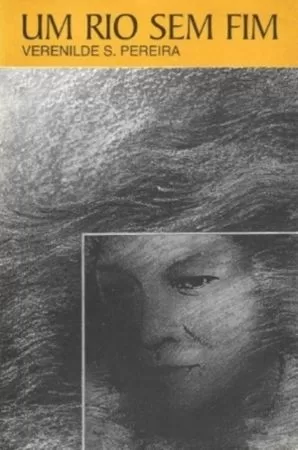
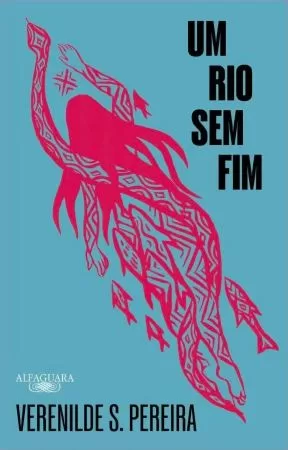
PEREIRA, Verenilde. Um rio sem fim. Brasília: Thesaurus, 1998.
Leda Cláudia da Silva
Illustrated by Dona Dora
Translated by Kennedy Moen
Despite being little known by literary critics until recently, the writer Verenilde Pereira (Manaus, AM, 1956) plays an important role in the Afro-Indigenous literary movement, even being considered its pioneer. As the daughter of a Black woman and an Indigenous man of the Sateré Mawé people, an indigenist, and a holder of a Master’s degree and PhD in journalism from the University of Brasília (UnB), Pereira recognizes writing as a political act and literature as an instrument for the preservation of memories. The writer, who has lived in the federal capital since 1986, previously worked as a reporter for numerous Northern Brazilian newspapers and as a teacher both on a rubber plantation in the state of Amazonas and at journalism schools. She is the author of essays, academic articles, and reviews, in addition to having published the book Não da maneira como aconteceu (Not the Way It Happened, Thesaurus, 2002). As a storyteller, the author’s greatest references span between oral and written tradition, ranging from the ancestral voices of her mother and grandmothers to the legacy of Latin American writers, such as Jorge Luis Borges.
In Um rio sem fim (An Endless River), a product of the author’s Master’s thesis from the College of Communication at UnB, Pereira presents a labyrinthine and multifaceted narrative that combines elements of the novel, reporting, and anthropological study. The story takes place in the mid-1980s at a Salesian mission in northern Amazonas, where an Italian bishop, Dom Matias Lana, imposes the colonizer’s worldview upon the Indigenous community by introducing civilization and modernity through Catholicism: “Sacraments, that was his greatest fetish.” The storyline concentrates on the lives of the Indigenous girls boarding at the mission, who are subjected to a rigorous and authoritarian education that seeks to impose concepts such as modesty, fidelity, and matrimony. The novel demonstrates that the religious people felt they were being generous by executing the civilizing mission, imposing language, religion, customs, clothes, and rigid daily schedules—for waking up, eating, and sleeping—dictated by the church bell.
The narrative is disruptive and polyphonic, interlacing diverse voices and perspectives, which provides a multifaceted view of the characters’ conflicts and lived experiences, enriching one’s understanding of the plot. Nonetheless, there is a character portrayed as a journalist or researcher who, years after the start of the Salesian mission, investigates how the process came to be, interviews people, and collects information. This character, who bears resemblance to the author of the novel, drives part of the story by narrating segments in the first person. In other sections, the narration is in the third person from an omniscient perspective, detailing the other characters’ thoughts and feelings. Furthermore, there are moments in which “this story’s fatal Narrator” (journalist, researcher) shares space with other characters, such as Maria Assunção, who also narrates the story in the first person in the passage where she recounts the story of the cat she named after herself.
Structurally, the work comprises a little over one hundred pages, divided into parts that introduce or revisit distinct events at every turn. The author’s handling of language stands out through passages replete with visual plasticity and others with repetition of words and expressions that create a poetic effect and a sense of proximity to spoken language.
The events are told in a spiralling manner, rather than linear, with flashbacks and time jumps that reflect the characters’ memories and experiences. The women are the novel’s protagonists, and their voices and perspectives are central to the narrative. The author presents a group of female characters baptized with the Christian name Maria, four of whom are central to the story—Maria Assunção, Rosa Maria, Maria Rita, and Maria Índia—“three Indigenous women and one of mixed Indigenous and White parentage (cabocla).” Of the four, the first two stand out in the work. In this process of colonization, Christian baptism devalues the names of the Indigenous peoples and contributes to these individuals’ subjugation.
Regarding the various Marias that emerge, the author points to the attempt to depersonalize these female figures: “in 1985, 760 Indigenous children between the ages of one and six were baptized, and 372 were baptized after that age. […] Of the baptized children, 308 received the name Maria. Observe: Maria Etelvina, Maria Eugênia, Maria Bernadete, Maria da Esperança, Maria…” Thus, Um rio sem fim follows, particularly, Maria Assunção (cabocla) and Rosa Maria (Indigenous) from childhood into adult life, tracing their journey through a village on the Negro River (crossing the Equator’s imaginary line) and through Manaus, where children were sent to work in the houses of families who supported the religious missions.
Through these characters, the author also explores the education and socialization of the Indigenous children of Brazil, revealing a picture of oppression and violence. Pereira describes how the children were punished and humiliated by the missionaries for not being able to adapt to the norms they imposed on them. This included the prohibition of speaking in their native language and wearing inadequate clothing and shoes. The story is a testament to the way Indigenous children were dehumanized and stripped of their cultural identity, in addition to how they fought to survive in a hostile and oppressive environment.
The character Maria Assunção Augusta had neither father nor mother, but survived through the kindness and “generosity” of the nuns. She was wild; she did not fear the wind. She represents cultural resistance in the face of the process of catechesis imposed by the missionaries commanded by bishop Dom Matias. This process is characterized by physical and symbolic violence, involving the imposition of the Christian faith on the Indigenous and cabocla traditions and beliefs of the Amazonian region. Marked by her hybrid cabocla identity, Maria Assunção is a complex character who revolts against this oppression, refusing to passively accept the destruction of her culture and identity. Through this character, the novel critically exhibits the process of catechesis as a mechanism for domination, and at the same time bestows the role of protagonist upon a female figure who resists external imposition and seeks to affirm her autonomy. It was by telling stories since childhood that Maria Assunção was able to preserve herself and continue her fight, a biographical trait of the writer that can be associated with her female characters.
Rosa Maria, a strange, “bed-wetting (mijona) Indigenous woman,” was Laura Dimas’s granddaughter. In Manaus, while still a child in the house of Judite—a white girl whom Rosa Maria helped take care of—, Rosa Maria was beaten by the fat, Black woman: “Defend yourself from me, Rosa Maria, you sluggish Indian, you Indian with the muddled speech. But who, even so—look at that… had the good fortune to be born with skin whiter than mine. Maria Rosa, you wretched white Indian!” Now an adult, Maria Rosa marries Ismael and transforms into a person who the bishop would condemn—according to Sister Isabel, Dom Matias’s loyal assistant—for she fell into a state of decline, and was seen begging tourists for money and cigarettes at the museum’s entrance. She had a mental breakdown and ended up living on the streets. In one of her deliriums, she imagined she was an eel.
While Maria Assunção is a character who challenges the customs imposed by the missionaries and represents a form of Indigenous, even cabocla, resistance and affirmation, Rosa Maria is a representation of an annihilated and humiliated nation, symbolizing the way in which women and Indigenous peoples were treated as objects and exploited by colonial society.
Among the characters, there is another that stands out as well: the elderly Indigenous woman Laura Dimas, Rosa Maria’s grandmother, who represents an intense identity conflict resulting from the clash between Indigenous culture and non-Indigenous society. She is described as a “simulacrum of a civilized and sinful Indian” because, throughout the narrative, her trajectory reveals the contradictions between tradition and modernity, between her people’s values and western society’s impositions: “The young man went against those who turned Laura Dimas into an obstacle—despite being anonymous and dispersed—for the Brazilian nation.” She embodies the complexities of Indigenous identities in colonized contexts, exposing the oppression suffered by her people.
Still regarding the complexity with which the characters are constructed, there is the couple Antônio Sávio and Mariana Aparecida (he being Indigenous, and she being multiracial) who, despite not ranking among the principal characters of the plot, are featured in varied scenes that range from direct critiques of colonial subalternity (“I only hate your humiliation,” the wife would say to her husband), to resistance through eroticism and comedy. Even the bishop Dom Matias Lana is described in childhood as a kind and dreamy young man who wanted to be a poet, but was steered toward priesthood. And then there is the shaman (pajé) Lauriano Navarro, who stages, right at the beginning of the storyline, an impactful episode in which books written by the missionaries are burned in a bonfire because they brought nothing but lies about him and his people, according to the Indigenous leader.
Although what transpired between Maria Assunção and the bishop is known almost at the beginning of the work, when she returns from Manaus to the village some time later to tell the religious man what happened to Maria Rosa, the final pages of the book culminate in an open ending. There is not a defined conclusion accounting for the paths that each character’s life may have followed. The author invites the reader to create various routes so the “endless river” can continue to flow, escaping the violence and strengthening forms of resistance.
Given the novel’s many strengths, it is inevitable that one would question the 25-year delay in the author’s and the work’s recognition. A possible explanation could be the fact that only more recently has the interest in and appreciation of Indigenous, Black, and Afro-Indigenous literature from a decolonial perspective risen, culminating in the long overdue recognition of these genres’ authors, such as the writer Verenilde Pereira, an Afro-Indigenous woman.
Further Reading
MEDEIROS, Jotabê (2023). As curvas de um rio sem fim. Amazônia latitude: ciência e jornalismo pela floresta, 10 ago. Disponível em: https://www.amazonialatitude.com/2023/08/10/as-curvas-de-um-rio-sem-fim/. Acesso em: 28 fev. 2025.
OLIVEIRA, Priscila Lira de (2025). Fios verdes-sangue: o pensamento da floresta na literatura amazonense. Tese (Doutorado em Estudos Literários) – Universidade Federal do Paraná, Curitiba. Disponível em: https://acervodigital.ufpr.br/handle/1884/94523. Acesso em: 28 fev. 2025.
SIMON, Rodrigo (2022). Quem é Verenilde Pereira, pioneira da literatura afroindígena no Brasil. Folha de S. Paulo, 20 maio 2022. Disponível em: https://www1.folha.uol.com.br/amp/ilustrissima/2022/05/quem-e-verenilde-pereira-pioneira-da-literatura-afroindigena-no-brasil.shtml. Acesso em: 28 fev. 2025.
Iconography