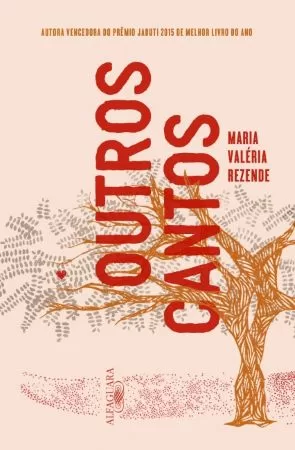
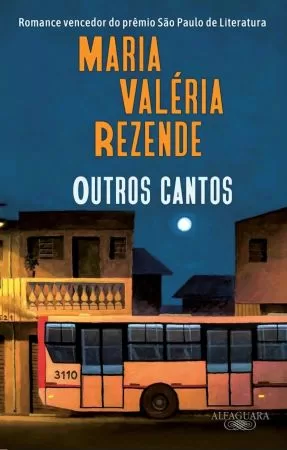
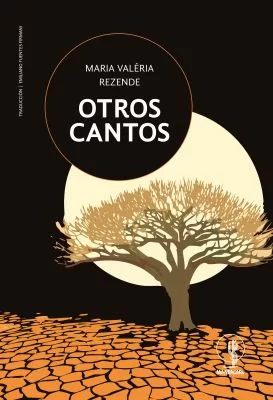
REZENDE, Maria Valéria. Outros cantos. Rio de Janeiro: Alfaguara, 2016.
Carlos Wender Sousa Silva
Translated by Harriet Wilson
Illustrated by Pamela Araújo
The novel Outros cantos (Other Songs), by paulista writer Maria Valéria Rezende (Santos, SP, 1942), was published in 2016. The book earned the author ‘Book of the Year’ category in the São Paulo Prize for Literature 2016 and a win in the Brazilian Literature category in the Casa de Las Américas Prize 2017, as well as third place in the 2017 Jabuti Prize. The author also won the Jabuti Prize in 2015 with her novel Quarenta dias (Forty Days, 2014). These two texts aside, Rezende made her debut with the novel Vasto mundo (Vast World, 2001), came in second place within the Children’s Literature category in the Jabuti Prize 2009 for her book No risco do caracol (On the Snail’s Trail, 2008), and third place in the Teen Fiction category with Ouro dentro da cabeça (The Gold Inside Your Head, 2012). The author has even more publications including the novels O voo da guará vermelha (The Flight of the Scarlet Ibis, 2005) and Carta à rainha louca (Letter to the Mad Queen, 2019). Passages from Outros Cantos have been published in English translation by Cristina Ferreira Pinto-Bailey in literary journals.
Maria Valéria Rezende began her career as a teacher at the start of the 1960s, initially on the outskirts of São Paulo and, later, in the Northeast Region. In the decades of the 1970s and 1980s, she lived in Pernambuco and in Paraíba—in both the countryside and the capital, João Pessoa. One of contemporary Brazilian literature’s finest authors, Rezende is a missionary sister (a kind of nun). Her writing is marked by creativity and depth, yet also characterised by lightness and fluidity. She has a perception of literature and culture that goes beyond that which is usually represented in Brazil’s hegemonic cultural foundation, mostly as a result of what she experienced during her time working with communities in many different places.
In Outros cantos, we follow the story of Maria, who, in the 1970s, travels to Brazil’s sertão (backlands), inspired by the teaching methods of Paulo Freire. The novel’s setting in time and space corresponds to Rezende’s own lived experience, but one must not conflate the protagonist’s story with that of the author. The protagonist operates within the dynamic of the narrative; she has her own personality, her own quirks, and a viewpoint that is her own, something made possible through the author’s creative process. At the beginning of the text, the protagonist-narrator Maria, a literacy teacher, is on a long bus journey. She describes the boarding and disembarking of various passengers who bring with them their stories, dreams, fears and, certainly, a good deal of hope and courage when facing the reality that confronts them. During this journey to the sertão, she witnesses the return of some travellers who went to try their luck somewhere else, and watches the traces of the passage of time in the tarmac, on the road, and in the vast landscapes through which the bus travels. The protagonist observes people and families who stop off at various points along the way, leaving behind them as many stories as can be told.
Maria retakes this journey forty years after first visiting the region in the 1970s. She returns to a place that is no longer what it was: “Yes, times have changed, that’s for sure, and it’s full of new dangers, but perhaps much more conducive to life.” Weariness and disappointment accumulated over the course of a harsh, brutal and austere life have left their mark on both the protagonist-narrator and the people she has met on the road, on this journey and others that she recalls. She notices a certain kind of hope that pervades the entire region: hope that revives itself, that insists on persevering, as something intrinsic to the individual survival of so many people there, both in the moment and in the past. Their work, shared community life, and smiles, between one celebration and another, all bring hope to a forgotten group of people. As Maria thinks back to her first time in the Northeast, in the 1970s, bit by bit a world is revealed, one of invisible and unspoken secrets, many of which are buried deep and need to be exposed by removing the rubble—the scraps of stories and passing of time—that covers them. Beneath the ruins are many secrets with the potential to be recovered and restored. This is work that requires the weaving together of fragments that she is piecing together on the road, and it is precisely this task of reconciling history and community that Outros cantos does so well.
Many themes are present within the narrative, including the exploitation of workers (people having to spend the little money they have on substandard drinking water). On the TV screen at a bus station, the protagonist-narrator watches “the silhouettes of armed men, all sparks and flares”, in a sociopolitical and dictatorial context of oppression and violence. She leaves fear and the bursts of gunfire and terror behind her, and instead enters the backlands of the Northeast, attending the novena prayer services the village community holds to honour Catholic symbols, as well as joining in with the procession to celebrate the patron saint, and Christmas celebrations. These are all events that bring the community together in their best clothes, with their beliefs and worship, their hymns and songs, and their stories. This is when they celebrated holy days: religious festivals like the novena, the pastoril, the lapinha, the reisado. These festivities are the complete opposite to the hostile environment of the sertão that surrounds them and the violence of the military dictatorship which had instilled horror and brutality as a political practice across the country. In that small village community, festivals are also an opportunity for relief from the day-to-day grind of work. Stories, musings from the past, expectations, journeys (both the successful ones and the unsuccessful) made across the length and breadth of the country, in search of money, and fantastical tales are all also shared during the festivities; “[…] retelling age-old stories, those passed down, all mixed up with the new, recently-arrived stories, songs, verses and jokes”. The people living there cling to their hopes that the forgotten backlands might one day become a better place for everyone.
Alongside these encounters, other stories are shared between members of the community: the midwives who come to the aid of pregnant women; the mother who goes to Rio de Janeiro to try her luck working as a maid and needs to deal with an unexpected problem (her son, who suffers from seizures, cannot adapt to the school environment in the capital, where he is treated as stupid and slow by the other children); another mother who must choose which one of her children can remain in school, whilst the other works as a market porter. The extra work people have to do in December in order to afford clothes and presents for Christmas. The hopes of rain in the transition from February to March and the prayers to Saint Joseph asking that the entire region be showered in heavy rainfall. And that rain brings life to a land near death; be it through the blossoming of the mandacaru cactus; the rivers that swell; barely living branches that turn green once more; or the flowers that bloom on cacti. And everything becomes more joyful in the community, with the promise of abundance.
Forty years later, on her bus journey northwards, Maria reflects on everything she was once witness to there: “I let my mind wander through memories whilst everything else—the cowboy, the bus, the caatinga scrubland, the road—plunge into oblivion.” People’s relationship with time has changed since then. She no longer carries the same hopes felt on that first journey, hopes which “were greater and more futile than they are now.” Now, Maria has more modest and patient expectations. The protagonist-narrator also speaks of her travels through Algeria, Paris and Mexico, all experiences that allowed her to create new narratives. Maria is a public educator, who teaches children and adults to read and write. And it is in this context that she learns stories and goes on to tell her own, new configurations of the world coming together amongst real-life and fantastical tales.
The protagonist-narrator experiences a lot during the time she spends in the sertão. Certain elements of the narrative expose the social, historical and political context of the period, such as the switched-on portable radio, the chatting of soldiers in the bar, and the announcement of jobs for civil servants and engineers for the new highway and dam, and the cowboys’ tales. There are also stories of domestic workers recently arrived in São Paulo, hired to work without fixed contracts, or the man who, wrongly imprisoned, dies in a flood on the dirty and polluted streets of São Paulo after getting put on parole; all these stories intersect with the experiences of the protagonist-narrator, bringing her ever closer to this community, as well as making her forget the box of trinkets that she carries with her, full of ghosts, memories and worries.
Maria sees children and adults alike first attempting and then enjoying mastering the alphabet and words. However, combatting the way these people put up with exploitation and injustice is not an easy job. One of the strongest arguments they use is that the suffering they undergo is the will of God. But Maria does not give up and manages to foster a political and social conscience in them. Delivering this liberating project of education is even more challenging during the dictatorship, a time of oppression, persecution and systemic violence, when expressing values like those held by our protagonist may put one’s life at risk, as it did for all those who sought to establish a more inclusive society.
The protagonist-narrator initially travelled to this forgotten region with the aim of “raising awareness”, “the organisation, the long struggle, truly of the people and all-reaching, gradually pervading the entire country and continent, against all forms of oppression.” Maria’s project, through education, had been to light the spark of a democratic spirit amongst this small community, and, even though Brazil was living under a dictatorship, to foster the development of social, political and cultural awareness. Where in the story are the countless other characters who dedicated themselves to pursuing this path of building a democratic country, with access to education, food, healthcare and culture? Outros cantos centres around these open-ended and as yet unsolved questions. It is about what has been forgotten, about what people pretend has been forgotten, about what has been silenced; about who silenced and who was silenced.
Outros cantos brings us the important reminder of the implications of the past on the present and of the importance of engaging with these spaces of conflict today. There are two distinct projects of human experience in the novel, jostling for power: one concerned with humanity and solidarity, the other with violence and brutality. One is about recovering our sense of the collective and the other creates a pecking order of the stronger over the weaker. The protagonist-narrator fought for and dreamed of achieving the first project, guided by principles like social justice and solidarity.
Further Reading
DALCASTAGNÈ, Regina; OLIVEIRA, Rejane Pivetta de; THOMAZ, Paulo C. (Orgs.) (2020). Literatura e ditadura. Porto Alegre: Zouk.
FIGUEIREDO, Eurídice (2017). A literatura como arquivo da ditadura brasileira. Rio de Janeiro: 7 Letras.
REZENDE, Maria Valéria (s.d.). Não nos lembramos dos rostos invisíveis. Suplemento Pernambuco.
REZENDE, Maria Valéria (2022). From Other Songs. Translated by Cristina Ferreira Pinto-Bailey. Latin American Literature Today, n. 23, September 2022. Available at: https://latinamericanliteraturetoday.org/2022/09/from-other-songs-by-maria-valeria-rezende/. Accessed: 19 May 2026.
REZENDE, Maria Valéria (2024). ‘Fátima’, from Outros cantos. Translated and introduced by Cristina Ferreira Pinto-Bailey. Absinthe: World Literature in Translation, n. 30. Available at: https://journals.publishing.umich.edu/absinthe/article/id/6851/. Accessed: 19 May 2026.
SANTINI, Juliana (2018). “Um lugar fora de lugar”: a mulher e o sertão em Maria Valéria Rezende. Estudos de Literatura Brasileira Contemporânea, Brasília, n. 55, p. 267-284.
Iconography