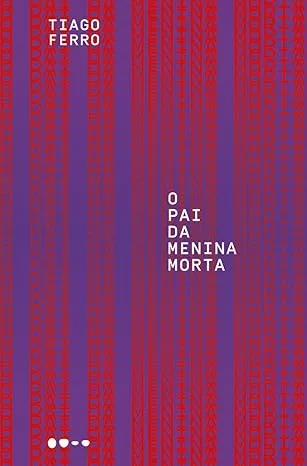
FERRO, Tiago. O pai da menina morta. São Paulo: Todavia, 2018.
Samara Lima
Illustrated by Manuela Dib
Translated by Shaina Thelen
On October 27, 1977, the day after his mother’s death, Roland Barthes wrote: “First wedding night. But first mourning night?” The notes that Barthes used to record his emotions, written more for himself than for the eyes of others, are sporadic and erratic, mirroring the discontinuous pain experienced by someone facing the loss of a loved one. The themes of the notes, which culminated posthumously in the 2009 Mourning Diary, are diverse. One can find everything from the slight unease that settles into the author’s daily life and his desire to integrate “heartbreak into writing,” to his comments on his fear of profaning his mother’s death by transforming it into literature, “although in fact literature originates from these truths.”
It is precisely from a truth more or less similar to the one described by the French critic—that is, a truth born from the experience of grief—that O pai da menina morta (The Father of the Dead Girl, 2018), the debut novel of writer, essayist, and editor Tiago Ferro (São Paulo, SP, 1977), was constructed. Ferro experienced the death of his own daughter two years before publishing the book.
In August 2016, Ferro wrote a nonfiction piece for Revista Piauí, “Já não era mais terça-feira, mas também não era quarta” (It Was No Longer Tuesday, but It Wasn’t Wednesday Either), dedicated to his daughters and their mother. The child was only eight years old when she died in March 2016 from myocarditis resulting from a complication caused by the Influenza virus. In the text, Ferro addresses the events that followed Manu’s death and the void left by her absence.
O pai da menina morta, which won the São Paulo Prize for Literature and the Jabuti Award in 2019, is written in the first and third person singular by a narrator-character who finds himself faced with the death of his own daughter: “My daughter died on April 26, 2016. Am I still part of this world?” It is then, through the perspective of this narrator-character, who seems to oscillate between dream (or nightmare) and reality, that the reader will follow his mental confusion and the reaction of all those affected by the tragedy.
But it is interesting to note that, despite originating from the child’s death, the narrative is not solely concerned with recounting what happened. In fact, what seems to be continuously at stake is the attempt to investigate, through the narrator-character’s subjectivity, what remained latent after the death and to retrace the narrator’s life even before becoming a father: “Am I the Father of the Dead Girl? Who is speaking here after all? Who am I?” In this way, various narrative threads gradually connect as the story progresses: we gain access to the protagonist’s childhood memories, his search for an alternative lifestyle through yoga, the divorce process, the political events that took place in the country in 2016, and the memories of family trips, among others.
In this story, most of the characters are referred to by their roles—“the doctor,” “the Yoga Teacher,” “the Buddhist Therapist.” The father and daughter, on the other hand, are identified only as “the Father of the Dead Girl,” “the Leprous Father,” the “Father Who Got Screwed,” and “My Daughter” or the “Dead Girl.” This decision may indicate that the narrator and author wish to separate the spheres of fiction and reality to avoid simplistic interpretations of the way in which both are intertwined in the narrative. The blurring of these spheres is already hinted at on the cover of the novel itself, where the author’s name, positioned in the upper left corner, seems to point vertiginously toward the title of the work, centered on the right.
There are also three black-and-white photographs reproduced throughout the text. One of the photos, for example, belongs to the author’s personal archive and is inserted in the fragment [1978]. The image shows a baby, dressed in striped clothes, on what appears to be a bed. Considering that the author states he was born “in the city of São Paulo on May 26, 1976,” we can assume that the photograph portrays the protagonist and, ultimately, the writer Tiago Ferro himself at two years of age.
The photo, which could easily be interpreted merely as an illustration of a moment from the narrator/author’s childhood, upon closer reading can lead us to consider the dual temporality that every image carries: “this-was” (the record of a past event that will not be repeated) and “this-will-be”, a concept used by Barthes to characterize photographic representations. In this way, it is as if the photograph of the protagonist as a baby drifts between the innocence of his early childhood and what tragically awaits him in the future: marriage, the birth of his daughter, fatherhood, the child’s death, and his new and eternal status as “The Father of the Dead Girl.”
At various points in the narrative, the narrator states that each of his gestures is “overinterpreted on a level of paranoia and exegesis,” since he finds himself face to face with everyday judges who evaluate any step toward normalcy as an attack on the child’s memory: “How do you still have the nerve to show your face around here? How do you still have the audacity to eat, sleep, smile, fuck, breathe? How? Answer me!”
At first, the reader is led to believe they are reading some kind of diary that allows them to glimpse the narrator’s day-to-day life after the child’s death, as there are a series of bracketed entries indicating the days of the week. The fragmented nature of the narrative is presented through lists (grocery lists, dictionary entries, trivial fears, and the best songs in English), WhatsApp messages, and the reproduction of emails. Thus, family, places, religion, sexuality, and the daughter’s death itself are addressed in “short and disconnected paragraphs” and demand heightened attention from the reader. It is as if the use of different elements serves as an attempt to lend cohesion and meaning to what happened and to the account of it, but the fact is that they only make more explicit the difficulty of understanding and narrating it. It is no wonder, then, that the narrator’s conclusion at the end of the book is that “language is a trap.”
Another resource used in the narrative to “give shape to pain” is the investment in otherness, in the search for an imaginary group that “went through the same kind of suffering.” At various points, the narrator draws on references to celebrated figures from different fields of knowledge to weave his personal story into a series of portraits of fathers who were also orphaned by their children: Gilberto Gil, who “pulled his son from the rubble of the accident”; Charles Darwin, who persisted “with his fiction of the animal kingdom” after the death of his daughter; Hermann Kafka, who “received the manuscripts of his son who had died”; and many other individuals who experienced this same “inversion of the law of nature.” The objective, then, is to find meaning through the experience of the other with the intention of also finding a reasonable way to cope with the grief experienced from the tragedy. For this reason, more than to the daughter—since the book will not, after all, bring her back to life—the narrative is dedicated “To those who remain,” to those who survived.
O pai da menina morta engages with many contemporary works that create textual material from the experience of grief. One need only recall Lili: novela de um luto (Lili: A Novel of Grief, 2021), by Noemi Jaffe, and As pequenas chances (Small Chances, 2023), by Natalia Timerman. However, it is also a work that belongs to the field of productions that reject rigid boundaries by embracing the hybridity of genres and language, blurring the very category of “novel” and the lines between reality and invention. By the end of the reading, one might say that the reader is faced with a work that, yes, departs from the reality of the facts, but only to fracture them and produce an effect closer to the experience of absence caused by the death of a daughter.
Further Reading
BARTHES, Roland (2009). Diários de luto. Lisboa: Edições 70.
CAETANO JÚNIOR, Antônio (2019). Luto e escrita de si: jogos autoficcionais em O pai da menina morta. Monografia de Conclusão de Curso (Graduação em Letras) – Universidade Federal da Bahia, Salvador.
VELASCO MONTEIRO, Tiago (2021). A inespecificidade em O pai da menina morta. Signótica, Goiânia, v. 33, p. e69126. Disponível em: https://revistas.ufg.br/sig/article/view/69126. Acesso em: 24 out. 2024
Iconography