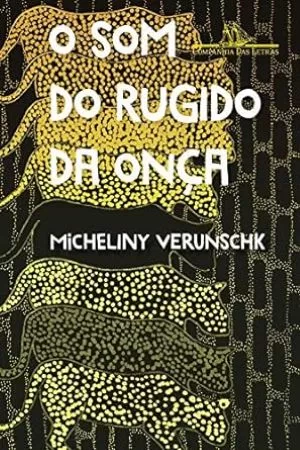
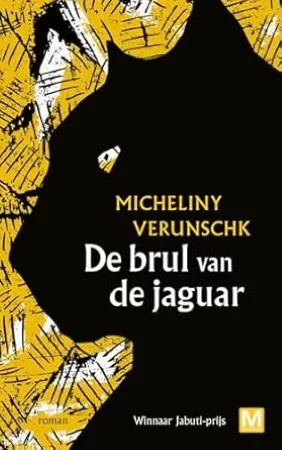
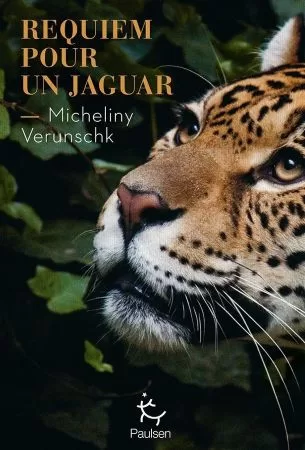
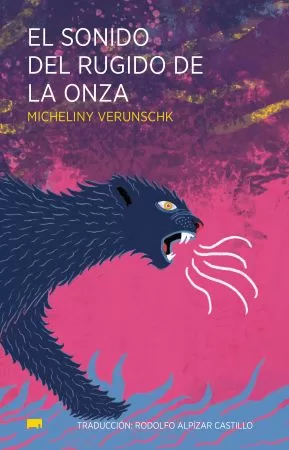
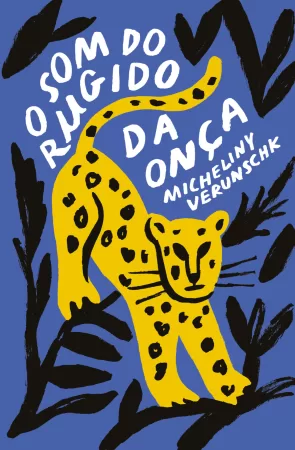
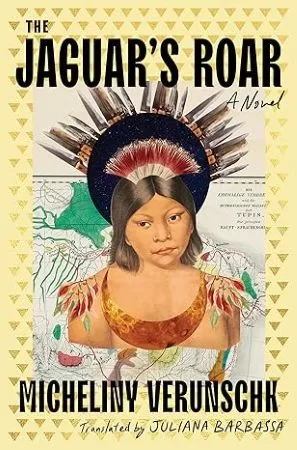
VERUNSCHK, Micheliny. O som do rugido da onça. São Paulo: Companhia das Letras, 2021.
Amelie Puglia
Illustrated by Guilherme Franzoni
Translated by Leila Santos
O som do rugido da onça (The Jaguar’s Roar, translated by Juliana Barbassa, Liveright, 2026) brought renewed attention to contemporary Brazilian literature in 2021. Micheliny Verunschk (Recife, PE, 1972), a poet and writer, lived most of her youth in Arcoverde, a city she claims is close to her heart. She describes herself as a historian by training; her historical background inspired her to write this novel. Verunschk spoke emotionally about the origins of the work during several interviews following the book’s release. In 2016, she visited the permanent exhibition of the Itaú Brasiliana Collection at the Instituto Itaú Cultural (Itau Cultural Institute). Upon seeing the lithographs (a type of printmaking) of two Indigenous children—a girl from the Miranha people and a boy from the Juri people—she was deeply affected by the shock she experienced and decided their story needed to be told.
She later sought to find more information about the children: they were captured in the 19th century by two scientists, Martius and Spix, during an expedition in Brazil. The scholars took their “discoveries” of various kinds with them back to Europe; including animals, plants, and, tragically, humans.
In the podcast Matéria Bruta (Raw Material), from Canal Curta (2023), the author discusses how she quickly realized the barriers to writing a historical novel to represent the story of the kidnapped Indigenous children. First of all, from purely a practicality standpoint: the official documentation was insufficient to reconstruct the two children’s trajectories. Second, for ethical and moral reasons: the “official” history is always told from the colonizers’ perspective, and that is not Verunschk’s objective. The intention of the work emerges instead as a narrative about overcoming colonial violence, which persists in the Brazilian DNA like a disease. The book also serves as an exercise in ethical responsibility in the face of this past.
Before O som do rugido da onça, Verunschk published the poetry collections Geografia íntima do deserto (Intimate Geography of the Desert, Landy, 2003), O observador e o nada (The Observer and the Nothing, Edições Bagaço, 2003), and A cartografia da noite (The Cartography of the Night, Lumme, 2010), as well as the novel Nossa Teresa (Our Teresa) (Patuá, 2014) and the Trilogia infernal (Infernal Trilogy, Patuá, 2020), set during the Brazilian military dictatorship. Her fifth novel, O som do rugido da onça, won the Jabuti and Oceanos awards in 2022, during a political and social moment marked by the rise of Indigenous literature, a genre seeking to reclaim its place in Brazilian literature.
This period also coincides with the amplification of Indigenous voices in the artistic and literary fields, particularly in relation to ethnogenocide and environmental destruction, both of which are struggles that gained momentum beginning in the 1980s with the Indigenous Movement. Despite these challenges, Verunschk takes a risk and acknowledges that “This is not a narrative that belongs to me, it belongs to the Indigenous people.” How, then, can a white writer claim the right to tell a story about the violence suffered by Indigenous peoples? The book is the author’s response to this question: the result of extensive research, direct contact with Indigenous communities, and, above all, her experience with the ayahuasca ritual; all of these factors brought her closer, albeit symbolically, to the experience of loss endured by the two children.
A key characteristic of Verunschk’s work is its ability to articulate multiple temporalities. In O som do rugido da onça, the past and present merge harmoniously. In 1820, a young Indigenous girl from the Miranha community, Iñe-e, was handed over to the Bavarian scientists Martius and Spix by her own father, “who’d sickened with a white sickness.” In addition to her, the scientists purchased seven other boys, including a child from the Juri people, rivals of the Miranha.
The two children, who were incapable of communicating because they did not speak Nhengatu (the general Indigenous Tupi-Guarani language), German, or Portuguese, were transported anyway by ship to Munich. At the king’s court, they were baptized as Isabella and Johann and treated like dolls by the princesses and princes, symbolizing the peak of colonial violence.
In the letters sent to the King of Bavaria, Martius expressed a viewpoint similar to that of Pero Magalhães de Gândavo. According to the History of the Province of Santa Cruz (História da Província Santa Cruz) (1576), Gândavo observed the absence of the letters L, F, and R in the Indigenous languages and concluded: “a thing worthy of astonishment, because thus they have neither faith, nor law, nor royalty. In this way, they live disorderly, without having, moreover, any reckoning, weight, or measure.”
Similarly, Martius interpreted certain Indigenous practices and rituals as demonic manifestations of the land: “Before my horrified eyes unfolded a scene more hellish than human: a dance of depraved cannibals, heightened by a triumphant elation and sensuality.” Thus, for both Gândavo and Martius, the land that would come to be named Brazil was simultaneously a paradise, with an untouched nature, and demonic, as it was inhabited by beings seen as hellish.
Alongside this historical background, Verunschk presents the story of Josefa, a character the author uses to discuss the biographical event of visiting the museum and experiencing the shock upon seeing the lithographs. Josefa’s role is to understand history through the rediscovery of her own Indigenous past.
The well-known Portuguese expression heard from grandmothers, “pegar a laço” (to be caught with a lasso), is synonymous with having “wild character” that needs to be tamed. The same colonial violence rooted in this colloquial saying acts as a recurring theme in the text: “My great-grandmother on my mother’s side was a real Indian, did you know that? Same as so many others in Brazil—mine, yours, the doorman’s.”
Josefa, however, grew up with her paternal grandmother, a “a tough Colombian lady who’d always bring up this relative of mine when I pushed back to say I had a rebellious streak that couldn’t be tamed ” Josefa reflects.
Josefa’s voice resonates like an echo of the ideological constructs that persist in contemporary times, but also like a roar from the ancestral past—a force that, upon emerging, not only denounces, but also becomes a builder of a conscious future.
The final pages of the book intensify the intertwining of multiple storylines in the plot, revealing the complexity of Verunschk’s narrative. Iñe-e, transformed into a jaguar and guided by the jaguar spirit, comes into contact with her forebears and realizes, with sorrow, that the history of captures and violence began long before her and continued for a long time afterward. This awareness also unfolds in the present, in 2020, when the devastation persists: the death of Indigenous people from Covid-19, the destruction of the Amazonian flora, and the murders of Indigenous children. At this moment, the character receives a message that echoes the pain and the continuity of historical evil: “Listen here, evil doesn’t end, it extends, lengthening, jauá, jauá [onomatopoeia meant to replicate the bacurau bird sound[. That’s why I wanted to make you see all this. So you never forget.”
The novel encapsulates the paradox of the country’s formation, the birthplace of a mixed-race population whose origins lie with Indigenous peoples: “She saw her people mix with other people, mix their languages and their blood; but, if some happiness came of it, some of it was a turning away, too, a people turning its back on itself. Everyone’s an Indian, no one’s an Indian. And Brazil, this canoe.” Verunschk thus narrates not only colonial violence, but also the continuous denial of Indigenous ancestry, creating tension in Brazil’s national identity, marked by mixture and denial, by memory and erasure.
O som do rugido da onça is also a novel about language and the power of words. Words and phrases from the Nhengatu language punctuate the text, constantly bringing the reader back to the “discovered” Brazil, the colonized Brazil, stolen from Indigenous communities. Invented words also stand out, for literature and fiction can build something new; in this way, Verunschk restores value to the Indigenous worldview of Native American perspectivism, in the terms of the anthropologist Viveiros de Castro, where even rivers and monkeys speak their own language.
The awareness of the power of words is present in both Western and Indigenous perspectives. For Indigenous people, the word is life: “And without speech, there is only death—that is what Iñe-e and the others learned.” For Westerners, the written word becomes an instrument of power, with which a single line through a name is enough to erase a life story: “Martius erases. He omits the boy’s fate.”
Furthermore, the novel thrives on the convergence of multiple authors. First, there is the reference to the short story “Meu tio Iauaretê” (“My Uncle Iauaretê”) () by Guimarães Rosa, with whom she shares an experience of metamorphosis into a jaguar. The jaguar, the ancestral relative, is at the same time an animal to be feared, and one with which the protagonists manage to have an intimate relationship, based on trust and mutual respect. The author herself states that in this text, she dialogues with Indigenous voices to transcend the boundaries of Western knowledge, treading carefully into Indigenous perspectives from the Americas and respecting their stories.
Thus, the book features quotes from the shaman Davi Kopenawa, stories of Miranha, Juri, and Yanomami myths, and, on the cover, a reproduction of a painting by the artist Jaider Esbell, the same artist who, in his essay-work Makunaima, o meu avô em mim! (Makunaima, My Grandfather within Me!,Iluminuras, 2018) remembers that “without entering the doors of the worldviews of the Indigenous peoples, it is impossible to discuss decolonization.” Verunschk seeks to do something similar: decolonize our thinking through a book that brings the reader to the present and recount a past silenced for centuries by colonial violence. The metamorphosis into a jaguar-author represents the ancestral “roar” that resonates in the present to spread into the future.
Further Reading
DORRICO, Julie; DANNER, Leno Francisco; CORREIA, Heloisa Helena Siqueira; DANNER, Fernando (Orgs.) (2018). Literatura indígena brasileira contemporânea: criação, crítica e recepção. Porto Alegre: Fi.
ESBELL, Jaider (2018). Makunaima, o meu avô em mim! Iluminuras, Porto Alegre, v. 19, n. 46, p. 11-39.
GÂNDAVO, Pêro de Magalhães (2004). História da Província Santa Cruz a que vulgarmente chamamos Brasil. Lisboa: Assírio & Alvim.
VERUNSCHK, Micheliny (Entrevistada) (2023). Matéria Bruta: O Som do Rugido da Onça com Micheliny Verunsch. Episódio 78 [Podcast]. Locução de Flávia Mano. Canal Curta!. Disponível em: https://www.youtube.com/watch?v=yrbGD3EYg28. Acesso em: 16 jun. 2024.
VIVEIROS DE CASTRO, Eduardo (2005). O perspectivismo ameríndio ou a natureza em pessoa. Ciência & Ambiente, Santa Maria, n. 31, p. 123-132.
Iconography