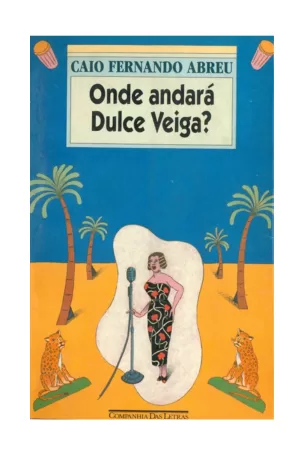
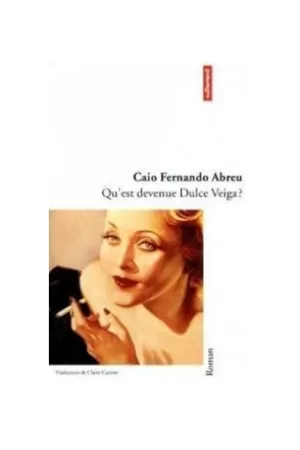
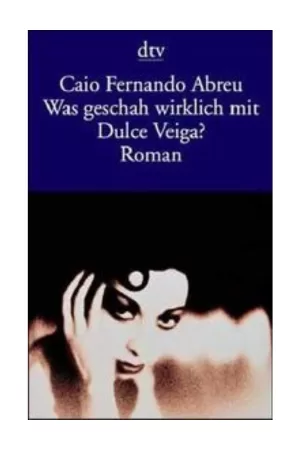
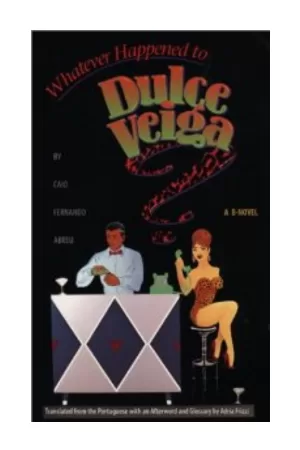
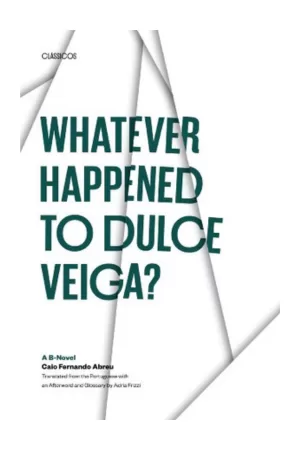
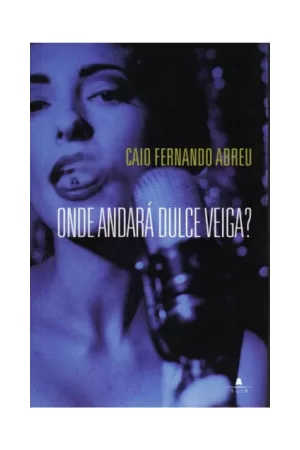
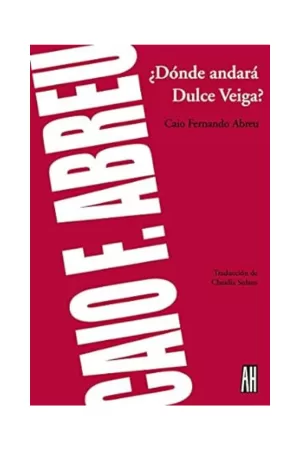
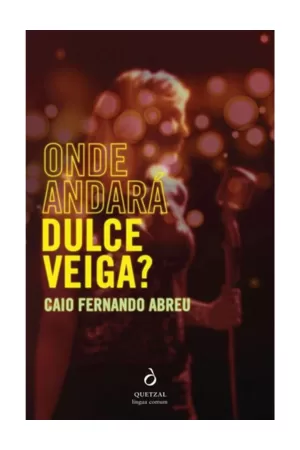
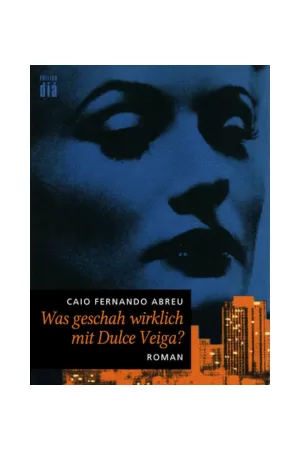
ABREU, Caio Fernando. Onde andará Dulce Veiga? Um romance B. São Paulo: Companhia das Letras, 1990.
Amanda Bruno de Mello
Illustrated by Bernard Martoni
Translated by Svea Morrell
Caio Fernando Abreu (Santiago do Boqueirão, RS, 1948 – Porto Alegre, RS, 1996) published Onde andará Dulce Veiga? (Whatever Happened to Dulce Veiga?, translated by Adria Frizzi, University of Texas Press) in São Paulo, 1990, and defined it as a hysterical detective novel. The protagonist, who narrates the novel in the first person, is a journalist about to turn 40, who lives a modest life, a man who finally secured a job after a long period of unemployment. As his first task for the newspaper, he interviews a popular rock singer and discovers that she is the daughter of Dulce Veiga, a singer who disappeared in the 1960s on the day of the premier of her first major show, an act that likely would have heightened her stardom. The protagonist writes an article titled “Whatever happened to Dulce Veiga?” in which he describes the diva’s talent and examines her disappearance. Readers of the newspaper react enthusiastically, and the owner of the paper tasks himself with leading a mission to find her. This investigation is the primary detective element of the narrative. As the search advances, clues are gradually revealed, though always with an air of mystery: the complex relationships between characters from the past and present and the existential anguish that burdens each one of them.
The hysterical element of the novel may be fairly represented in the emotional instability or the excess of the characters, whose origins are not linearly defined by the plot, but who appeared connected to a past of pain, abuse, and repressed traumas. The existential anguish, present in almost all of Abreu’s work, appears not just in the protagonist—who goes through a period of serious economic difficulty, is tormented by passionate memories, and who questions his sexuality—but also the other characters, who search for—through drugs, music, or sex—a form of escape. At first, the traumas appear to be individual, but little by little the novel also reveals the traumas of the military dictatorship, the period when Dulce Veiga disappeared that led to consequences that are proven to be more and more significant over time. While not the central theme of the book, the military regime appears as a ghost that haunts the daily life of the protagonist and his peers.
Caio was accused by contemporary critics of being a “down-in-the-dumps author” but the novel does not seem fated, from the beginning to the end, to dejection. There is a construction of empathetic relationships of care and affection between the characters. Aside from this, there is also the constant presence of religions and esoteric beliefs: orixás, the casting of conch shells and tarot readings, alternative communities, and astrology, which are all present as timely oracles or as paths to salvation. Aside from showing the diversity and religious fusion in Brazil, the work does not definitively condemn the characters to a miserable existence. Instead it leaves gaps in which to search for something different than the anguish and the desperation that shapes urban life in a recently democratized Brazil. The protagonist himself, whose name is never revealed, undertakes a search for his own identity that seems—at the end of a journey permeated by mystical encounters—successful.
The concern for the esoteric, for Eastern philosophies, and for alternative ways of living are all present, indeed, in the personal life of Caio Fernando Abreu, who lived through a countercultural movement and was knowledgeable about astrology. The latter appears not only as a theme mentioned by characters in his stories, but also as a structural logic behind some of his work, such as Triângulo das águas (Triangle of Waters), a 1984 Jabuti award winner, constructed from the three symbolic archetypes of water.
Abreu also won the largest award in Brazilian literature in 1988 (the Jabuti), with Os dragões não conhecem o paraíso (Dragons, Verulam Publishing, 1990, translated by David Treece) ), and won it again in 1995 with Ovelhas negras (Black Sheep). When he published Whatever Happened to Dulce Veiga? He was already a well-known writer, author of stories, crônicas, and plays, who was missing, just maybe, a good novel (his other novel, Limite branco (White Limit), published in 1970, was written when he was 19 years old). Winner of the Associação Paulista de Críticos de Arte (APCA) (São Paulo Art Critics Association) award in 1991, Dulce Veiga fills this gap by returning to themes, processes, and settings that had already been explored and perfected in his earlier works.
Among the processes, it is worth mentioning the relationship established by Caio Fernando Abreu between literary writing and the techniques of film: its language, images, and clichés. This relation was already shown in the novel’s subtitle, Um romance B (A B-novel)—which alludes to B films—and in the title itself, since the character who gives the work its name is based on a character played by Odete Lara in A estrela sobe (The Star Rises), a movie from 1974 by Bruno Barreto. It is no coincidence that, in 2008, Abreu’s novel was adapted for cinema by Guilherme de Almeida Prado.
In Whatever Happened to Dulce Veiga?, the eye of the narrator, like a cinematic camera, is endowed with intention and seems to make use of different framing to provoke a sense of mystery in the reader, as if there were something in the presented scenes that they cannot see. In general, the impression is that the book starts with a close-up that opens up over time, revealing what was always there, but just was not a part of the composition. Contrary to what the chapters that make up the book appear to indicate—there are seven, one for each day of the week, starting on Monday and ending on Sunday—the pace of the narrative is not totally linear, but is interrupted by flashbacks that cast light on the events from twenty years ago that led to the disappearance of Dulce Veiga and show the narrator’s affair with Pedro.
Besides references to cutting and montage, perceived in the plot’s ordering, collage also influences Caio’s writing. The relation with the world that the narrator presents to the reader, aside from not being objective—since it is affected by her sensations and reflections—also is not truly a direct experience because it is mediated all the time by references to literature, music, cinema, in sum, pop culture. In this way, the author paints an experience of living in the contemporary world, in which subjectivity itself, through media, is affected by a myriad of experiences, sensibilities, opinions, and narratives that, initially alien, are appropriated by individuals.
The narrator has some things in common with the author, who also worked as a journalist to survive and, at the time he wrote the book, was also approaching middle age. Abreu, born in Santiago do Boqueirão, in Rio Grande do Sul, lived in various cities (just like the protagonist of his B-novel), settling for some time in Porto Alegre, Rio de Janeiro, and São Paulo. At the start of the 1970s, persecuted by the Departamento de Ordem Política e Social (Dops) (Department of Political and Social Order), he self-exiled in Europe, travelling through Spain, Sweden, the Netherlands, England, and France. He is not linked to the tradition of Gaucho regionalism, but sets his narratives in urban spaces and gathers his characters among the figures marginalized by capitalism, by morals and good customs: figures of homosexuals, transexuals, addicts, punks, and metalheads, for example, are found in Dulce Veiga, but also in many of his other works. In this novel, São Paulo and its diversity of landscapes and microcosms becomes almost a character in itself, and its inhabitants do not symbolize a Brazilian national identity, but a non-hermetic diverse group of identities, which are always in construction, in process. The narrator herself does not know if he is gay or not, the character Jacyr/Jacyra, while not using this term, is genderfluid, alternating between identities of male and female. In a country heir to the attempt of imposing cisgender, heterosexual, patriarchal, patronizing, and repressed morality, Abreu mainly highlights a cast that lies outside of these characteristics.
Caio worked intensively on his writings, poring over drafts and different versions of the same book, reading aloud, and recording what he read. In respect to Whatever Happened to Dulce Veiga? he states, in a letter to José Márcio Penido, that he spent 13 years with the book in his head and heart and one year holding it by the hair to transform the more than 2,000 typed pages into just over 200 pages. The result is a poetic script, full of singular images, catalogs of alternative possibilities, with a careful rhythm, which seems exact, necessary, as if the phrases guarded a magic and could not have any other form than that which is recorded.
Today, reading Whatever Happened to Dulce Veiga? is to access this recently democratized Brazil, which demonstrates more than the optimism of the end of the civil-military dictatorship, but also carries the ghosts of that period, never resolved and collectively debated; it is to access a generation that, like the author, enters middle age frustrated with the limitations and, if it is not exaggerating to say, the failings of counterculture; it is to feel the hard blow of AIDS, of addictions and overdose in the aspirations of sexual liberty and experimentation. And also, on the other side, to access a kaleidoscope of identities and possibilities of the human experience, of relation with otherness, and the pleasure of artistic fruition.
Further Reading:
LEAL, Bruno Souza (2002). Caio Fernando Abreu, a metrópole e a paixão do estrangeiro: contos, identidade e sexualidade em trânsito. São Paulo: Annablume.
LEAL, Bruno Souza (2001). A literatura como cartografia textual: “Onde andará Dulce Veiga?”, de Caio Fernando Abreu. Revista de Literatura Brasileira, Porto Alegre, ano 12, n. 25, p. 39-67.
NASCIMENTO, Cyro Roberto de Melo (2019). Stella Manhattan, de Silviano Santiago, e Onde andará Dulce Veiga?, de Caio Fernando Abreu: dois romances homotextuais brasileiros. Tese (Doutorado em Estudos da Linguagem) – Universidade Federal do Rio Grande do Norte, Natal. Disponível em: https://repositorio.ufrn.br/jspui/handle/123456789/27726. Acesso em: 12 mar. 2023.
PERES ALÓS, Anselmo (2012). Gênero e ambivalência sexual na ficção de Caio Fernando Abreu: um olhar oblíquo sobre Onde andará Dulce Veiga? Estudos de Literatura Brasileira Contemporânea, Brasília, n. 40, p. 177-204. Disponível em: https://periodicos.unb.br/index.php/estudos/article/view/9847. Acesso em: 12 mar. 2023.
Iconography: