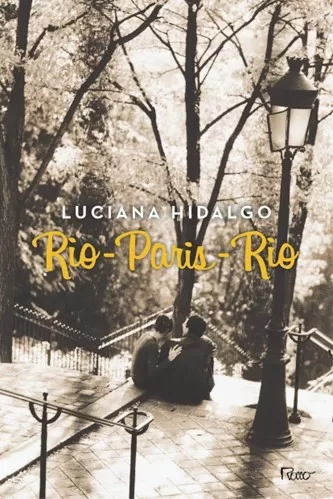
HIDALGO, Luciana. Rio-Paris-Rio. Rio de Janeiro: Rocco, 2016.
Maria Clara Lysakowski Hallal
Translated by Annika Prickett
Illustrated by Marlova Aseff
Luciana Hidalgo (b. Rio de Janeiro, RJ, 1965) is a two-time recipient of the Jabuti Prize, recognized for her books Literatura da urgência: Lima Barreto no domínio da loucura (Literature of Urgency: Lima Barreto in the Realm of Madness) in the Literary Theory and Criticism category (2008), and Arthur Bispo do Rosário: O senhor do labirinto (Arthur Bispo do Rosário: The Lord of the Labyrinth) in the Biography category (1996). She made her fictional debut with O passeador (The Wanderer), in 2011, set in Rio de Janeiro during the Belle Époque. In her second novel, Rio-Paris-Rio, written in a clear and direct style, Hidalgo immerses readers in a turbulent period—the Brazilian civil-military dictatorship and the May 1968 student protests in Paris—interwoven with the romance between the two protagonists, Maria and Arthur.
The story is told in third person, blending fictional characters with a real historical backdrop. It comprises twelve short chapters, only one of which, chapter eight, is titled: “Jouissez Sans Entraves” [Enjoy Without Obstacles]. Through philosophical musings delivered by a keenly observant narrator, we learn that the protagonist, Maria, is a Brazilian immigrant forced into exile in Paris.
Thanks to Hidalgo’s fluid prose, the reader is invited to wander through the streets of Paris and become complicit in the unfolding events: love, friendships, travel, and the political happenings in both Brazil and France. The novel also reflects deeply on the immigrant experience—the transformations required to belong to a new land. Hidalgo herself lived in Paris for many years while pursuing postdoctoral studies at the Sorbonne—the very university attended by Maria, the protagonist.
The story begins in 1964, introducing Maria, exiled in Paris following the military takeover in Brazil. A philosophy student at the Sorbonne, she lives according to Cartesian logic, where a method lies behind everything. But this changes after she meets Arthur.
The central axis of the narrative is the meeting of Maria and Arthur in 1968. Arthur, a fellow Brazilian, is a poet and street artist. They are neighbors, and their relationship begins with anonymous poems he leaves at her door. The romance blossoms quickly. For Maria, Arthur becomes a kind of roaming Ithaca—referencing Homer’s Odyssey—the homeland to which the hero Ulysses longs to return, where his love awaits.
After a shared trip and the rhythms of life in Paris, Maria realizes she is no longer alone—her life has become inseparable from Arthur’s. She no longer believes in Descartes’s method; Arthur becomes her method. Gradually, she loses the ability to distinguish herself from him.
Amidst the romance, readers are exposed to the immigrant experience in Paris, likely similar to that in other cities. The author points out how acculturation begins with translating immigrants’ names to make pronunciation easier and perhaps less threatening in the new language. At one point, Maria recognizes that, in some way, all foreigners are intruders, never fully belonging to the place they inhabit.
Despite being a foreigner and effectively an exile, Maria builds a circle of friends: Marechal (a fellow Brazilian fleeing the horrors of dictatorship), Martine (her free-spirited French friend and foil), and Luc (French, and possibly the building owner). Each reveals a different facet of Paris to her—an adventurous city, a place of refuge for those fleeing their homelands, or a city still marked by stark social divisions.
As Paris reveals itself as many cities in one, Arthur also appears to possess many identities: writer, sculptor, philosopher. Maria is at times amused by these contradictions, but also overwhelmed by loving so many people in one. She, too, has secrets—she is the granddaughter of a hardline general from the Brazilian dictatorship. Throughout the book, possibly in an effort to unburden herself, she tries to share this fact with her friends, especially Arthur, but either lacks the courage or goes unheard.
The novel’s climax centers on the occupation of the Sorbonne by students from Nanterre on May 10, 1968, a movement that began in Paris and spread its ideals globally. Amid police crackdowns and street chaos, Maria loses her glasses. Due to her nearsightedness, she can only see shadows—an apt metaphor for the violence she witnesses. This culminates when she fails to recognize Arthur in the crowd, though he leads her to a hideout under the Pont Neuf. There, in a visceral mix of bodies and wildness, Maria gives herself to Arthur with a kind of primal force.
Following this encounter, the author presents a transformed Maria. Shaped by the protests, the violence, and the night with Arthur, she becomes more melancholic—perhaps more pragmatic and less idealistic about either France or Brazil. She realizes that both countries face deep challenges, though Brazil is clearly undergoing a more violent and obscure period. She begins to draw parallels between the May 10 events in France and Brazil’s civil-military dictatorship. To her, both nations are backward, chaotic, and rural—and for the first time, she shows affection when remembering her homeland.
Maria reflects that the protest, at least at the time, brought little concrete change. A new character enters the novel: Ciaei, a Brazilian who had been in Paris but returned home for a time. Through him, readers learn that the dictatorship in Brazil has intensified—with more torture and deaths—but also that opposition has not been silenced. The Passeata dos Cem Mil (March of the 100,000) took place in Rio de Janeiro. This marks another turning point: Marechal, tense and anxious, returns to Brazil to join the armed resistance. Arthur departs for Amsterdam, embarking on his odyssey, to try to find himself in the world.Maria remains in Paris to pursue her own. She travels with Martine to the French commune of Arles, to the so-called “colorful house,” a refuge for people dealing with personal struggles and seeking new ways to live. There, Maria has an epiphany—she affirms that her values are fundamentally different from those of her authoritarian grandfather. This realization is echoed by a metaphor about her myopia: before being diagnosed, she saw the world as blurry; once she wore glasses, the world became colorful and defined. It becomes clear that Maria has chosen to embrace the present—to see the world clearly, even if it means standing on the opposite side of her grandfather.
Back in Paris, she finds telegrams from her grandfather, who had come to Europe and wanted to visit her. Maria admits she went to Arles to avoid this meeting. Eventually, Arthur returns, and the couple reunites. Maria understands that they are like geometrically linked shapes—part of each other.
In the final chapter, fifteen years later, in 1979—a month after Brazil’s Amnesty Law is passed—the couple returns to Brazil. Although the ending remains implicit, it is clear that, despite the challenges, they chose to stay together and return to their homeland.
Rio-Paris-Rio was published in 2016, a time of contradictions in Brazil. That year, the country hosted the Olympic and Paralympic Games (August and September), and also in August, President Dilma Rousseff was impeached and permanently removed from office. A new, unpopular administration took power, enacting a series of measures that harmed the population, particularly the poor (e.g., labor rights rollbacks, pension reform, and the spending cap amendment). Though likely written before these events, the novel allows parallels to be drawn between Brazil’s turbulent moments in 1968 and in 2016.
Moreover, the novel is important in preserving the memory of the May 1968 movements, which sparked global debates and progress—especially regarding racism and women’s rights. And, of course, it reminds us never to forget the horrors of Brazil’s civil-military dictatorship.
Further Reading
BARBERENA, Ricardo; FERRÃO, Ana Carolina Schmidt (2020). Desvelando identidades: realismo e subjetividade em Rio-Paris-Rio, de Luciana Hidalgo. Revista Investigações, Recife, v. 33, n. 1, Dossiê̂: Literatura Contemporânea de Língua Portuguesa, p. 1-12. Disponível em: https://periodicos.ufpe.br/revistas/index.php/INV/article/view/245169. Acesso em: 10 fev. 2023.
SAID, Edward (2003). Reflexões sobre o exílio e outros ensaios. São Paulo: Companhia das Letras.
Iconography