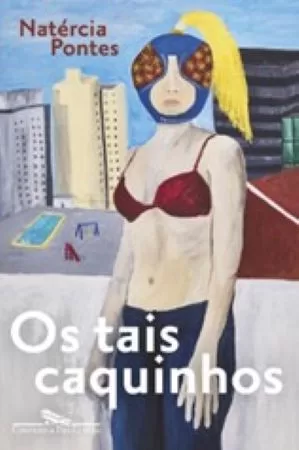
PONTES, Natércia. Os tais caquinhos. São Paulo: Companhia das Letras, 2021.
Gabriela Dal Bosco Sitta
Illustrated by Rafael Tinco
Translated by Sophia Beal
Natércia Pontes (Fortaleza, CE, 1980) published Os tais caquinhos (Those Shards) in 2021. The publisher’s website defines it as a “tragic and moving Bildungsroman,” which may not be the most accurate synthesis. Published nine years after Copacabana dreams, which earned Pontes a place among the finalists for the Jabuti prize, Os tais caquinhos presents a series of instantaneous episodes of the narrator’s unsettled family’s daily life in an apartment adorned with years of a father’s compulsive hoarding. The book has a keen eye for the world and a writing style that frequently includes compelling descriptions, while often abandoning narrative cohesion.
The plot, based in the 1990s, revolves around the narrator, Abigail, her sister Berta, and their father, Lúcio, who live together in a chaotic apartment in which leftover food, mold, books, used packaging, and countless other items have accumulated for years. The story begins with a scene in which two of Abigail’s friends use Q-Tips to clean the narrator’s ears and—shocked by the quantity of filth that comes out of them—their eyes bulge “with fascination and disgust.” Those two nouns, fascination and disgust, characterize the reactions that the protagonist’s family and its way of life tend to elicit in the reader, and these words synthesize useful ideas for interpreting Os tais caquinhos.
Abigail’s mother, before the start of the plot, leaves home with, one assumes, the narrator and Berta’s two younger siblings. Their father, in turn, is unemployed and spends much of his time sitting in front of glasses of warm beer in sophisticated restaurants (it is unclear where his money comes from). The teenagers Berta and Abigail, due to their family’s negligence, gain autonomy that they are not old enough to manage. Although they continue to live with their father and go to school, their most basic needs are not met, and they receive unusual donations of eggs from women in neighboring apartments to satisfy their hunger. At one point, Berta—with whom the narrator has a series of conflicts, many of which are suppressed—begins to spend more time at a friend’s house than in her family’s apartment. Meanwhile, Abigail becomes involved with various boys, drinks too much, and uses drugs. In a recurring image in the book, she stretches her feet out on the wall and, with an empty stomach, spends hours observing insects.
Instantaneous episodes, like that in which Abigail appears with her feet against the wall, comprise a good part of Os tais caquinhos and are presented in quite short chapters. There are images of the protagonist meeting up with boys in the apartment where she lives, of Lúcio’s swollen belly button rising and falling in time with his breathing as he sleeps, and of the sisters occasionally feasting in a restaurant their father takes them to. The chapters generally are well written, even if the adjectives and the lists within them sometimes border on excessive. Indeed, those techniques—like the book’s structure with its short chapters that have little cohesion among them (some are snippets of diaries and notes)— point to the author’s attempt to emulate in book form the hoarding that characterizes the apartment where the protagonist lives. However, due to the way that structure is explored, many of the actions and events seem mismatched, which is accentuated by the use of verbs in the preterit imperfect that make it hard to know when events took place and for how long.
The chapter titles often are not obvious, nor do they directly address the content of that section, an inventive tactic that adds layers of meaning to the text. Among the titles, some are merely descriptive, but what they describe is surprising, curious, or poetic. This is the case with “Buttoning a Shirt with One’s Eyes Closed,” which refers to an odd habit of Lúcio’s with a very image-based appeal. There are also titles that show an unautomated view of the world, like “Sardine Backbone,” “Ripping Papers with Excellence,” and “Maps That Lie.”
Some of the chapters are notes or letters written by Lúcio and Abigail, and in these the disgust that her father initially may have caused — as a compulsive hoarder, a negligent father, a man with poor personal hygiene, a drunk, and an idle person, etc.— gradually turns to fascination. The notes he writes reveal a person who, though he has negative attributes, is also caring and articulate, with an appreciation for the arts, as can be gleaned from the books strewn about the apartment and some references to what appear to be interests shared by father and daughter (at one point, Abigail cites the Japanese filmmaker Yasujirō Ozu, for example).
Although the theme of Os tais caquinhos seems to be a teenager’s process of growing up in the context of a troubled family — with the typical dilemmas of adolescence added to those of a broken family —perhaps what is most captivating in this work is Abigail’s view of her father. That view, like almost all of the book, is permeated by fascination, but, specifically, it takes its time, stirring up questions and generating disquiet.
The voice of sons and daughters who decide to talk about their parents has surged in contemporary literature. That voice can be found in, for example, Paul Auster’s The Invention of Solitude (1982), Philip Roth’s Patrimony (1991), Rosana Campo’s Dove troverete un altro padre come il mio (2015, Where Will You Find Another Father Like Mine), Paloma Vidal’s Mar azul (2012, Blue Sea), and José Henrique Bortoluci’s O que é meu (2023, What Is Mine). In all these works, the narrators are mobilized by the desire to carry out the task of giving some meaning to what they inherited. That same desire moves Abigail who seeks to find in her father something that explains his compulsive behavior and his dismay toward life (“Why won’t death come for me?” is a recurring question he asks aloud). “Why does Lúcio mistreat himself so much? I wish Lúcio mistreated himself less,” she asks at one point.
Like Lúcio’s love — a love that is far from obvious — Abigail’s love reveals itself in notes that she writes to her father, but also in commentaries she formulates after observing him with the attention of someone solving a mystery. That is evident in this passage, for example: “Then [Lúcio] kept heading toward the drawer area where he could with much silence and care reach his underwear and put it on, still seated, […] finally getting up and pulling up the elastic of the underwear already practically in place. The higher the dry snap of the elastic hitting the hard flesh of his belly, the happier Lúcio was.”
In The Telemachus Complex, a book about contemporary parenting relationships, the Italian psychoanalyst Massimo Recalcati writes of “inheritance (a singular movement and not an acquisition as a given right).” In Natércia Pontes’s book, the inheritance that the father gives to his daughters does not seem worth much as first: in concrete terms, they inherit piles of misplaced objects and trash; in subjective terms, they inherit an inappropriate way of life, marked by a dysfunctional relationship with the world and difficulty coping with and appreciating one’s own life. But, if readers follow Abigail’s example and observe things with more attention, perhaps they will realize that she achieves what Recalcati calls “a singular movement” to appropriate her inheritance on her own terms. That movement happens through words.
As Recalcati notes, parenting has changed significantly in the last decades and today there no longer exists a “demand for power and discipline.” “The demand for a father is no longer a demand for ideal role models, dogma, for legendary, invincible heroes,” he writes. Thus, fathers face the difficult task of reinventing their role, which for Recalcati involves the notion of the witness: the father invoked today is the one “capable of showing, via his own life, that life can have meaning.” The epigraph and title of Os tais caquinhos come from a song, written by Antonio Cicero and sung by Marina Lima, which has a diagnostic similar to Recalcati’s, as well as a call for reinvention: “To start/Who will glue/Those shards/From the old world/Homelands, families, religions/And prejudice/It broke there is no way/Now find out for real/What you love/That all can be yours.”
In the story Abigail narrates, the father repeatedly fails in his role of witnessing the possibility of life, indicating a break with the parental model, but, in some moments, with tricks such as awkward little dances that make his daughters laugh, wordplay, and help with a change, he ends up offering the narrator an inheritance that she can appropriate.
In the end, what is most powerful in Os tais caquinhos is the daughter’s view of her family and later of herself, as well as a singular relationship to words, which involves fascination for the inventiveness of language, but also involves the disgust that stories sometimes cause us.
Further Reading
BEAL, Sophia (2025). Writing on Walls with Her Feet: Abjection and Narration in Natércia Pontes’s Os tais caquinhos. Revista Hispánica Moderna,v. 78, n. 1, p. 53-67.
SANTOS, Darlan Roberto dos (2021). Os tais caquinhos, de Natércia Pontes. Matraga, v. 28, n. 54, p. 615-618. Disponível em: https://www.e-publicacoes.uerj.br/index.php/matraga/article/view/62100/39539. Acesso em: 5 out. 2024.
Iconography