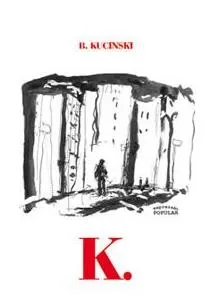
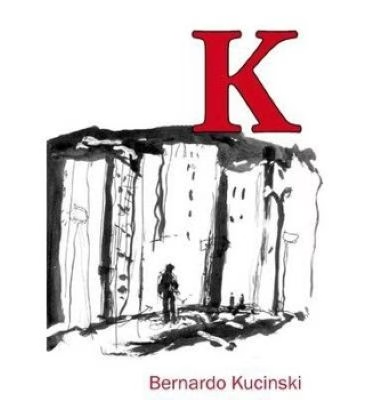
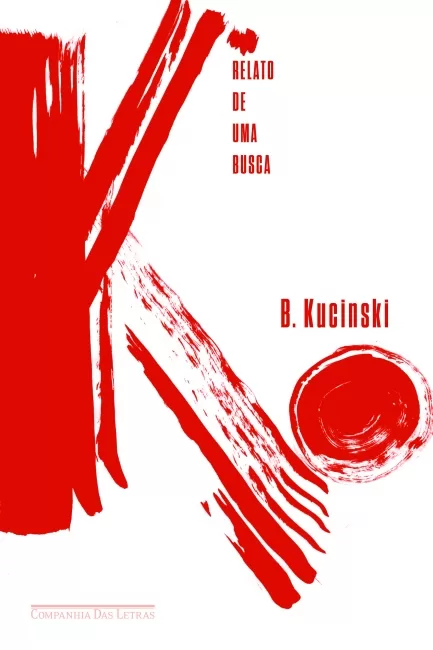
KUCINSKI, Bernardo. K. — Relato de uma busca. São Paulo: Expressão Popular, 2011.
Amanda Lacerda de Lacerda
Translated by Lucy Rowland
Illustrated by Graça Creidy
“Dear reader: Everything in this book is invented, but almost everything happened.” This word of warning to the reader is the epigraph that opens the original Brazilian version of the novel K. Relato de uma busca (K., translated by Sue Branford, Practical Action Publishing), by Bernardo Kucinski (São Paulo, 1937). In the English translation, the same sentence begins a short, explanatory section, “To the reader”, signed by the author, which does not appear in the same position in the original. The statement is paradoxical and synthesises the aporia inherent within discourses on trauma (often expressed in writing which appears problematic, impossible and unclear) which permeates the work. The book narrates the story of a father in search of his missing daughter who disappeared during the military dictatorship in Brazil, reflecting the author’s own family history, blending fact and invention while interweaving historical narratives and the plasticity of memory.
Kucinski, from São Paulo, the son of Polish immigrants, is best known for his career as a journalist. Recognition of his performance in this field has earned him various awards, amongst them the Prêmio Especial Vladimir Herzog de Anistia e Direitos Humanos (the Vladimir Herzog Amnesty and Human Rights Special Award) in 2018. He was an activist during the student-led movement against the dictatorship (1964–1985), was imprisoned and exiled, only to return to Brazil in 1986, when he took up a lecturing position at the School of Communications and Arts, part of the University of São Paulo, a position from which he has now retired. His family history is marked by the disappearance of his sister Ana Rosa Kucinski Silva, also a left-wing activist, who was imprisoned and tortured by the military in 1974.
On the subject of the dictatorship, Kucinski has also published a collection of short stories, such as Você vai voltar pra mim e outros contos (2014) [You Will Return to Me, and Other Stories], and the novels Os Visitantes (2016) [The Visitors], Júlia: nos campos conflagrados do senhor (2020) [Júlia: in the Burned Fields of the Lord] and O congresso dos desaparecidos (2023) (The Congress of the Disappeared, translated by Tom Gatehouse, Practical Action Publishing, 2025). During a podcast interview for Quatro Cinco Um magazine, in 2020, at the time Júlia was published, the author stated how: “As I approach old age, I increasingly feel the need to address the subject of the dictatorship.” Thus, literature becomes a potential means for re-addressing trauma, and a powerful space for representing the lived realities of terror. It is through his prose that Kucinski draws the reader to face feelings of disgust and unease, in response to the plot.
K. is a hybrid, polyphonic novel. Inserted between the chapters that solely recount the father’s search for his daughter, are a wide range of short narratives told in a variety of different voices. They include: the lover of a torturer, the therapy session of an interrogation room cleaner, the letter from a friend of the missing daughter, reports about hiding places and pick up points, the minutes of a university council meeting, the transcript of an interview with a deposed general, accounts from activists involved in the armed struggle and dialogues between torturers. All of them revolve around a central figure: the father who undertakes an impossible and fruitless search for his daughter. Seemingly independent chapters narrate different perspectives and experiences of the Brazilian dictatorship in such a way that they intersect. Each narrative can be read as a fictionally elaborated fragment of what occurred during that period, in which the reader assumes a position analogous to that of the protagonist, K.; searching for meaning, experiencing the fractured nature of reality.
The structure of each chapter also varies, as the story is told through numerous letters, interviews, minutes of meetings, and recollections, which are framed by the two narratives that function as a form of contextualisation. In “Letters to someone who does not exist: and “Post script”, which mark the beginning and ending of the work, the text is in italics as if to indicate a specific narrative voice. This narrator dialogues with the present day by situating both the beginning and end of the novel on 31 December 2010. This establishes a timeframe which both delimits the narrative and, within it, enables movement across different temporalities and perspectives on the trauma of the dictatorship. It amalgamates fiction and history, and fills in, with invented solutions “gaps that came from what I’d forgotten or from what my subconscious had blocked,” just as the author’s explains in his words of warning to the reader.
The tensions between fiction and reality bring to life the persistence of the legacies of the military dictatorship, constructing new representations of this collective past. The uncertain boundaries between literature, memory and history create conditions for the re-writing and exposure of oppressive historical events that are constantly undergoing processes of relativisation and erasure. The novel thus demonstrates a commitment to fostering new reflections on, and understandings of, an authoritarian past.
It is the father’s search that connects the varying narratives together and gives the book coherence. Throughout this process K. finds himself increasingly unable to find reliable information on the whereabouts of his daughter, and the impossibility, and inescapability of his search become apparent. The use of the expression “foram desaparecidos” [they were disappeared] is worth highlighting. This passive construction functions as part of a process of re-signification and confrontation of the dictatorial regime through the way the author chooses to name a human act. The language used establishes a resistance to the rhetoric that normalised disappearances as a solely voluntary phenomenon, and undermines the systematic nature of the dictatorship, which used kidnapping, torture and murder against those who opposed it.
Paradoxically, as he moves further and further away from uncovering the truth about his daughter’s whereabouts, the search brings K. closer to his own past, intertwining his memories of fatherhood in passages about his daughter’s childhood (such as when she got her first pair of glasses), with recollections. These originate, mostly, from a more distant past: his involvement as a communist militant in Poland during the Second World War, which led to his exile in Brazil. There are parallels in both K. and his daughter’s trajectories, such as the way they had both opted for left-wing political militancy, progressively revealed as K.’s still latent memories of his youth come to light.
In this manner, “story-telling” and “invented solutions” work alongside “recollections” and “gaps that came from what I’d forgotten”, as is the case with all memoir writing, whereby the narrative becomes a metaphor for a psychological process. The search undertaken by the father becomes a link between the past and present, enabling him to assert that his story is always evoked by incidents in his memory, as a two-time survivor of catastrophes. The narratives overlap, alternating between the past of persecution he lived through as a communist Jew, and the present incessant and fruitless search for his daughter, kidnapped and murdered by the dictatorship.
Throughout K.’s trajectory, the significance of the unsaid and ellipses stand out, given that they prevent the father from attaining a complete understanding of the traces he encounters, and of the framework that shapes the novel’s meaning. In the chapter “Memories, an inventory”, for example, photography is foregrounded, as K. finds a box of old photos of his daughter, which will make him, once again, return to thoughts of his own past. Each photograph opens up a space where memory is amplified, and brings with it fabulation of information that goes beyond the edges of the picture itself. The protagonist stumbles across a new universe upon discovering that he does not have photos of himself with his daughter, and, in the few where she does appear, he cannot identify the people alongside her, leading him to imagine the paths that led her to militancy, or to attempt to explain her absence. Thus, K. is overcome by feelings of guilt and regret, because alongside these photographs are others in which he appears, alongside activists and important people from his youth, significant moments in his life of which he is proud, and which contrast with the lack of images of his daughter. This lack was perpetuated not just by K., but by the whole family: “He recalled that his wife had filled the last two empty pages of this album with two or three pictures of her sons, and a photo of her first granddaughter. But no picture of her daughter.” The photo album, therefore, functions not just as an incomplete record, but also as a trigger for the remembrance of his past, in which there is a noticeable absence of images of him with his daughter. In the present, the shame he feels at not knowing her life story stands out: “And only now, seeing her frozen in time and space, that he realises just how fragile a person she’d been. K. had never imagined that photos could provoke such strong feelings. Some of them even seemed to want to tell a story.”
In his 2011 article, the year K. was published, Flávio Aguiar asserts that the novel assumes the form of a cathartic process, enacting a realisation of reminiscences. This “purgação de memória” [purging of memory] is not understood by the critic as forgetting or anaesthesia, but as the recovering of the past and emancipation of the future, thereby avoiding historical repetition. The dynamic of remembering and forgetting is by those living in post-dictatorship societies as a confronting of the official discourse that emphasises consensus, the idea that it is necessary to “virar a página” [turn the page] and build a future, but fails to undertake any reckoning with the past. In this context, literature can, ethically, take on the role of resistance.
Collective memory is also subject-matter for K.’s reflections. In “Streets and Names” the protagonist is invited to visit a housing development “across the Rio-Niterói bridge”, where the streets are named after political desaparecidos [disappeared], including his daughter and son-in-law. Confronting this, K. reflects on never having observed the names of the streets and viaducts which he passes daily, as if this visit had alerted him to a non-human face of the dictatorial regime, which normalises its continued presence through the choice of who it commemorates in Brazil’s major cities. In this chapter, the narrative engages with how questions of public memory and the need to respect the suffering of those persecuted under authoritarian regimes are dealt with from a historical-cultural perspective. In this context, K. sees such tributes to disappeared activists as being stripped of their meaning.
Literary writing about military dictatorships is becoming increasingly common, with contemporary works which interrogate the traumatic personal and intimate place that our dictatorship occupies within Brazilian society. K. holds an exemplary position among the proliferation of such works—books widely encouraged and reaching critical momentum after 2014, in the wake of the National Truth Commission and the fiftieth anniversary of the military coup in Brazil, an event that was (and still is) disputed, given that people and institutions continue questioning whether it was a coup, a revolution, or a mass movement. In this context, Kucinski’s novel corroborates the considerable overlap between ethics and aesthetics in Brazilian literature.
Further Reading
AGUIAR, Flávio (2011). O livro do Bernardo. Observatório da Imprensa. 31 out. Disponível em: https://www.observatoriodaimprensa.com.br/armazem-literario/_o_livro_do_bernardo/. Acesso em: 08 dez. 2023.
BRAIT, Beth (2019). Discursos de resistência: do paratexto ao texto. Ou vice-versa? ALFA: Revista de Linguística, São Paulo, v. 63, n. 2, p. 243-263. Disponível em: https://periodicos.fclar.unesp.br/alfa/article/view/11452. Acesso em: 10 set. 2023.
Ditadura e Literatura #22 [Locução de]: Paulo Werneck. [S. l.] 451 MHz Podcast, 17 de jul. 2020. Disponível em: https://www.youtube.com/watch?v=zmByOleFRZ8. Acesso em: 27 dez. 2023.
FINAZZI-AGRÒ, Ettore (2020). O corpo expropriado: Bernardo Kucinski – Diário de uma perda. Estudos de Literatura Brasileira Contemporânea, Brasília, v. 60, p. 1-6. Disponível em: https://periodicos.unb.br/index.php/estudos/article/view/30753. Acesso em: 10 set. 2023.
LACERDA, Amanda Lacerda de (2022). Construir a ficção, reler a História: literatura contemporânea e ditaduras latino-americanas. São Paulo: Lutz.
RUSSO, Vicenzo (2017). Pater, pátria e a memória como patrimônio: sobre K.: relato de uma busca, de Bernardo Kucinski. Estudos de Literatura Brasileira Contemporânea, Brasília, v. 50, p. 35-46. Disponível em: https://periodicos.unb.br/index.php/estudos/article/view/10166. Acesso em: 10 set. 2023.
SCARAMUCCI, Marianna (2020). Monumentos precários: luto (im)possível e lápides de papel em K.: relato de uma busca. Estudos de Literatura Brasileira Contemporânea, Brasília, v. 60, p. 1-14. Disponível em: https://periodicos.unb.br/index.php/estudos/article/view/30755. Acesso em: 10 set. 2023.
Iconography