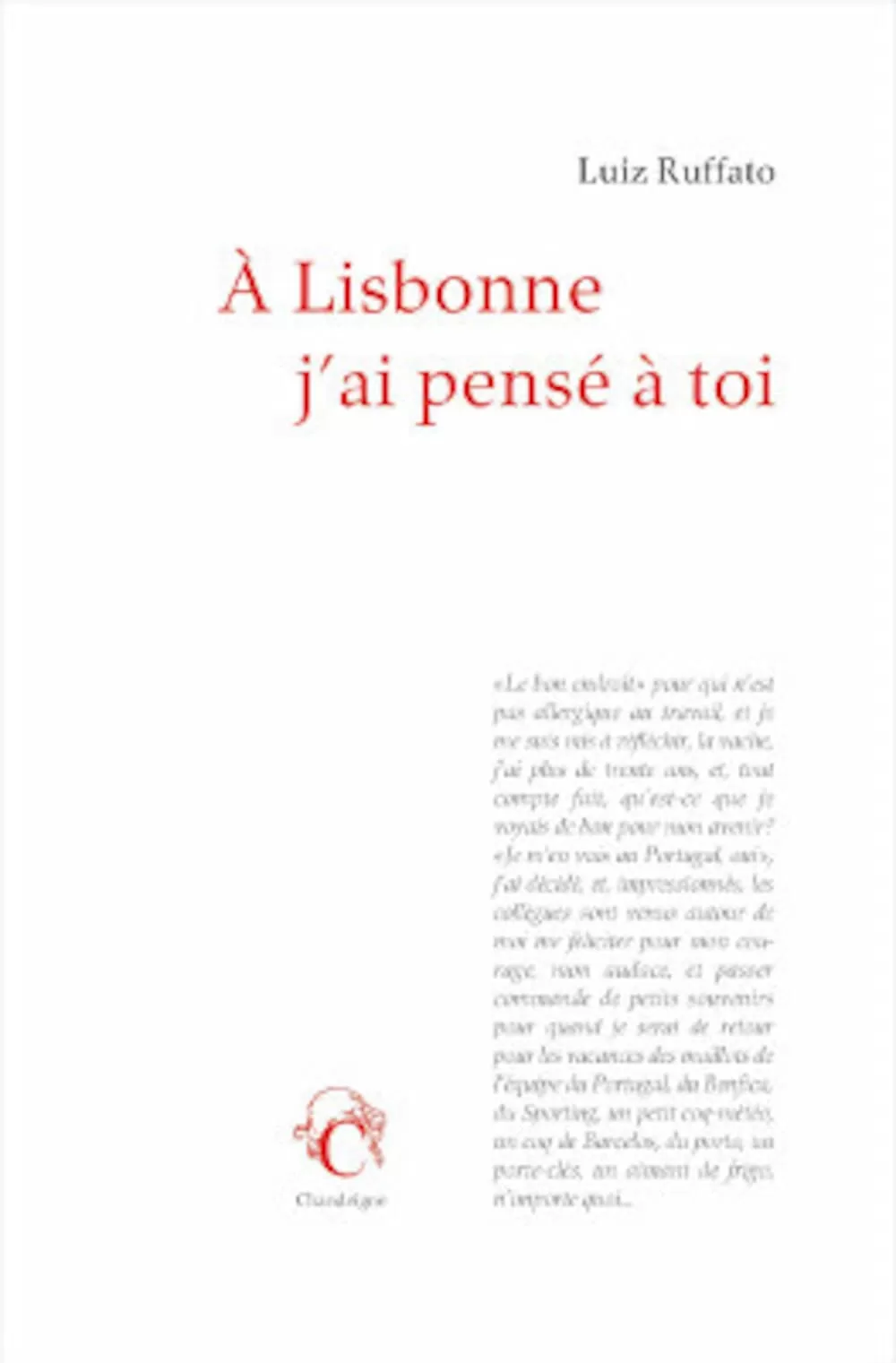
RUFFATO, Luiz. Estive em Lisboa e lembrei de você. São Paulo: Companhia das Letras, 2009.
Gabriel Estides Delgado
Translated by Dexter Angell
Ilustrated by Jamilly Starling
The front cover of the first edition of Estive em Lisboa e lembrei de você (I Went to Lisbon and Thought of You) includes a beautiful Barcelos cockerel printed onto a black background, done in the same style as the textured dotting used on the ornaments which depict the renowned cockerel. And just like what is commonly seen on Portuguese souvenirs, stylized hearts are found alongside the country’s symbol. It is a small novel—due to its size, we might call it a novella—by the celebrated writer from Minas Gerais, Luiz Ruffato (Cataguases, MG, 1961). This commercial and ostentatious characteristic of Estive em Lisboa e lembrei de você is no coincidence. The book is the finest product to come out of the publishing phenomenon which rocked Brazil’s literary market in the 2000s and 2010s. The “Amores Expressos” collection, bankrolled by Companhia das Letras and the producer Rodrigo Teixeira, sent off around the world 17 writers, the majority of whom were men and from Southeastern Brazil—the cause of great discomfort and instigator of public debates in the press—, to spend a month living in various foreign cities whilst developing what would be a love story inspired by their location. The prose, moreover, would have to maintain the characteristics of a script, making sure it could be easily adapted for cinema, namely: natural, conversational writing, lively dialogue, the structural composition of the text, and detailed stage directions.
This narrative formula alone—above all, when commissioned for an essentially commercial project—might achieve nothing more than inclusion in a creative writing manual. However, if executed flawlessly, as in Estive em Lisboa e lembrei de você, its success will still be dependent on finding magnetic content. The underlying theme of Ruffato’s work, which is already extensive and indispensable to a social and cultural understanding of contemporary Brazil, stands out prominently at this point: the profound decline of Brazilian industrialisation at the turn of the twenty-first century. A vital part of this process is the recurrent setting of his works in Cataguases, a small city in Minas Gerais which is the birth-place of the author and home to a thriving textile industry in the first half of the twentieth-century, whose decline would later lead to waves of migrants heading for larger urban centres.
This growth and shrinkage of the population of Cataguases, the consequences of which Ruffato continues to explore in his most recent books, finds an important turning point in the novella, which is worth noting. The fact is that Estive em Lisboa e lembrei de você, as we will see, stands out from the rest of the author’s work. In this ‘operetta’, his readers have the privilege of seeing just how far his style can go, imbued as it is with the Minas Gerais dialect “mineirês”, both folksy and melancholic, and also of observing a Ruffato free from the heavy burdens of the socially-conscious writer which weigh down his plots, never denying them the humour characteristic of all good literature, but rather preventing the constant mockery which, however, comes to light in Estive em Lisboa e lembrei de você.
The first picaresque exaggeration in the story concerns the basic plotline following the experiences of the protagonist. Serginho is a citizen of Cataguases who decides to emigrate to Portugal; strictly speaking, this is not really a tradition of the city or even the Zona da Mata region of Minas, which is more associated with local migration to Rio de Janeiro or São Paulo. The idea is extravagant, quixotic, outlandish, literary. In order to make it work, Ruffato’s solution fits the bill perfectly: he “hands over” the narration of the book to his character. The free-flowing first-person narration, the humorous ramblings, drawing on the very best that the Minas Gerais accent has to offer—in the finest tradition of Guimarães Rosa—facilitates the mockery inherent in this authorial style, which is somewhat unique in Ruffato’s oeuvre. Let us take a look at the moment Serginho first came up with the idea of migrating: (“I spent the rest of the week in a fluster, unable to sleep or eat properly, feeling off. On one hand, smiling my face off, I strutted up and down those same streets like a lord, with everyone fawning over me, Serginho this, Serginho that, Mr Serginho, doing everything except lying down on the ground for me to walk on them, but at the same time I was shitting bricks, not being much of a traveller, the only big cities I’d ever visited were Rio de Janeiro (five times, on day trips, to dip my toes in the sea at Copacabana, ride the cable car up Sugarloaf Mountain, and watch a Flamengo match at Maracanã stadium) and São Paulo (so Semíramis could buy clothes to resell), and Juiz de Fora too, but Juiz de Fora doesn’t count, it’s kind of Cataguases’s backyard, as well as Piúma, it’s become all the rage to spend New Year’s Eve on the beach there (…), entertaining myself playing card games in Pau-Morto square (because of the crowd of pensioners), chasing after single girls at the mall and the factory, devising ways to pimp my motorbike to show off when visiting relatives scattered across the grottos between Ubá and Viçosa (Senador Firmino, Presidente Bernardes, Dores do Turvo, Senhora de Oliveira), and now to set off for the far-off lands of Portugal, all on my own, oh my God!” [Editor’s Note: it is extremely difficult to capture in English all the character’s idiomatic expressions, slang and regional ‘accent’, despite the translator’s excellent efforts. Thanks to Gui Perdigão Murta for his help with mineirês!]
The book (which was indeed successfully adapted for cinema in 2015, as a feature film of the same name, by the Portuguese director José Barahona), takes the form of a statement made by Serginho, in Portugal, following a series of serious misadventures which culminate in the theft of his passport. The character ends up settling in Lisbon as an illegal immigrant—working mainly as a waiter—caught up in a long and ill-fated attempt to save up enough money for a successful return to Brazil, where his son is waiting for him. The novella is split into two parts: the first is entitled “How I quit smoking” and it tells of the hope inspired by the prospect of immigration as a reaction to unemployment in the interior of Minas Gerais—one of Brazil’s wealthiest states, it should be noted. The second part answers the criteria set out by the organisers of the “Amores Expressos” series and is set entirely in Lisbon. Due to the setbacks that thwart his aspirations of upward mobility, it is entitled “How I started smoking again”.
In a tangential sub-plot, Serginho meets Sheila, a fellow Brazilian immigrant from the city of Goiás, who, unable to find another job, ends up having to turn to prostitution, according to the somewhat clichéd and sexist plot choice made by Ruffato. Although perfectly plausible, given that the author’s characters are mostly poor or belong to the lower middle class, it is well known that portraying women as prostitutes in fiction is amongst the most commonly-used literary clichés despite also being one of the most limiting in terms of an artistic representation of reality.
The romance between them, although barely begun and ultimately unsuccessful, despite fitting neatly with the novella’s structure, functions merely as a fulfilment of the commercial demands of the series to which the book belongs, since, in my view, the novella’s poetic power derives from the migrant characters’ nostalgia for their place of origin, a nostalgia transposed into form, or rather, into living language—images of a variety of languages crafted expertly by the writer: “Senhor Seabra banged hard on the bedroom door before seven in the morning, I’d gone to bed late, worn out by the hustle and bustle at ‘O Lagar do Douro’ restaurant. I woke up groggy, my eyes stinging, ‘Senhor Sampaio, Senhor Sampaio’, he shouted, ‘Phone call’, I faltered, my legs weak with foreboding, I imagined the worst, death, sickness, a plea for money, one of those hassles, from someone back in Brazil. Stela knew the hotel’s number, Semíramis too, in case of emergency, but no one ever called, I transferred money to my sister-in-law’s account, religiously, an allowance to help Pierre or Noemi, at the Western Union office. There was only pittance left over to see me through the next four weeks, and, ever the economist, I was also saving up to buy some property in Cataguases, to guarantee myself a future”. This passage clearly expresses the chronic longing for home, the sadness known to be insurmountable, trapped in a reality of impossibilities all too often experienced.
As for reception and sales figures, thanks to the high quality of this and other titles in the collection—novels by Amílcar Bettega, Sérgio Sant’Anna and Bernardo Carvalho, to name some of the finest—, the “Amores Expressos” series has become a landmark in the history of contemporary Brazilian literature. Above all, it marks an important stage in the internationalization of Brazilian literature. Estive em Lisboa e lembrei de você is a prime example: not only was the film adaptation made by a Portuguese director, but the book’s translation rights were also extensively negotiated on the international market, resulting in translations into Spanish, Italian, French, German and Finnish. Ruffato’s success led to his selection as speaker at the opening of the 2013 Frankfurt Book Fair (the world’s largest publishing event), when Brazil was guest country. For a country and a language that have always, quite rightly, resented their appalling marginalisation and even invisibility on the international cultural stage, significant developments were beginning to take shape, with the help, believe it or not, of capital investment.
Further Reading
DELGADO, Gabriel Estides (2013). O depoimento como forma: leitura de Estive em Lisboa e lembrei de você, de Luiz Ruffato. Palimpsesto. Rio de Janeiro, n. 16, p. 1-17. Disponível em: https://www.e-publicacoes.uerj.br/index.php/palimpsesto/article/viewFile/34841/24614. Acesso em: 12 jan. 2023.
GUERINI, Andréia; AIRES, Leomaris (2017). Entrevista com Mathieu Dosse, Gian Luigi de Rosa e Michael Kegler – Tradutores de Luiz Ruffato em francês, italiano e alemão. Cadernos de Tradução, v. 37, n. 3, p. 406-245. Disponível em: https://periodicos.ufsc.br/index.php/traducao/article/view/2175-7968.2017v37n3p406/34864. Acesso em: 12 jan. 2023.
Iconography