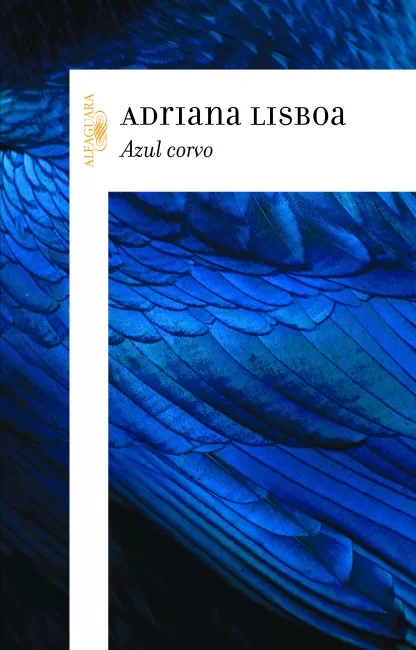
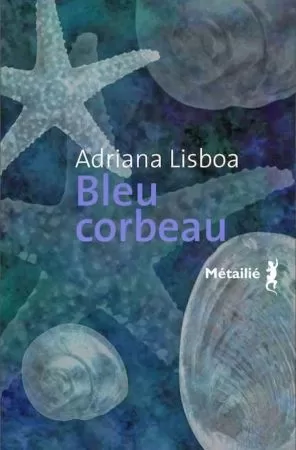
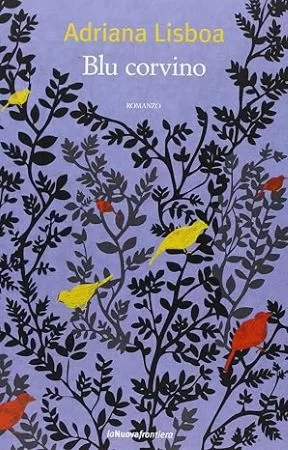
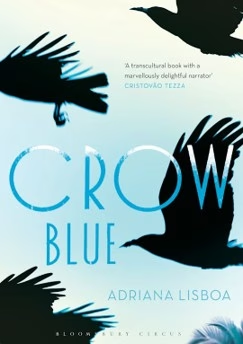
LISBOA, Adriana. Azul-corvo. Rio de Janeiro: Rocco, 2010.
Claudia Miranda da Silva Moura Franco
Translated by Kate Savage
Illustrated by Carolina Vigna
Human beings are, so to speak, filled with “what ifs”: a universe of possibilities that invades the mind at any possible moment. The literary critic Antonio Candido used to say that it is a trait of human nature to surrender to the imagined universe, and this, he argued, is the “driving force” of literature: the moment of displacement that is responsible for the creation of an idea, the recovery of a memory, the formation of a recollection. This could come in the form of a cathartic moment, an opportunity for the unconscious mind to make a noise in deafening silences, as in the case of narratives that explore the realm of totalitarian regimes and state repression, breaking the long silence that had for so long characterised the absence of social and political memory in Brazil.
It is exactly this breaking of silence that defines the writings of Adriana Lisboa (Rio de Janeiro, RJ, 1970), author of Azul-Corvo (2010) (Crow Blue, translated by Alison Entrekin, Bloomsbury, 2013). Adriana is also a poet, essayist and short-story writer, having published novels such as Sinfonia em branco (2001), Um beijo de colombina (2015), Rakushisha (2014), Hanói (2013) and Todos os santos (2019), as well as her poetry collections: Parte da paisagem (2014), Pequena música (2010), Deriva (2019) and O vivo (2021). She also wrote the essay Todo o tempo que existe (2022) and the short story Caligrafias de sucesso (2009). As well as Crow Blue, her first and third have been translated into English by Sarah Green, for Texas Tech University Press, with the respective titles Symphony in White (2010) and Hut of Fallen Persimmons (2011). Many of her works went on to win awards; however, it was with Azul-corvo that she received both national and international recognition.
The novel was first published by Rocco in 2010. The story harks back to the military dictatorship, focusing on the Araguaia Guerrilla Movement which was active in Southeastern Pará and Northern Goiás (a region also known as ‘Bico do Papagaio’ [The Parrot’s Beak], now in the state of Tocantins). The guerrilla fighters started to arrive in the region in around 1966, as it was considered to be a favourable location for armed conflict, as Ângelo Arroyo has suggested. Arroyo, a former guerrilla fighter who once led the Brazilian Communist Party, argued that the forested area would make an even battlefield because “the enemy cannot use tanks, artillery, aerial bombardment, etc. They have to be on foot like a guerrilla” (Arroyo, 1974, cited in Campos Filho, 2012, p. 108).
One of the defining features of contemporary Brazilian fiction has been its focus on past political events in the country and how they are (and can be) interpreted, and Crow Blue serves to document the Araguaia Guerrilla Movement, eliciting an immediate emotional response in the reader: “the triggers of the past awakening memory and activating all the machinery of recognition”. The novel also brings other stories and minor details to light, such as the erasure of the participation of black and female soldiers in the movement, as well as issues of gender, race, and even mixed-race identity and immigration. These themes offer reflections of a universal nature (“something hybrid and impure”), providing a space for discussion about what it is to be black or mixed-race both then and now.
Crow Blue is a story of losses and searches, but also of reunion, interwoven with episodes featuring countless discursive intersections that allow for an exploration of the fictional representation of historical events. As an intertextual example of a dual aesthetic nature, this novel draws on the factual as a means of creating fiction, in which traditional modes of literary narration intersect with contemporary ones. In this manner, the novel’s aesthetic aligns with that proposed by Rancière, for whom aesthetics “designates a mode of thought that develops with respect to things of art and that is concerned to show them to be things of thought” (Rancière, 2009, p. 11-12).
The story of Evangeline, nicknamed Vanja, resembles the story of many sons and daughters who grew up during the military dictatorship in Brazil, children who know very little about themselves and even less (if anything) about their parents lives in guerrilla struggles. They were the ones who stepped off the fence, took a side of history, and lost their lives because they believed in an ideal encapsulated by the lyrics of Me and Bobby McGee: “Freedom’s just another word for nothin’ left to lose. Nothing don’t mean nothing honey if it ain’t free, not now.” This is how we are introduced to Suzana, Vanja’s mother, a free-spirited woman (and a fan of Janis Joplin) who falls in love with Fernando, a former combatant in the Araguaia Guerrilla Movement.
After the death of her mother, thirteen-year-old Vanja, feeling lost and “in the middle of nowhere” embarks on a journey in search of her own roots. To do so, she must dive headfirst into the life story of her mother and the two men who played an important role in the choices she made. The narrative takes the reader from Rio de Janeiro to Lakewood, Colorado (USA), and to São João do Araguaia (in the state of Pará), portraying these borderland spaces as metaphors for a transition between past, present and future.
Genette (1979) addresses these repetition-related aspects of storytelling as literary devices that lend credibility to the narrative. In this case, the repetition of “crow-blue shells” becomes an element that encapsulates much of Vanja’s personality. The shell, functioning as a dwelling place, can be identified as a space that gives her a feeling of belonging; the colour blue, the most unearthly of colours, suggests emptiness through the sense of infinity it provides; and the crow can be interpreted through the symbolism of loneliness that surrounds it, first as a symbol of voluntary isolation and, on a deeper level, as a symbol of hope for tomorrow, since its godlike characteristics give it an almost divine quality.
The mention of the Marianne Moore poem ‘The Fish’, which reads: “through black jade. Of the crow-blue mussel-shells, one keeps / adjusting the ash-heaps”, reinforces the idea of meandering paths, and secrets that remain hidden.
Luigi Pareyson (1950), addressing the verisimilitude in Aristotle’s poetics, develops the idea of the happenable and the possible, creating a bridge between History (what has happened) and Poetry (what is possible). Literature draws on this in-between space to reveal everything that is possible or happenable, whether it has or has not occurred. In this case, although historiography contributes to the identification of historical episodes which did take place during the military dictatorship and the guerrilla struggle in the Amazon region, fiction is grounded in the narratives of those who are unaware of their own history. Vanja is the fictional version of many real-life sons, daughters, and relatives who live and die every day, in the uncertainty of not knowing the whereabouts of the bodies of their loved ones who were murdered during the dictatorship. Verisimilitude is anchored precisely in such liminalities of knowledge.
The narrative also touches upon another type of disappearance: that of the political history of Brazil, a nation that insists on rehashing the past in a distorted and often violent manner. The overlapping of past and present is the path along which the reader travels, reflecting on the impacts of yesterday. The lack of information and the need to construct memories make narrativizing an act of justice, since, as Ricoeur (2007, p101) has claimed, “the duty to do justice, through memories, to another than the self” can be grounded in the effects of forgetting as a catalyst for memory and history. As such, through the act of remembering, literature can be a means of reviving social memory, revealing the horror and violence of this period of history as an aesthetic experience. Vanja and her mother’s ex-husband, Fernando, a former guerrilla who fought in Araguaia, experience the “potential shadow of the past” and, in their own lives, the deviation between the events of their own personal stories, the knowledge of facts hitherto unknown to Vanja, and the certainty that “nothing is going to be the same as before”. Knowledge has a way of doing this: it allows us to plunge into immense abysses and discover our own history within someone else’s. To break the silence surrounding the country’s political history is to recover the memory of that period and to challenge the lack of answers and the silence regarding the countless bodies that are still unaccounted for.
What, then, is behind the absence of personal and social critical awareness of the dictatorship? The lack of memory, or the unwillingness to face it. From an aesthetic perspective, in Merleau-Ponty’s words, “Art is a personal apperception, which I embody in sensations and which I ask the understanding to organize into a painting” (p. 116). Is this lack of vision responsible for the invisibility of the death and violence perpetrated in this period? As such, art as a “process of expression” (p. 119) can make accessible “the spectacle in which most men take part without really seeing it and who makes it visible to the most ‘human’ among them” (p. 120). Perception is the action of seeking; Merleau-Ponty points out that depth is always new, it demands to be sought out, not just once in life but throughout one’s entire lifetime (p. 293). The more immersed people are in the search for a historical event and its repercussions, the closer they will become to discovering the “voids” in the landscape of their memories.
Further Reading
BRAUCKS, Noraci Cristiane Michel; BARZOTTO, Leoné Astride (2016). Mobilidades culturais em Azul-corvo, de Adriana Lisboa. Raído, v. 9, n. 20, p. 191-201.
CAMPOS FILHO, Romualdo Pessoa (1997). Guerrilha do Araguaia – Esquerda em Armas. Goiânia: Universidade Federal de Goiás.
GENETTE, Gérard (1979). Discurso da narrativa: ensaio de método. Tradução de Fernando Cabral Martins. Lisboa: Arcádia.
MERLEAU-PONTY, Maurice (2013). A dúvida de Cézanne. In: O olho e o espírito. Tradução de Paulo Neves e Maria Ermantina Galvão G. Pereira. São Paulo: Cosac & Naify.
PAREYSON, Luigi (1989). Os problemas da estética. São Paulo: Martins Fontes.
PIZZUTTI, Geovana Turella (2023). A memória coletiva em relação à protagonista na obra Azul-corvo, de Adriana Lisboa. Dissertação (Mestrado em Letras) – Universidade Estadual de Mato Grosso do Sul, Campo Grande.
RANCIÈRE, Jacques (2009). O inconsciente estético. São Paulo: 34.
REIS, Marina (2015). Identidade e pertencimento em Azul-corvo de Adriana Lisboa. Monografia (Bacharelado em Português) – Stockholms Universet, Estocolmo. Disponível em: https://www.divaportal.org/smash/get/diva2:848981/FULLTEXT01.pdf. Acesso: 05 mar. 2024.
RICŒUR, Paul (2007). A memória, a história, o esquecimento. Campinas: Editora da Unicamp.
Iconography