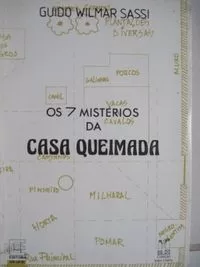
SASSI, Guido Wilmar. Os 7 mistérios da casa queimada. Florianópolis: Editora da UFSC, 1989.
Raul José Matos de Arruda Filho
Illustrated by Ruben Zacarias
Translated by Kennedy Moen
By the time Modernism arrived in Santa Catarina, the Brazilian movement was no longer considered modern. In 1947, the Círculo de Arte Moderna (later called Grupo Sul) established a late milestone. A significant part of this group of artists (writers, visual artists, actors, filmmakers) resided in Florianópolis or other nearby cities. However, Guido Wilmar Sassi (Lages, SC, 1922 – Rio de Janeiro, RJ, 2002) was an exception: as an employee of the Bank of Brazil at the time, he lived in the state’s interior.
Sassi was a restless writer who moved across various literary genres. Despite a significant part of his work being grounded in realism, he never stopped searching for universality. He hoped to produce literature that would exceed the limits of provincialism and transcend regionalism. Two of his collections of short stories, Piá published in 1953 and Amigo Velho (Old Friend) published in 1957, are considered essential in order to understand the fight for land and the complex relationship between highlanders (homem serrano) and the Araucaria angustifolia pine tree. However, the peak of his literary production was the 1964 novel Geração do deserto (Desert Generation). Geração do deserto was the first work of Brazilian literature focused on the Contestado War (1912-1916), a messianic conflict that occurred in Santa Catarina and Paraná. The novel was adapted for film in 1971 as A guerra dos pelados (The War of the Shaved Heads), directed by Silvio Back.
The 1989 novel Os 7 mistérios da casa queimada (The 7 Mysteries of the Burned House) differs significantly from the other books published by Sassi. It is set in the Santa Catarina Plateau during the first few decades of the 20th century, but it is not directly related to its rural setting. Following the trend of bourgeois narratives grounded in the conflicts of the privileged classes, the book presents the pharmacist Thiago Valtrichi’s dysfunctional family and agregados (people that live in another family’s house who have an ambiguous status that is neither that of a family member nor that of a servant) who live in the city of Gales (anagram of Lages).
Since this is a narrative that oscillates between reality and fiction, some speculative sources geographically place the Casa Velha (Old House), Casa Nova (New House), Casa de Trás (Back House), the orchard, and the surrounding buildings—such as the Casa dos Negros (House of Blacks), Puxado, and Puxadinho—in specific locations in Lages. The Reduto (the name given to a group of buildings), “a true agricultural estate (latifúndio) in the center of the city,” would possibly be located on the block between the current Hercílio Luz and Jorge Lacerda Streets, intersected on the right side by João de Castro Street. In the 1980s, the restaurant Restaurante Caravelle operated on the corner of the upper part of the building. However, this is uncertain: perhaps these are deceptive clues planted by the author to awaken curiosity in the reader.
Following this intermingling of fact and fiction, some figures from Lages’s public life are transported to the fictional Gales. For example, the famous Italian anarchist doctor Cesar Sartori (1867-1945) is cited multiple times. Etelvina, holding a copy of Alma cabocla in her hands, recalls the period in which Paulo Setúbal (1893-1937) lived in the region (1918-1919). The owner of the brothel, Davina Bico Preto—also called Mãe Davina—evokes Teresa Bicuda, someone well known in the area of prostitution in the 1970s and 1980s. At this intersection between real and imagined, between history and fiction, the novel weaves a portrait of the city’s social life.
The book is divided into seven chapters, each one addressing a so-called mystery (which is more a series of events), with some divided into numbered subchapters. A third-person omniscient narrator alternates the narration with Carlos Alberto Valtrichi, known as Betinho, one of Thiago Valtrichi’s sons. The basic storyline centers around a great catastrophe: the fire at the Reduto. Nevertheless, before the cause of the misfortune is clarified, a myriad of parallel stories are added, many engaging with classics from world literature. Notably, Simeão Valtrichi, upon looking in the mirror, imagines seeing Edmond Dantés (The Count of Monte Cristo, by Alexandre Dumas), but his attachment to money brings him closer to Harpagon (The Miser, by Molière). The nail brought by Basilissa from the Holy Land alludes to an event from The Relic (Eça de Queiroz).The forbidden love between Valentim and Veridiana touches on Romeo and Juliet and Othello (both by William Shakespeare). Nonetheless, these references do not cause estrangement, as the novel is full of literary and cinematic quotations.
In Betinho’s opinion, “life is a melodrama, a feuilleton full of mystery.” The descriptions of some incidents involving his family substantiate this claim. Maria de Fátima, known as Fatiminha, after the death of her husband, plunges into prostitution. Every time something out of his control occurs, Thiago begins to tear paper. This compulsive behavior constitutes a protective wall against the horrors imposed by reality. Another form of distancing is evident in the transformation of the fearful boy. To his father Coronel Toninho Valtrich’s horror, after his teenage years, Luís Valtrich, or Lula, adopts integralist fascism.
The story takes on a comic opera tone in the love affair between Etelvina and the pharmacist Conrado Mansutti, culminating in the discovery that he sabotaged the reproduction of flower seedlings to eliminate competition in the planting of violets and pansies. To prevent the bride from obtaining undeserved inheritance rights, the marriage contract between Amantino and Veridiana stipulated children. This created an impossible situation; the old man had orchitis at some point in his life, and as a result became sterile. Regardless, his wife became pregnant. When the child was born, shock was evident and eliminated any possibility of accessing economic benefits. Another grotesque occurrence is the death of Raquel, who was impregnated by an unknown man and found hanged, which, in the official version, was deemed a suicide. In the context of the novel, prejudice determines the future of the characters and prevents forgiveness for those who break the most fundamental rules in a world that, due to moral issues regarding female behavior, evokes the colonization of the Santa Catarina Plateau in the 18th century.
His novel encompasses three or four decades and various generations. In this period of time, progress is made slowly in Gales. Nonetheless, in the transition from candles and lanterns to electric light, modernity altered customs and habits in the city. But it was not enough. Superstition, exacerbated Christianity, uncontrolled sexuality, the hypocrisy of the middle class, and intrafamilial violence, among others, are elements that distinguish the text. Seeing as Sassi was a pessimistic writer who did not believe in redemption or the joy of being alive, none of the characters that appear in Os 7 mistérios da casa queimada manage to escape their tragic fates, which are predetermined from the very first page of the novel.
After much speculation about the cause of the fire that destroyed Reduto (including the precarious power cord from the electrical energy, the nervous breakdown of some of the characters, and some kind of vengeance), only on the final page does the answer come to light: “A strong gust of wind violently slams the door. The displacement of wind causes the cooker to fall and roll onto the pile of paper.”
Further Reading
RICCIARDI, Giovanni (1992). Os 7 mistérios da casa queimada: uma leitura. In: SOARES, Iaponan; MIGUEL, Salim. Guido Wilmar Sassi: literatura e cidadania. Florianópolis: Editora da UFSC. p. 113-125.
Iconography