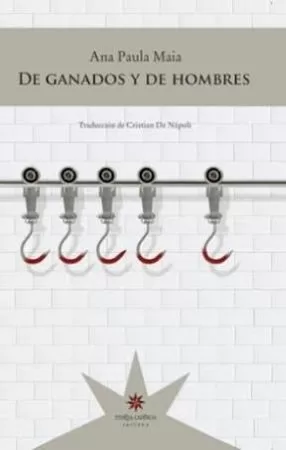
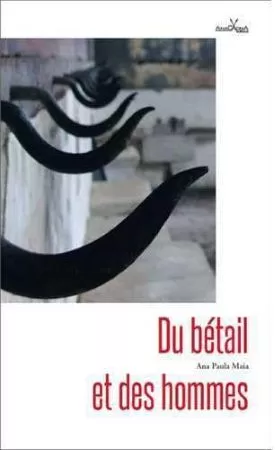
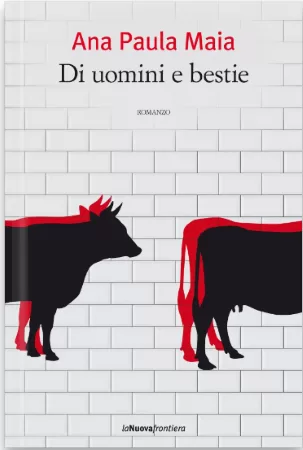
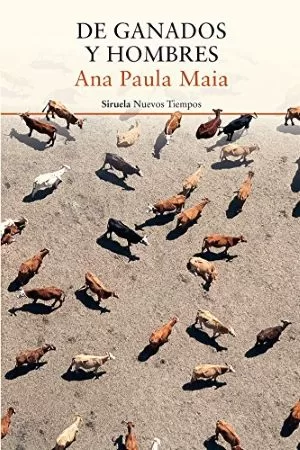
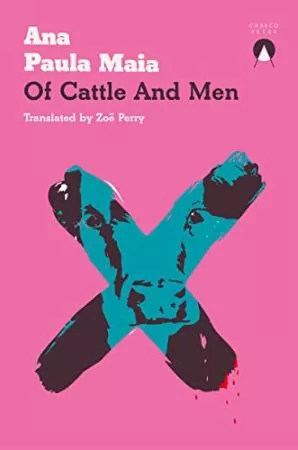
MAIA, Ana Paula. De gados e homens. Rio de Janeiro: Record, 2013.
Juliana Florentino Hampel
Illustrated by Moreno Lago
Translated by Leila Santos
Ana Paula Maia (Nova Iguaçu, RJ, 1977) is a writer and screenwriter who debuted on the literary scene with O habitante das falhas subterrâneas (2003), published by 7 Letras. In 2007, she published her second novel, A guerra dos bastardos, in which a character named Edgar Wilson first appears, a rough laborer who becomes part of the violent, desolate setting of her subsequent stories. Entre rinhas de cachorros e porcos abatidos and O trabalho sujo dos outros are two novellas published together by Record in 2009, in which striking characteristics of her writing stand out, such as the narrative style that closely resembles a television series, with a discourse driven by action and constant movement. With “Carvão animal (2011), the author ends the trilogy, known as “A saga dos brutos” and characterized by concise, direct writing that centers on death, approached “with a poignant aesthetic centered on remains and ruins” (Neves and Zolin, 2021). The first two were published in English translation with these respective titles: On Earth As it is Beneath, translated by Padma Viswanatha, Charco Press 2025 and the Saga of Brutes trilogy, translated by Alexandra Joy Forman, Dalkey Archive Press 2016.
Published in 2013, De gados e homens (Of Cattle and Men, translated by Zoë Perry, Charco Press, 2013) is Maia’s fifth novel, and features Edgar Wilson working as cattle stunner at a beef slaughterhouse. According to the author herself, the idea for the book was inspired by her personal observation of the workings of a butcher shop near her home, where she witnessed the daily unloading of animal carcasses and people’s unrestrained consumption of meat. To write about the subject, Maia says she visited animal slaughterhouses in small rural cities, where she sought to observe and understand the work carried out there.
The story is set in the slaughterhouse Touro do Milo, located in the Vale dos Ruminantes (Valley of the Ruminants), situated in some distant, rural corner. There, Edgar Wilson lives and works alongside Bronco Gil, the ranch foreman who also appears in the author’s other books. Wilson’s daily routine consists of slaughtering as many animals as possible because in the slaughterhouse, “the work is endless [and] as long as there’s a cow in this world, there will be a man keen to kill it. And another keen to eat it” (Maia, 2013, trans. Perry). What distinguishes him, however, is his method of preparing the animal for death. He believes he does not cause suffering because he performs a kind of ritual prior to the slaughter. In fact, he “cares about ordaining the souls of each ruminant that crosses his path” (Maia, 2013, trans. Perry). In this process, he believes himself to be the most competent: “His precision is a rare talent that bears a preternatural knowledge for handling ruminants” (Maia, 2013, trans. Perry). He takes no pride in the work he does and says, “he’s not proud of what he does, but if someone has to do it, then let it be him, who has pity on those irrational beasts” (Maia, 2013, trans. Perry).
From a narrative perspective, the story employs a clinical tone, stemming from a focus on the inner workings of the slaughterhouse. The visual aspect of the work aims to explore reality in its fullest expression, reaching “the hard and authentic core of events” (Neves and Zolin, 2021), using the present tense, typical of film scripts, and creating a cinematic discourse in which obscenely violent scenes are portrayed via a scientific aesthetic (Aguiar, 2022).
In Of Cattle and Men, the theme of the beastialization of men in contrast to the humanization of animals is presented through scenes in which the killing of a person can be carried out with the same technique used to slaughter animals and, contradictorily, with even greater cruelty. This is how Edgar Wilson eliminates his co-worker Zeca, believing that Zeca takes pleasure in witnessing the suffering of the cattle killed on the farm, acting “with the same efficiency as his work, [but] without the compassion shown to the cattle” (Coelho, 2022).
Contact with the animal remains, that which is no longer useful to society, and with ruins, represented by the decrepitude of a world in which everything is rotten, exposes deteriorated spaces and bodies. The plot reveals to the reader a brutalized world in which labor exploitation and the productivist logic of the market reign. This reality is represented through a raw language that borders on realism and naturalism, in a hybrid form that refers back to the crime novel genre. The evil presented is banal, and the violence is present in the very work itself, in the practical life and leisure of the characters: “The man holds his breath and plunges his head into a water barrel. At first, the others stand around making jokes. They laugh. When a minute passes, they gradually fall silent until only the hum of the blowflies that feed on the remains of dead cattle is left. […] Nineteen seconds later, Burunga’s head emerges, purple from lack of oxygen” (Maia, 2013, trans. Perry). He does this because he is in “[need] of money, he needs to get some glasses for his daughter” (Maia, 2013, trans. Perry).
Furthermore, the criminality depicted in the plot is associated with the state’s inefficiency in guaranteeing the safety of its citizens, who forge their identities in a brutalized manner based on this ineffectiveness of public security, which operates through a system of cronyism and neglect. The silence of perpetrators and witnesses reigns in the face of an inefficient and disinterested police force (Kill and Guizo, 2020). As André Aguiar (2022) states, “violence is the theme and the abject is the form” in Maia’s work. It is a violence generated by the very system to which these exploited men are subjected, abandoned to their own fate and forced to create their own rules of survival, exposing a world of aggressive relationships mediated much more by knives or firearms than by words.
Because of this, the narrative draws a parallel between the behaviors and spaces of men and animals. The Touro do Milo lodging where Edgar Wilson lives with the other workers who do not have families is similar to the corral reserved for the cattle: “Two enclosures, one for cattle and one for men, stand side by side. Sometimes the smell is familiar. Only the voices on one side and the mooing on the other distinguish the men from the ruminants” (Maia, 2013, trans. Perry). A barbarized universe in which “animal and human[differences] are usurped by biopolitical technologies of separation, containment, and capitalization” (Neves and Zolin, 2021) and in which an experience of reality is offered that is explicit and obscene, highlighting the processes of human and animal objectification.
In Of Cattle and Men, the reader encounters continuous forms of human and animal exploitation within an economic rationality that prepares them to be both commodities and a labor force. Thus, living and dying are occurrences that do not interrupt the production line of bodily transformation: “Two weeks after Burunga’s accidental death, it’s as if he had never been there. One of the butchering employees who had some experience on the job was placed in his role, and the work on the dressing line was shared among others. Just as cattle resemble one another, the same seems to happen with men. It’s difficult to tell them apart. The march of time is like the march of death: it cannot be stopped.”(Maia, 2013, trans. Perry). Burunga dies electrocuted by an eel that had been placed in the water barrel where he held his breath during bets. It is an accident caused by the new stunner, Santiago, who “just wanted to keep the eel as a pet” (Maia, 2013, trans. Perry).
The climax of the narrative momentarily suspends the mechanical routine of the slaughterhouse when, for reasons unknown, the cows begin to commit suicide. In three separate episodes, the ruminants break through the corral fences and run headlong toward a precipice, throwing themselves off and falling onto the banks of the Rio das Moscas (River of Flies). Edgar Wilson reflects that, “In those places where blood mixes with soil and water, it’s difficult to make any sort of distinction between man and animal” (Maia, 2013, trans. Perry). The oxen begin to make decisions that do not correspond to those of “irrational” beings, as they are perceived by the workers. However, the novel presents the episode without any further questioning from the narrator or the characters, who are resigned and unable to alter reality.
Death, in this way, is presented in its most varied forms, and, especially, as food for the miserable people who live in the vicinity of the slaughterhouses, and for the workers themselves, who, on certain occasions, manage to consume the hamburgers produced by the factory that is supplied by the slaughterhouses. “Nearly an hour later, Tonho dumps a sack of fat pieces of cow at the women’s feet for them to contend with the pack of hungry dogs that circle the slaughterhouse whenever the crematorium furnace is lit” (Maia, 2013, trans. Perry). In another scene, Edgar Wilson eats a hamburger for the first time with his colleagues, a food that, “Round and seasoned like that, they don’t even look like they had ever been a cow. Not one glimpse of the unbridled horror behind something so tender and delicious” (Maia, 2013, trans. Perry).
Maia’s prose ultimately leaves the reader with the vision of a universe degraded by capitalism, in which life and death are intertwined because they are complementary parts of the system that allow it to function fully. Death permeates all of nature: in the flowers, made redder by feeding on the blood of the Rio das Moscas (River of Flies); in the region’s misery, which brings hunger and dehumanizes people; and in the degrading conditions of the workers, who earn pennies for each head of cattle slaughtered. In Of Cattle and Men, it becomes evident that capitalism itself pollutes everything, from nature to human and animal relations. This movement must, therefore, be regarded with a degree of suspicion, since there seems to be no way out, or at least none offered by the narrative.
Further Reading
AGUIAR, André Luiz Godinho (2022). Paisagens, animais e homens em Ana Paula Maia. Dissertação (Mestrado em Letras) – Universidade Federal de Viçosa, Viçosa.
COELHO, Paulo Vítor (2022). A agonia de gados e homens e o real saturado em um romance de Ana Paula Maia. In: LIMA, Gabriel dos Santos (Org.) Estudos do Romance Brasileiro no Século XXI. Porto Alegre, RS: Editora Fi, p. 98-120.
KILL, Diego; GUIZZO, Antônio Rediver (2020). O abatedouro e os abatidos de Ana Paula Maia: um estudo das representações da violência em De gados e homens. Olho d’água, São José do Rio Preto, 12(2), p. 201-214, jun-dez.
NEVES, L. de A.; ZOLIN, L. O (2021). Ana Paula Maia e a literatura de autoria feminina: mulheres no seu (in)devido lugar. Estudos de Literatura Brasileira Contemporânea, (62), p. 1-13. Disponível em: https://periodicos.unb.br/index.php/estudos/article/view/37471. Acesso em: 28 maio 2024.
OLIVEIRA, Andria da Silva (2020) O olhar que transcende os olhos: De gados e homens, de Ana Paula Maia. Revista Alere, ano 14, vol. 22, n. 2, jul, p. 55-69.
Iconography