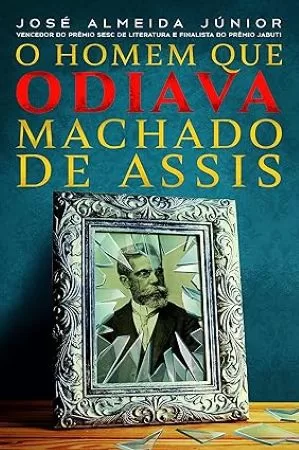
ALMEIDA JÚNIOR, José. O homem que odiava Machado de Assis. São Paulo: Faro, 2019.
Samara Lima
Illustrated by Daniela Versiani
Translated by Kennedy Moen
The author, José Almeida Júnior (Mossoró, RN, 1983), who is currently a public defender for the Federal District, has distinguished himself in the field of literature with his novels that seek to use History as a setting for the practice of fiction. His first book, Última hora (Last Hour), came out in 2017 and won the Sesc de Literatura Prize that same year. In it, the author presents Brazil in the early 1950s to narrate the conflict between Carlos Lacerda and Samuel Wainer, with Marcos, a journalist who was tortured during the dictatorship, as the protagonist. This dilemma is revisited in his most recent publication, from 2022, Bebida amarga (Bitter Drink), which addresses the political divergences and familial conflicts between a father and son during the military dictatorship.
O homem que odiava Machado de Assis (The Man Who Hated Machado de Assis), published in 2019 by Faro Editorial, is the author’s second book. Set in 19th century São Paulo, Portugal, and Rio de Janeiro, it is narrated in the first person by Pedro Junqueira. The story begins with Machado de Assis’s wake, where a profoundly troubled Junqueira analyzes the ceremony from the Taverna do Ferreira, a tavern located a few meters away from the event. He is surprised by the general consternation—Mário de Alencar, for example, “was in tears,” while José Veríssimo tried to console him—surrounding the death of someone he considered a frivolous individual who built his reputation “on the basis of fraud and flattery” (Almeida Júnior, 2019). Another person who also does not understand people’s reverence towards the intellectual is Sílvio Romero, who soon joins the character, inflating his spiteful comments about the funeral and encouraging him to write a memoir in order to reveal the little-known truth about the Brazilian author. The book that the reader has in hand is, therefore, an autobiography of sorts about Junqueira.
Over the course of 33 chapters, it becomes obvious that the protagonist has much to say about Machado. The rivalry between the two characters begins at childhood, when Pedro, orphaned at the age of six after the death of his mother, must move out of São Paulo. His father, a prominent coffee grower and slave owner, as well as a man alienated from his parental obligations, decides to send Pedro to live with his aunt Maria José in Morro do Livramento, Rio de Janeiro. It is in this small country house that the boy meets Joaquim and Joana, both Black and agregados, people that live in another family’s house who have an ambiguous status that is neither that of a family member nor that of a servant. As they spend more time together, the conflicts between them intensify, especially when the two boys both fall in love with the same girl.
When Maria José dies, Junqueira is sent to boarding school. He later travels to Portugal to study Law, where he has a brief relationship with a woman named Carolina Novais. After years of receiving no communication from Joana and Joaquim—who, at the height of his literary career, becomes known by his surname, Machado de Assis—Junqueira returns to Brazil and reunites with his old childhood friend, who is now married to Carolina. This reunion revives the tension between the two men and gives new life to old hatred.
But, the conflict between the two does not end in the realm of love. At one point in the story, the narrator comments that Machado de Assis plagiarized his “idea of writing a novel with a deceased author that shamelessly narrates his life” (Almeida Júnior, 2019). Junqueira, who wants to publish a novel and believes himself superior to Machado, while simultaneously failing in his political career, once again feels wronged.
In an interview for the channel Conversa Literária, José Almeida points out consistencies between his book and Machado de Assis’s works, stories, and crônicas. The seductive character of Joana is inspired by Capitu, just as the love triangle between Carolina, Machado, and Pedro evokes the conflict in the book Dom Casmurro. Pedro has a similar personal journey to that of Brás Cubas, since he belongs to the aristocracy, studied in Coimbra, and is a failure in his profession and in his romantic relationships. Regarding the description of Morro do Livramento, the author states that it was taken from the novel Casa Velha (Old House).
Along with these references, the story incorporates a variety of biographical details about Machado de Assis: the death of his 4-year-old sister from measles; the reference to his work for the newspapers A Marmota and O Diário Oficial, as a contributor of poems, crônicas, and reviews; the mention of the publication of the writer’s books, such as Ressurreição (Resurrection), Memórias póstumas de Brás Cubas (The Posthumous Memoirs of Brás Cubas), and Dom Casmurro; his stutter and epilepsy; his relationship with the Portuguese woman Carolina Novais; the conflict with the critic Sílvio Romero and his peers, specifically due to the accusation that “Machado, despite being mixed-race (mulato), was never interested in the topic” (Almeida Júnior, 2019) of abolitionism; and many other easily verifiable events that make up the author’s biography.
Regarding the question of Machado’s racial background, the writer himself responds to the complaints, affirming that he combats abolition in his own way: “the meanness (mesquinhez) of slavery is in my novels, my stories, and my crônicas. Anyone with the slightest discernment can see that” (Almeida Júnior, 2019). When thinking about Machado the civil servant, one cannot forget the work of the many researchers, like Eduardo de Assis Duarte, in their attempts to show how Machado circumvented the established ideas of the country during his lifetime to depict the ills of 19th-century society in his works. Thus, the book also engages with critical reinterpretations of Machado de Assis’s relationship with his ethnicity, not just narratively, but through the image that appears on the book’s cover as well, the same one used by the “Real Machado de Assis” campaign. Upon restoring the “Blackness” of the author, the white-washing of his image is combated.
José Almeida takes advantage of the resentment towards his protagonist, which transforms Machado de Assis into an anti-hero, to retrace the writer’s biography. In this sense, one of the book’s strengths is precisely its ability to transform the real author into a fictional character, blending biographical information about Machado, characteristics of his works, and literary devices such as humor and irony. Furthermore, the book incorporates important events and literary figures of the 19th century to drive the plot. A few years earlier, Silviano Santiago also explored the conjunction between fiction and biography in his novel Machado (2016). Unlike Almeida’s novel, Santiago puts faith in a greater blurring of the lines between literature and life, projecting himself into the narrative and engaging in critical digressions about the writer’s work. The comparison serves to highlight Almeida’s ability to manage biographical information and historical facts and the way he blends both with certain traits of Machado de Assis’s poetics to enhance the fiction that is based on Junqueira’s memories. Even though Almeida utilizes research about the past to gather information for his stories, he makes an effort to give life and new meaning to that same past.
Further Reading
ALMEIDA JÚNIOR, José (2017). Conversa Literária. [Entrevista concedida a] Darwin Oliveira. Fortaleza, 17 set 2017. Disponível em: https://www.youtube.com/watch?v=klo8u138_EE. Acesso em: 12 jul. 2024.
ALMEIDA JÚNIOR, José (2019). Entrevista com o romancista histórico José Almeida Junior, autor dos romances Última hora e O homem que odiava Machado de Assis. Encontro na Livraria Cultura – Casa Shopping – Brasília – DF, no dia 25 de junho de 2019. Concedida ao pesquisador Cristiano Mello de Oliveira (Doutor em Literatura Brasileira – UFSC). Rascunhos Culturais, Universidade Federal de Mato Grosso do Sul, Coxim, v. 1, n. 1, p. 134-146.
ESTEVES, Antônio Roberto (2008). Considerações sobre o Romance Histórico (no Brasil, no limiar do século XXI). Revista de Literatura, História e Memória, Narrativas de Extração Histórica, Cascavel, v. 4, n. 4, p. 53-66.
SANTIAGO, Silviano (2016). Machado. São Paulo: Companhia das Letras.
Iconography