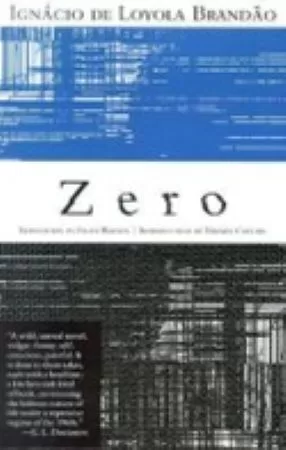
BRANDÃO, Ignácio de Loyola. Zero. Rio de Janeiro: Brasília, 1975.
Sandra Reimão
Illustrated by Théo Crisóstomo
Translated by Svea Morrell
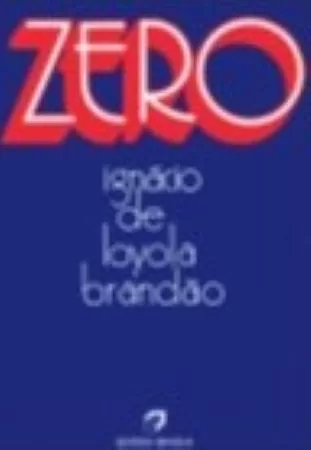
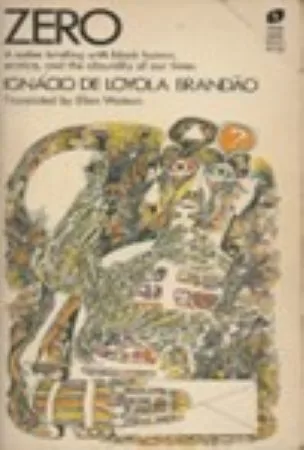
The novel Zero (translated by Ellen Watson, Dalkey Archive Press) by Ignácio de Loyola Brandão (Araraquara, SP, 1936), was first published in Brazil in 1975 by Editora Brasília, a small publisher based in Rio de Janeiro. The same publisher soon released a second edition.
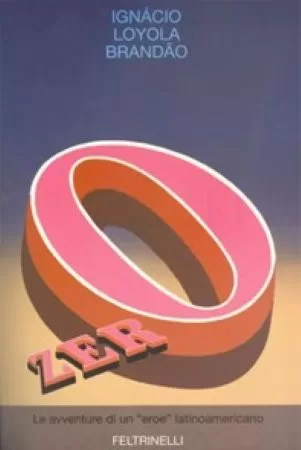
Before this Brazilian edition, there was a 1974 Italian edition published by Feltrinelli Editore, in Milan. The decision to initially publish the work overseas was due to publishers’ fears that it would be censored in Brazil. This fear was justifiable, as the country was living under a military dictatorship (1964-1985), and the central theme of the narrative can be described as an imaginary representation of authoritarian state violence against common citizens.
The narrative of Zero is introduced, in its subtitle, as a “prehistoric novel,” and the text anticipates the new future in the imaginary country of “América Latíndia”— a nation that becomes, over the course of the text, increasingly irrational, absurd, brutal, and violent. The protagonist José, a simple mouse exterminator working in a dingy movie theater, maintains a troubled and tense relationship with his girlfriend/wife, Rosa. Throughout the narrative, his basic rights are disrespected and violated daily by the authoritarian state of this fictional country and, finally, he finds himself involved in events he cannot comprehend.
Zero is fragmented, both in the narrative and graphics. There are pages with three or four subtitles in capital letters, others divided with vertical lines; in addition, there are lists of items, copies of product lists from stores, tickets, lists of random symbols, drawings, and allusions to recent events that occurred in the country. Brandão himself, in many interviews, highlighted the origin of some of these fragments, stating: “Zero was also born from censorship. I was a secretary at the newspaper […] and then I started throwing the first forbidden things in the drawer […] everything that is there is real, and it is Brazil, and then I said you could write a novel about this, you could create a novel”.
In analyzing the fragmented character of Zero’s narrative, Heloisa Buarque de Hollanda and Marcos Augusto Gonçalves point out that “Zero, at first, manifests itself as a great allegory of the violated and fragmented state of a country that still awaits its history […] the use of fragments […] promotes a shattering of the naturalistic perspective of the newspaper”. Finally, the authors highlight that “the technique of fragmentation here translates the disintegration produced by the climate of oppression that accompanies Loyola’s narrative at all times”.
In November of 1976, Zero was censored by the Ministry of Justice, which ordered the seizure of its copies under the allegation that the book was “contrary to morality and good behavior”. In practice, as happened with various other books, this seizure did not actually happen, and the novel sold around 6.000 copies during that time.
Censorship of books during the Brazilian military dictatorship can be divided into two periods: from 1964 to 1968, that is, between the 1964 military coup and the enactment of Institutional Act Number 5 (AI-5), and the period after the AI-5 decree. In the first period, the censorship of books in Brazil was characterized by a lack of clear criteria, with police raids, seizures, confiscations, and physical coercion. In April of 1965, a new building for the Federal Department of Public Security was erected in Brasília, where the Division of Censorship of Public Entertainment (DCDP) would operate, showing the government’s intentions to centralize censorship. When AI-5 was decreed, censorship activities were already centralized in the Ministry of Justice.
The enactment of AI-5 made it possible to revoke mandates, suspend political rights and individual guarantees, in addition to creating conditions for the censorship of the dissemination of information, the expression of opinions, and cultural and artistic productions. This period was known as the “lead years”, or, in Elio Gaspari’s words, the “blatant dictatorship.”
According to estimates by Zuenir Ventura, during the ten years that AI-5 was valid (from December 13, 1968 to December 31, 1978), 1.607 citizens were directly punished, whether it was through impeachment, suspension of political rights, imprisonment, or removal from public service. In the field of artistic and cultural production, still according to Ventura, censored items included approximately 500 films, 450 plays, 200 books, dozens of radio programs, 100 magazines, more than 500 song lyrics, and a dozen telenovela episodes.
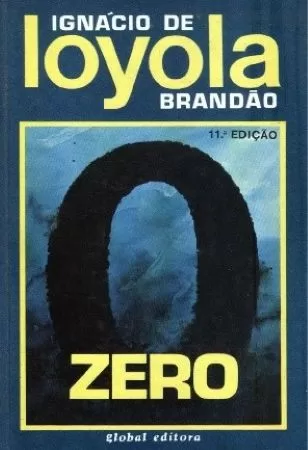
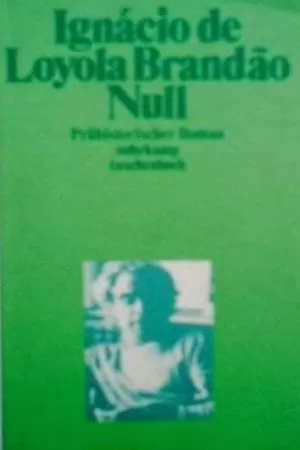
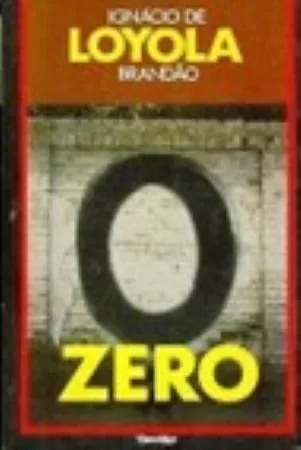
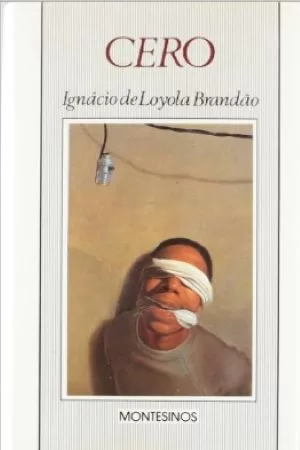
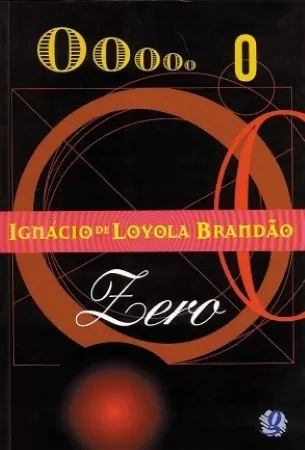
In 1979, after AI-5 ended, the third through eighth editions of Zero were published by Editora Codecri. Starting in 1984, it was published by Global. The book has been translated into various languages, including German, Korean, Spanish, Hungarian, and English.
Ignácio de Loyola Brandão has published 45 books and received the Jabuti and National Library awards for his children’s book O menino que vendia palavras (The Boy Who Sold Words), from 2007. He is a member of the Brazilian Academy of Letters (ABL). Zero is the fifth book published by the author.
Zero is part of a literature characterized by experimentalism and resistance that emerged in Brazil during the 1970s. Especially in the middle years of this decade, national literary production, created in the heat of the moment, had a central role in contesting and resisting the regime. To illustrate its relevance, innovation, and impact, it is worth highlighting some of the best-selling books in Brazil between 1975 and 1976: Fazenda modelo, by Chico Buarque de Hollanda; Gabriela, cravo e canela (Gabriela, Clove and Cinnamon, translated by James L. Taylor and William L. Grossman, Alfred A. Knopf, New York), by Jorge Amado; As meninas (The Girl in the Photograph translated by Margaret A Neves, Avon Books), by Lygia Fagundes Telles; Dôra, Doralina (translated by Dorothy Scott Loos, Avon Books), by Raquel de Queiroz; De notícias e não notícias, by Carlos Drummond de Andrade; Leão de chácara, by João Antônio; Solo de clarineta, by Érico Veríssimo; A travessia da via crucis, by Carlos Eduardo Novaes; Gota d’água, by Chico Buarque de Hollanda and Paulo Pontes; and Feliz ano novo, by Rubem Fonseca.
Further Reading
LAVORATI, Carla (2015). Ditadura e violência em Zero, de Ignacio de Loyola Brandão: a literatura como resistência ao silenciamento. Literatura e Autoritarismo, Santa Maria, n. 14, p. 41-50. Disponível em: https://periodicos.ufsm.br/LA/article/view/18511. Acesso em: 20 dez. 2024.
LIMA, Marcos Hidemi (2012). Zero: uma alegoria do Brasil. Signótica, Goiânia, v. 24, n. 1, p. 87-101. Disponível em: https://revistas.ufg.br/sig/article/view/15013. Acesso em: 20 dez. 2024.
OLIVEIRA, Joaquim Adelino Dantas de (2017). A literatura com a tesoura na mão: sobre Brandão, Burroughs e Gysin. Estudos de Literatura Brasileira Contemporânea, Brasília, n. 50, p. 488-512. Disponível em: https://periodicos.unb.br/index.php/estudos/article/view/10191. Acesso em: 20 dez. 2024.
Iconography