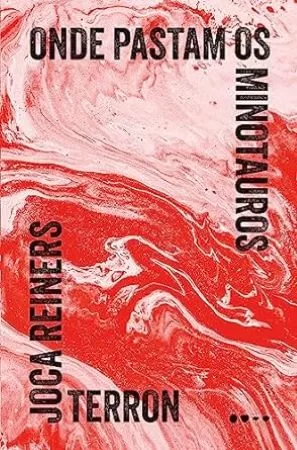
TERRON, Joca Reiners. Onde pastam os minotauros. São Paulo: Todavia, 2023.
Breno Kümmel
Illustrated by Manuela Dib
Translated by Svea Morrell
Joca Reiners Terron (Cuiabá, MT, 1968), originally from Mato Grosso and a decades-long resident of São Paulo, has a voluminous literary output. Beyond his eight novels, he has also published two short-story collections and five poetry collections since the start of his career in 1998. His books frequently operate under a fairly flexible understanding of plausibility, with elements of fantasy and surrealism, which are relatively uncommon in Brazilian literature. He explores both scatological and eschatological themes, spanning from bodily excrement to theological doctrine that studies the apocalypse.
As would be expected given Terron’s literary trajectory, his eighth novel, Onde pastam os minotauros (Where the Minotaurs Graze), is characterized not by a strictly realist or expository style that seeks to account for a supposedly complete or faithful portrayal of unvarnished reality. Instead, it is characterized by an essentially expressionistic style, with features characterized simultaneously by exaggeration and subtlety of language, creating a sense of constant, suffocating, and inescapable oppression.
The story takes place during the end of the year in a slaughterhouse in the middle of Mato Grosso. This slaughterhouse produces halal meat, which is shipped to Muslim countries. Here, the animals are slaughtered according to Islamic rules, with their heads turned towards Mecca. Aside from the common misery, low salaries, exhausting work, and the reality of constantly killing innocent animals, the characters also experience the tension of an imminent mass layoff, as the Brazilian workforce is replaced by a foreign Muslim workforce.
If life under the yoke of a poorly paid and demanding job is already in itself a barely tolerable type of suffering, the alternative would be to join the crowd of ragged people who live outside of the slaughterhouse, begging for rejected scraps and bones to appease their hunger. It is as if the characters live in a delicate balance on the edge of the abyss, with a constant view of decline and not one glimmer of hope for improvement.
This is one of those rare Brazilian novels that focuses mainly on the reality of labor. Although the book discusses the act of slaughter in detail, this occurs in a way that is far removed from a more instructive type of realism that is reminiscent of proletarian novels of the 1930s, with their old-fashioned way of instructing the reader about a reality they would need to understand in order to face. Instead, the plot is full of thick symbolic density, so that even a phrase that transparently describes an action earns the weight of an enigmatic allegory.
Although the novel deals with the daily lives of factory workers (since the slaughterhouse can only be understood in this way, with its time clocks and recorded productivity metrics) and the politically important macroeconomic reality of Brazil, it is the symbolic weight brought by the author’s stylistic decisions that cause the narrative to have a stronger impact. This is proven by the novel’s title and more vividly in the mythological excerpts that tell of a child born half-bull, imprisoned in the labyrinth like in the stories of Hellenistic Greece, in a deliberately distorted recovery of archaic narrative material. The book also contains various chapters narrated by the animals themselves, who bear witness with enigmatic calmness to the slaughter that surrounds and affects them, as well as the unshakable unhappiness of those responsible for the killing.
The text eventually addresses external reality, referencing the birthplace of a worker named Ahmed, and the massacre of Palestinians in the Middle East. Even so, the image that constantly permeates the reading is of a world reduced to the facilities and practices of the slaughterhouse. Through a labyrinth described in its concrete sense for the animals in the slaughterhouse, the novel’s style traps the reader as well in an apparently horizonless world, with paths that only lead one way (back, reluctantly or not, to the slaughterhouse).
The characters also reveal the tone of the narrative with their very names: Cão (Dog), Crente (Believer), and Lucy Fuerza (a nickname parodying the Paraguayan electric company Luz y Fuerza). Cão is the employee who ushers the animals to the killing floor, possessing a supernatural ease in his profession due to the psychic connection he feels with the animals he sends to a violent death several times a day. Having spent so much time with the cattle, Cão seems aware that the calmness with which he handles the animals is purely for productive purposes, that is, to kill a greater number of animals whose meat is less toughened by pre-slaughter stress, resulting in a better quality product. He tried to leave the slaughterhouse and sustain himself by trafficking drugs, but was incarcerated and released before the events of the novel.
Crente lives between exhausting work and diligent hospital visits. His daughter is hospitalized due to an unnamed illness, but the reader is led to believe, through very fleeting references, that the disease originated in a pandemic that killed the girl’s mother, something very similar to Covid-19. His suffering in the face of the uncertainty of his daughter’s future and his outrage when he concludes that the pastor of the church is to blame for her transmission of the virus is maybe the moment in which the narrative comes closest to a more immediate and less symbolic view of the injustices of the world. However, the reality of life in Brazil, with the growing dominance of evangelical power, shows the difficulty of addressing these issues without resorting to caricature.
The book is dense, even with its refined and clear style, because the homogeneity of negativity and despair makes the reading progress slower than it would initially suggest given the short chapters, most of which have only two to four pages. The ending is hopeful, but the journey continues to demand a great deal of courage and determination from the reader. The novel’s descriptive and stylistic refinement, beyond its imaginative power and ability to tackle an unusual theme for Brazilian literature, is more than enough to ensure that it stands as a work worthy of attention.
Further Reading
DINIZ, Lígia (2023). Joca Reiners Terron usa minotauros em denúncia lírica dos abatedouros. Folha de São Paulo, 28 jul. Disponível em: https://www1.folha.uol.com.br/ilustrada/2023/07/joca-reiners-terron-usa-minotauros-em-denuncia-lirica-dos-abatedouros.shtml. Acesso em: 4 ago. 2024.
FONSECA, Luiz Guilherme (2023). Sobre humanos e monstros. Quatro Cinco Um, 1 set. Disponível em: https://quatrocincoum.com.br/resenhas/literatura/literatura-brasileira/sobre-humanos-e-monstros/ . Acesso em: 4 ago. 2024.
NOGUEIRA, Paulo (2023). Joca Reiners Terron: narrativa perturbadora em Onde pastam os minotauros. Estado de Minas, 25 ago. Disponível em: https://www.em.com.br/app/noticia/pensar/2023/08/25/interna_pensar,1551619/joca-reiners-terron-narrativa-perturbadora-em-onde-pastam-os-minotauros.shtml. Acesso em: 4 ago. 2024.
Iconography