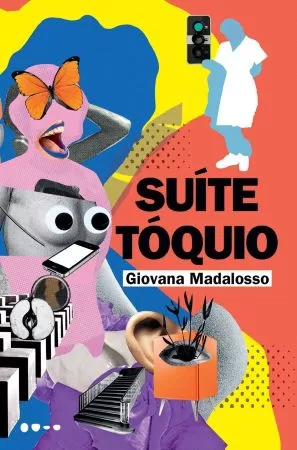
MADALOSSO, Giovana. Suíte Tóquio. São Paulo: Todavia, 2020.
Giulia Campos
Illustrated by@popi.oli
Translated by Svea Morrell
Suite Tóquio (The Tokyo Suite, translated by Bruna Dantas Loboto, Europa Editions), the third book by Giovana Madalosso (Curitiba, PR, 1975), has an energetic narrative, creating tension and curiosity from start to finish. Constructed using alternating first-person perspectives, the narration captures the reader from its first phrase: “I’m kidnapping a child.” From there, the reader is invited to accompany the thoughts and actions of Maju, nanny of four-year-old Cora, who decides suddenly to kidnap the child in her care, and, on the other side, Cora’s mom, Fernanda, who describes her discovery of the disappearance, going back and forth in time and contextualizing the backstory of the child and nanny, as well as her own deep disconnection from her maternal role.
Within this back-and-forth between the stories of the two protagonists, who vie for the narrative chapter by chapter, a different perspective is suggested about the nuances and complexities of maternal care, the hierarchy of work relations between employer and nanny, and the contrasts between the desires and thoughts of these two women.
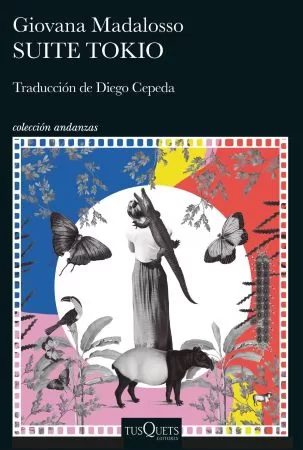
The book is the second novel by Madalosso, who started her career in 2016 with the collection of short stories, A teta racional (The Rational Teat), which explores her experience with maternity and breastfeeding. The set of stories was a finalist of the Clarice Lispector award in 2017 and was followed soon after by her first novel, Tudo pode ser roubado (Everything Can Be Stolen) published in 2018 by Todavia, which explores lost dreams and ambitions in the grand metropolis of São Paulo. In 2020, The Tokyo Suite was also published by Todavia, becoming the author’s most well known work, and the first to be translated into Spanish and also published in Portugal.
The story begins in Maju’s voice, explaining why she decides to kidnap Cora, whom she calls Picucha in her head. Immersed in the affection she developed for the girl from spending much more time with her than anyone else, Maju, throughout the odd-numbered chapters, alternates between narrating her journey with Cora as she attempts to leave the country with the girl, and presenting, through a stream of consciousness, her affection, suffering, dilemmas, and fears, composing the emotional universe of her character.
The nanny has taken care of the girl since she was a baby, living most of the week in her employer Fernanda’s apartment. She lives in a room attached to the home, a traditional “maid’s room,” with some amenities but absolutely no personality: the Tokyo Suite which gives the novel its name. Even her weekends off end up being renegotiated when Fernanda gets promoted at her job, creating a new arrangement in which Maju only has a right to two breaks a month, a monthly day off and a day for “conjugal visits,” an arrangement made between the nanny and the employer so Maju can try to get pregnant by her partner, Lauro. The change in the nanny’s schedule ends up influencing her relationship, and her partner leaves her. This is the context that creates an increasingly blurred distinction between Maju’s personal life and her care for Cora, with whom she develops a mother-daughter relationship.
Simultaneously, the even-numbered chapters are narrated by Fernanda, Cora’s mother. She is an audiovisual producer and the provider for her middle-class family. She is going through her own personal crisis after becoming a mother and is having an extramarital affair with her colleague Yara, a documentary filmmaker.
From the beginning, the disparities between the inner monologues of the two characters stand out. Fernanda’s narration is characterized to a greater degree by a chaotic tone, as well as by many temporal shifts, constructed as if to justify her decisions and actions, in a connection that highlights the character’s anxiety. Readers have access to her questions, which revolve around a certain awe of everything maternal, a fear intertwined with worry about the disconnect she feels in her relationship with her own daughter.
In less than five years The Tokyo Suite achieved critical acclaim, with several articles, a dissertation, and a master’s thesis in the field of literature covering the book’s nuances. The novel was immediately well received by critics and in two of the reviews published soon after the book’s publication — one from the Jornal do Estado de Minas, titled “The Tokyo Suite is a novel that makes us laugh and cry,” and one published in Folha de S.Paulo, “Child abduction in The Tokyo Suite is every mother’s nightmare”— it was highly praised for the quality and rhythm of the narrative and the excellent construction of its characters. The available studies analyze the complexity of the maternal role over the course of the novel and also propose a discussion about the hierarchy in the work relationship between the two characters.
The article “A (des)construção da maternidade no romance Suíte Tóquio, de Giovana Madalosso” (The (De)construction of Maternity in the Novel The Tokyo Suite by Giovana Madalosso), Gabriel Silva de Mello proposes a fruitful analysis of the character Fernanda, suggesting that Madalosso constructs a disruptive representation of motherhood: “The protagonist is tasked with demonstrating another facet of the mother-daughter bond, one that goes beyond the universal conception of expected maternal behavior, and this is reflected in her countless shortcomings and absences with Cora, her daughter” (Mello, 2022).
This aspect of Fernanda’s character becomes evident in the many moments in which she reflects on her life. The short chapter 34 is especially striking, when, already aware of her daughter’s disappearance and consumed by the desperation to find her, the protagonist describes, in less than a page, a child’s persistent attempt to get their mother’s attention: “Look at me dancing. Look at me jumping on the couch. Look, look, look. Look at me, mom.” In this excerpt, the repetition of the verb “look” seems to exemplify a child’s constant need for attention and the protagonist’s discomfort. The choice to include this daydream within the narrative as a recollection of a previous memory and in contrast to the grave reality of the child’s disappearance is also intentional, echoing the guilt Fernanda feels for not having paid more attention to Cora, which could have prevented her kidnapping. In the previous chapter, this guilt is evident in the police officer’s statement, who says that mothers who lose their children are ashamed to tell others because they feel responsible: “They’re like the mothers of kids who’ve drowned, they think it’s their fault even when it’s not.”
Kaio Rodrigues (2023) constructs a comparative analysis focusing on the hierarchy of the relationship between the two characters, presenting this dissonance as a kind of catalyst for the events that unfold in the novel: “[The protagonists] occupy antagonistic sides, one has privileges and an empty life […], the other keeping her life exclusively centered on the child she cares for, on religion, and on the future” (Rodrigues, 2023). The scholar also discusses the way that Madalosso “constructs a framework to criticize submissions and gentrified standards,” summarizing how the writer manages, through her narrative, to bring together various issues that permeate the female condition and maternal care work in Brazilian society.
The Tokyo Suite tells an engaging story, and the reasons for its immediate success are evident to readers from the beginning. Madalosso impresses by creating a narrative that is precise in its extremes. With a text that transverses the poetic and the harsh, the book develops its unsettling premise without losing rhythm, keeping the reader attentive as the story unravels. The use of a double narrative creates fertile ground for observing ancestral hierarchies of power, calling special attention to the clash between the ideals of individual freedom of Fernanda and Maju’s generation and the conflict of these ideologies with social hierarchies, such as work relations. With short and direct chapters, the novel unfolds dynamically, with its 200 pages organized in objective chapters that tie up all loose ends. In her third novel, Madalosso composes an intriguing mosaic of fears, maternal despair, and social contradictions, in a narrative that naturally evokes a comparison of Brazilian class tensions.
Further Reading
MELLO, Gabriel Silva de (2022). A (des)construção da maternidade no romance Suíte Tóquio de Giovana Madalosso. Revista Interfaces, Guarapuava, v. 13, n. 4, p. 69-80. Disponível em: https://revistas.unicentro.br/index.php/revista_interfaces/article/view/7264. Acesso em: 10 ago. 2024
RIBEIRO, Ana Elisa (2021). Suíte Tóquio é um romance que nos faz rir e chorar. Estado de Minas. Disponível em: https://www.em.com.br/app/noticia/pensar/2021/05/14/interna_pensar,1266447/suite-toquio-e-um-romance-que-nos-faz-rir-e-chorar.shtml#google_vignette. Acesso em: 10 ago. 2024.
RIBEIRO, Teté (2020). Rapto de criança em Suíte Tóquio é o pesadelo de toda mãe. Folha de S.Paulo. Disponível em: https://www1.folha.uol.com.br/ilustrada/2020/10/rapto-de-crianca-em-suite-toquio-e-o-pesadelo-de-toda-mae.shtml. Acesso em: 10 ago. 2024.
RODRIGUES, Kaio (2023). “Alguém joga xadrez com a minha vida”: mulheres e o tabuleiro social nas narrativas de Martha Batalha e Giovana Madalosso. Dissertação (Mestrado em Letras e Linguística) – Universidade do Estado do Rio de Janeiro, São Gonçalo. Disponível em: https://www.bdtd.uerj.br:8443/handle/1/19680. Acesso em: 10 ago. 2024 .
Iconography