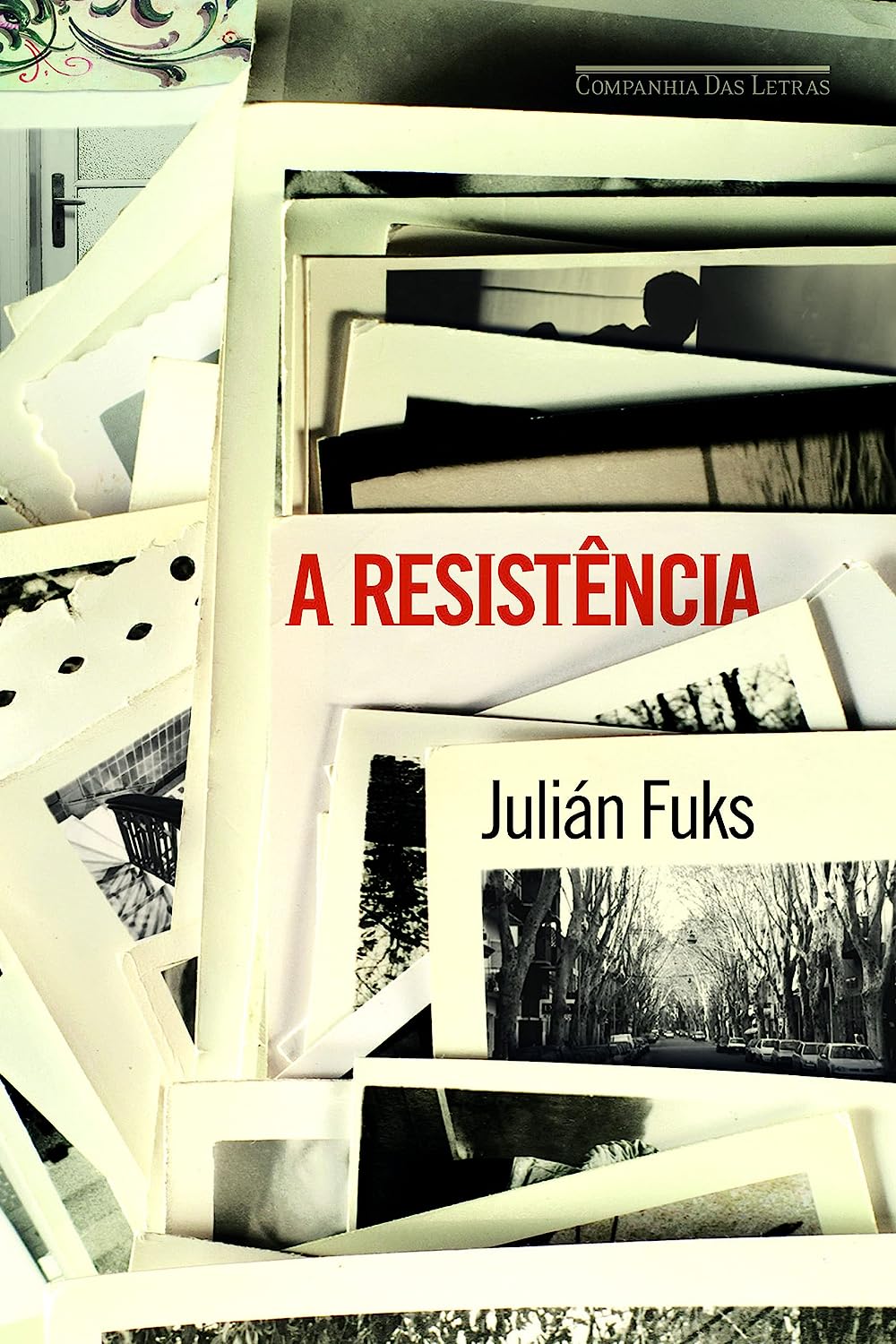
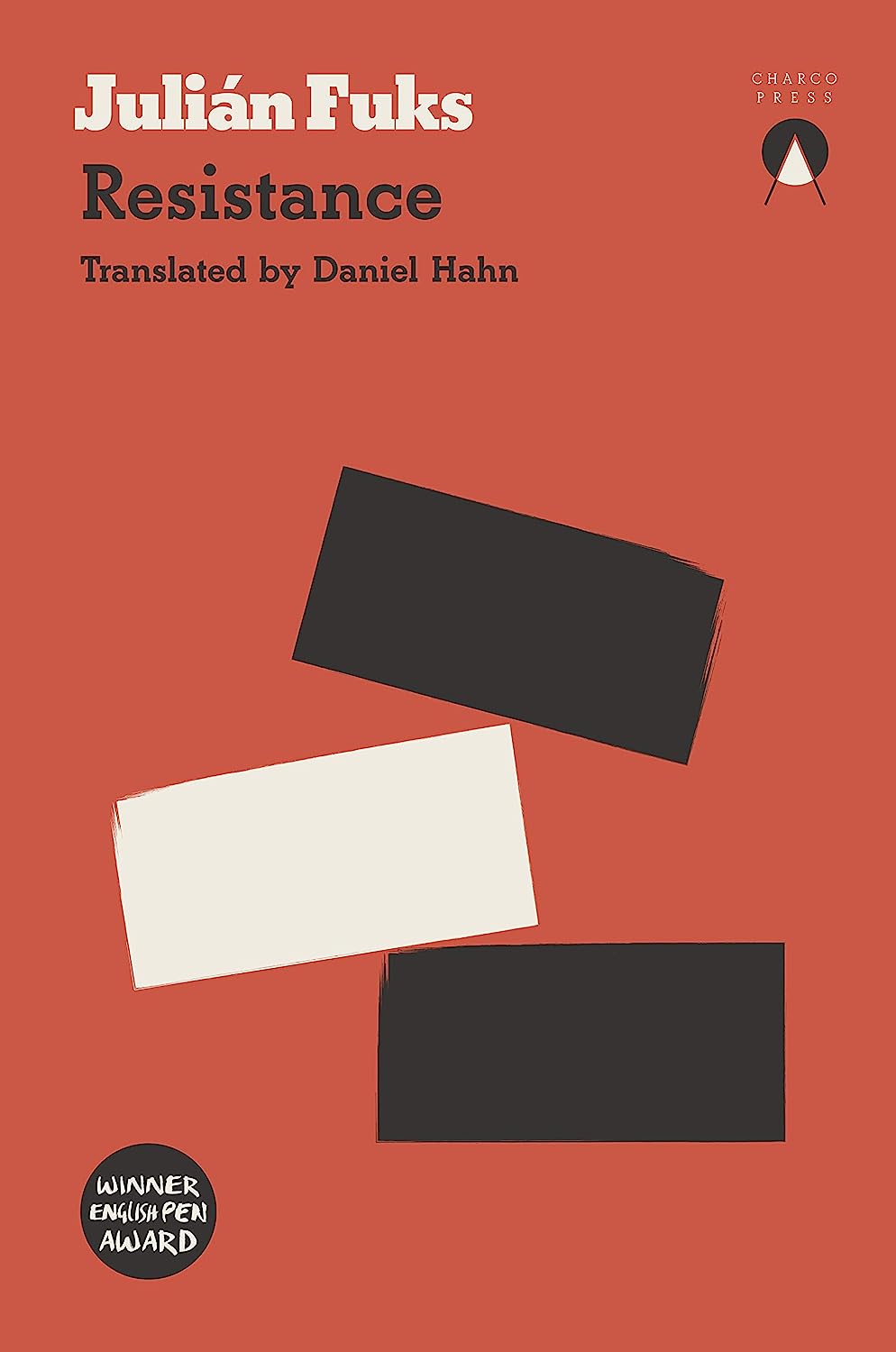
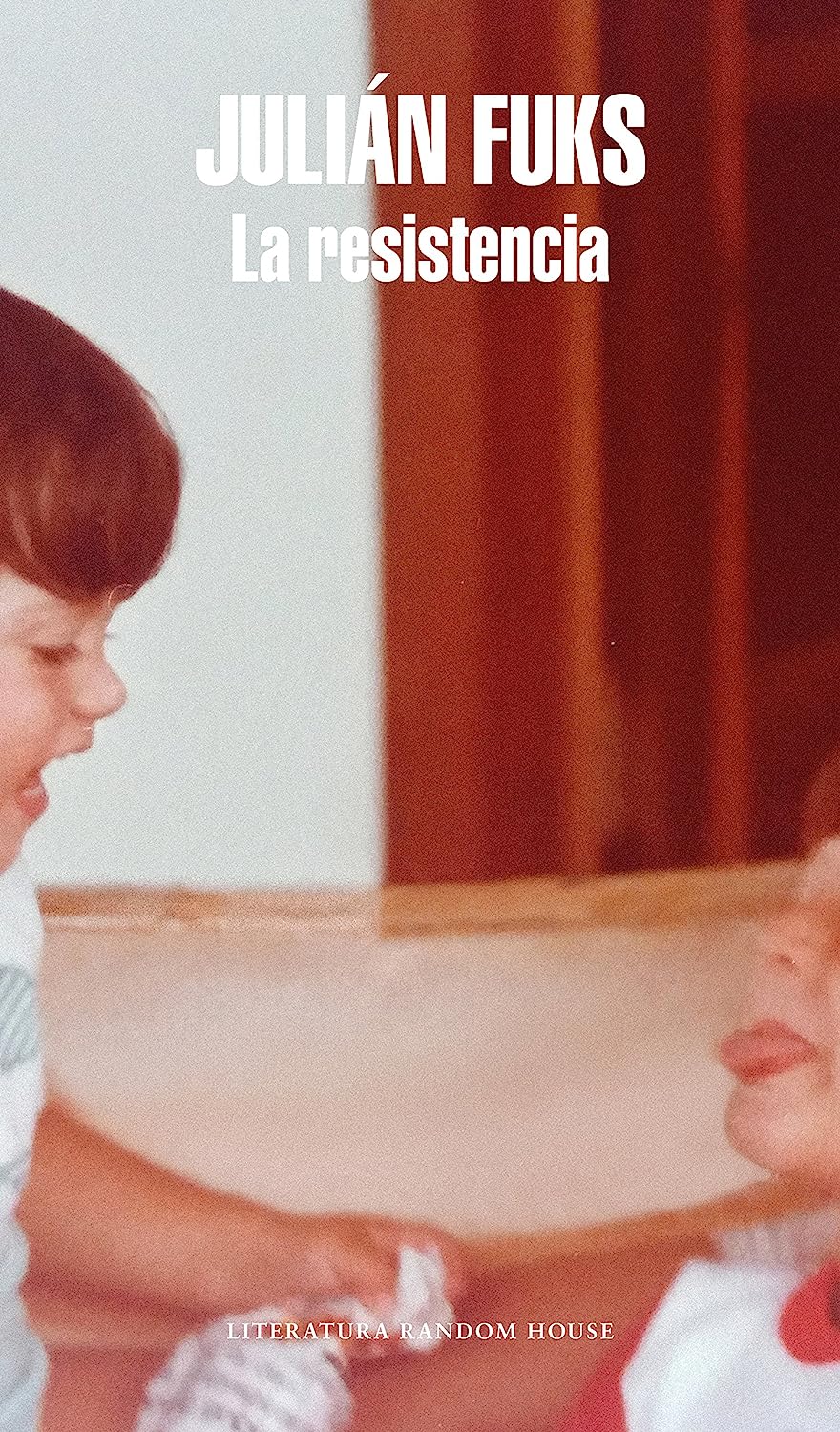
FUKS, Julián. A resistência. São Paulo: Companhia das Letras, 2015.
Sheila Jacob
Illustrated by Carolina Vigna
Translated by Annika Prickett
Narrated in the first person, the novel A resistência (Resistance, translated by Daniel Hahn, Charco Press) was published in 2015 by Julián Fuks (São Paulo, SP, 1981). The son of Argentine parents, the author —also a translator and literary critic — received national and international acclaim for this book. The work is constructed from memories that erupt as the narrator attempts to tell the story of his older brother, the adopted child of his psychoanalyst parents. His parents adopted this child while they were living in Buenos Aires during the height of the dictatorship, which they opposed. The activists, who fled their native country expecting their stay in Brazil to be temporary, ultimately chose to remain there. Years later, they had two biological children — one of whom assumes the task of telling this story.
The epigraph of the book, written in Spanish and taken from a work of the same name by Argentine author Ernesto Sábato, sets the tone: “I believe one must resist: that has been my motto. But today, how many times have I asked myself how to embody that word?” In this book, Fuks explores the various meanings that the word resistance can take, understood both within the family and in a broader historical and social context. It is political resistance, resistance to forgetting, and also resistance through and of language — even as its limitations are (re)acknowledged and made explicit.
The idea for the book arose from a request made by the narrator-character’s adopted brother: “You should write about this one day — about being adopted. Someone needs to write about it.” To meet this expectation, the narrator must dive into his memories and try to grasp the past, which always slips away but also cannot be escaped — bringing forth the tricks and imperatives of memory: “I can’t remember what it was like to spend a minute, ten minutes, an hour by your side, and yet I can’t avoid you.”
In addition to recalling intimate and domestic moments — some experienced during the family’s exile in Brazil — the novel also engages with Argentine history, depicting scenes and records from the country’s military regime, creating a narrative that flows between the personal and the collective. One such example is a dinner organized by the narrator’s parents for his mother’s coworkers. No one shows up, the narrator suspects, because they feared such a gathering might be unsafe. “Colleagues of all hours, companions in daily struggles, why did they disappear, why are they now silent?” Prompted by these reflections, the narrator imagines other suspended dinners, but for different reasons — times marked by persecution, torture, exile, murder, and sudden disappearances.
Fuks’s work is part of a growing body of literature on the Latin American dictatorships written not by those who directly experienced these regimes, but by their children, grandchildren, and relatives from later generations — individuals who seek to tell the stories of those who resisted, and who, as a result, were persecuted, forced into exile, tortured, driven underground, or even disappeared. It is as if, in unison with the author, they ask: “Can exile be inherited? Are we, the young ones, as expatriated as our parents? […] Is political persecution also subject to the laws of heredity?” In this case, writing becomes a way to honor the history of those who dared to resist and to preserve their legacy.
Alongside the theme of exile — both lived and inherited — the novel addresses the issue of political disappearance, referred to as an “incomplete death.” One example is the narrator’s mother’s colleague, the young psychologist Marta Brea, another victim of Argentine state terrorism. She was abducted during a work meeting and never seen again — until a letter received in 2011 confirmed her murder 34 years earlier. Here, the regime’s cruelty is recorded — its ability to eternalize grief by making mourning impossible. In the author’s words, it was “the atrocity of a regime that also kills the death of those it assassinates.”
In attempting to recover the trajectory of his older brother — whose origins are unknown and will remain so — the text also addresses a harrowing reality of Latin American dictatorships: the kidnapping of children of the disappeared by regime agents. When thinking of Argentina, one recalls the iconic film La Historia Official (The Official Story, 1985, directed by Luis Puenzo) and the renowned Grandmothers of the Plaza de Mayo movement, whose appeal centers on the return of “many kidnapped babies, appropriated by the military, handed over to families close to the regime, passed from hand to hand like valuable merchandise, lost without a trace.” The novel even includes the account of the recovery of grandchild number 114, a case of profound symbolic importance because he was the grandson of Estela de Carlotto, the historical leader and president of an association that can itself be seen as a personification of the keyword in the book’s title.
Resistance is “a book about that child, my brother — about childhood pains and experiences, but also persecution and resistance, about terror, torture, and disappearance.” It is also a work of metafiction with autobiographical traits — that is, it draws on experiences lived by the author while revealing the process of writing and the anguish that accompanies it.
This metafictional aspect becomes evident toward the end when a conversation with the parents is narrated after they read the book written by their son, inspired by the adoption of the older brother and its impact on family dynamics. The mother affirms the book’s faithfulness to the facts —“as faithful as one can be to the instabilities of memory”— while acknowledging some gaps and inaccuracies, emphasizing that she appreciated “that there was at least one clear deviation, a trace of so many others. I appreciated that not everything adhered to reality or attempted to mimic it.”
The reader is thus presented with an ambiguous and porous path where author and narrator draw close, merge, and simultaneously separate and create tension — a dynamic also seen in the mention of the alter ego Sebastián at the end. Sebastián appears in other works by Fuks, such as the preceding novel Procura do romance (The Quest for a Novel) (2011) and its successor A ocupação (Occupation) (2019): “With these immaterial ruins, I have tried to construct the building of this story, upon subterranean and tremendously unstable foundations.”
Thus, the interplay between reality and fiction is exposed — a foundation for this and many other narratives that attempt to address traumatic historical episodes, always reflecting on the gaps, the limits, the urgency, the inevitability, and the simultaneous impossibility of narrating lived experience. As the novel says: “I know I am writing my failure. […] I waver between an incomprehensible attachment to reality— or to the scattered remnants of the world we usually call reality — and an inexorable disposition toward storytelling, a fallback trick, the urge to forge meaning where life refuses to provide it. Not even with this double artifice do I achieve what I thought I desired.” In this search for the unreachable word, fictional narrative, essay, autobiographical account, and historical record are all intertwined. The text dissolves the rigid boundaries that used to define distinct literary genres. The author himself has called these hybrid approaches, common in contemporary novels — including this one —“post-fiction.”
With this work, Julián Fuks received several awards, including the Jabuti Prize for Best Literary Novel and second place in the Oceanos Prize, both in 2016. That same year, he was a finalist for the São Paulo Prize for Literature in the category of Best Novel of the Year. He also won the José Saramago Literary Prize (2017) and the Anna Seghers Prize (2018). In 2019, he again won the Jabuti Prize — this time in the category of Best Brazilian Book Published Abroad.
His early recognitions were widely celebrated, especially because, the year after the novel’s release, Brazil experienced a “rupture with democratic order” through the impeachment that removed President Dilma Rousseff. “Resistance and struggle were part of the everyday vocabulary,” as the writer emphasized in his acceptance speech at the Jabuti Prize ceremony. Added to that immediate context is the ongoing need to recover, publicize, and denounce the realities of dictatorship across Latin America, always pointing to the risks and threats posed by authoritarian regimes today. As the narrator’s father underscores in a dialogue from the novel, when asked why anyone would care about events from so long ago: “Dictatorships can come back — you should know that.”
Further Reading
FERNANDES, Pádua (2019). Poéticas da migrância e ditadura: exílio e diáspora nas obras de Julián Fuks e Francisco Maciel. Estudos de Literatura Brasileira Contemporânea, Brasília, n. 58, p. 1-12. Disponível em: https://periodicos.unb.br/index.php/estudos/article/view/28065/24111. Acesso em: 12 fev. 2023.
FIGUEIREDO, Eurídice (2020). A resistência, de Julián Fuks: uma narrativa de filiação. Estudos de Literatura Brasileira Contemporânea, Brasília, n. 60, p. 1-8. Disponível em: https://periodicos.unb.br/index.php/estudos/article/view/30795/25813. Acesso em: 8 fev. 2023.
FUKS, Julián (2017). A era da pós-ficção: notas sobre a insuficiência da fabulação no romance contemporâneo. DUNKER, Christian et al. Ética e pós-verdade. Porto Alegre: Dublinense, p. 73-93.
HEINEBERG, Ilana (2020). Exílio da ditadura na ficção brasileira da geração pós-memorial: a perspectiva e a estética dos filhos. Estudos de Literatura Brasileira Contemporânea, Brasília, n. 60, p. 1-12. Disponível em: https://periodicos.unb.br/index.php/estudos/article/view/30804/25814. Acesso em: 19 fev. 2023.
Iconography