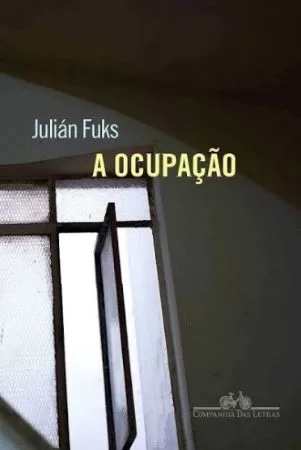
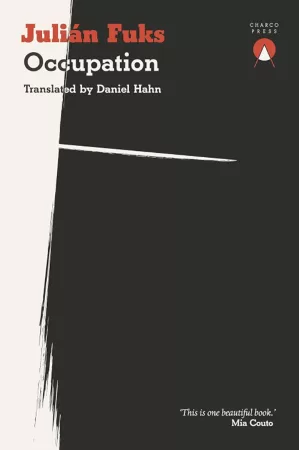
FUKS, Julián. A ocupação. São Paulo: Companhia das Letras, 2019.
Leila Lehnen
Illustrated by Léo Tavares
Translated by Svea Morrell
How to write about ruins? How to occupy — with words — ruins? How to reconstruct meaning in the face of ruins? A ocupação (Occupation, translated by Daniel Hahn, Charco Press), a novel written by Julián Fuks’ (São Paulo, SP, 1981), opens with a mise en abyme of ruins: human, urban, linguistic. The book starts with the narrator, who travels through the city with his partner and comes across the “ruin of man” in a metropolis where potholed sidewalks and precarious lives mix together in concentric circles of exclusion and violence. In the midst of the proliferation of debris, words fail.
Discerning meaning from the wreckage outlined in the first sentences of the book, creating new meanings in a present in which the meaning of words like “utopia,” “democracy,” and “truth” lose themselves in the rubble of politics and sociability is one of the threads that weaves together the narrative of Fuks’s book. The narrator, whose identity throughout the book overlaps with the author’s, recognizes how this attempt to “write a novel about this never-ending ruin that surrounds us” is a paradoxical gesture. On one hand, the enterprise fails to justify the expropriation, the hurt that the text tries to encompass (ultimately, as the author points out, he writes about “discouragement” “protected by firm walls”). However, on the other hand, literature is a form of protection against ruin, a talisman that safeguards against the meaninglessness traced in the tangle of invisible lives, exiled beings, fugitives. Paraphrasing the words of Mozambican author Mia Couto included in an epistolary form in the text, literature and specifically Fuks’s novel show us ways of renewal, preserving hope even in times of ruin. This hope is configured as an exercise in listening to others, of empathy excluding pity. The hope of literature is understanding of others.
Published in 2019, Occupation was conceived during Fuks’ artistic residence at the Cambridge Hotel under the mentorship of Mia Couto through the Rolex Arts Initiative Program. The relationship between the two writers is made explicit in the book through two letters, one written by Fuks to Couto (chapter 35), the other, the response to the letter from the Brazilian interlocutor. Couto’s voice is one of the many that occupy Fuks’s text, transforming it into a polyphonic artifact.
Narrated primarily in first person, Occupation contains 41 short chapters that revolve around three thematic axes. The narrator, Sebastián, deals with the proximity of his father’s death while also facing the possibility of becoming a father himself. Sebastián also recounts his experience with the residents of the occupation of what was once the Cambridge Hotel, in downtown São Paulo. From these three focal points, the book weaves a discussion about Brazil in a moment of “regression, repression, and loss of rights.” There is no date specified in the book, but there are various references to a post-2018 era. The chronology, at once specific and vague — the recession mentioned in the narrative could have happened before 2018 or could have continued after this date (as it in fact did) —, lets us understand the disintegration of politics and citizenship not as an one-off event, but as a reiteration of entrenched social and cultural practices. What we read is the attempt of the narrator, Sebastián, to understand the regression — and strategies of resistance — through language. The meta-theme of the book, therefore, is the role of literature in expressing not only one’s own experience, but also the experience of others. Following the author, whose voice appears in chapter 35 in the form of the aforementioned letter to Mia Couto, his goal is to “let them occupy me, let them occupy my writing: an occupied literature is what I can do in this moment.” During an interview with Paula de Carvalho for Quatro Cinco Um in December of 2019, Fuks explained the meaning of an occupied literature as being a textuality linked to the present, a literature of public spaces, which includes the voices of others.
The occupation that the title references and that the novel uses as a methodology has multiple meanings. The reiteration, though not a repetition, of the occupations, gives the book a spiraled structure. There are phrases, thoughts, resurging topics, evoking even other works by Fuks, in particular his 2015 novel A resistência (Resistance, translated by Daniel Hahn, Charco Press), which leaves an imprint on the text we read, occupying it to a certain extent.
The novel is not only about the physical occupation of abandoned buildings by people in need of housing in one of the most expensive cities in South America. The book is also concerned with the occupation of maternal bodies during pregnancy, the occupation of the imagination by a future child and a future book, the occupation of a living body by its inevitable death. Finally, the narrative itself is occupied by the voices of various squatters with whom Sebastián converses: Najiti, the Syrian refugee who offers an envelope with an account of his life in Homs to the narrator; Rosa, who runs from a rat infestation and who, instead of being occupied, wants to occupy; Gínia, a Haitian who left her country after the 2010 earthquake in which she lost her daughter and, while reporting her unspeakable loss over “the city [that] became an exposed cemetery” asks Sebastián that he “put in something more than pain, something more than misery, if you want to write something worthwhile.” Finally, Preta and Mrs. Carmen, women whose words reverberate between the walls of Cambridge Hotel and through other occupations, whose words sound between the lines of Fuks’s novel, who know the vitality of resistance, despite the violence they suffer for being women, for being black, for not keeping quiet.
Nonetheless, you should not read Occupationas a mere palimpsest or a simple attempt to give a voice to other people through literary text. Fuks constructs a narrative that occupies us as a political work and a text that transcends the politics of the moment. The book presents a reflection, a reminder of how literature could and should inform the understanding of our world, our place, and the place of other people in the world before ourselves. Occupation is overall an exercise in creating a world where there is space for both us and others.
Further Reading
CARREIRA, Shirley de Souza Gomes (2019). O fora é sempre o outro: Espaço e alteridade em A ocupação, de Julián Fuks. E-escrita. Revista do curso de Letras da Uniabeu, v. 10, n. 3, p. 87-98. Disponível em: https://revista.uniabeu.edu.br/index.php/RE/article/view/3814/pdf. Acesso em: 22 dez. 2023.
CARVALHO, Paula de. Fichamento: Julián Fuks. O autor de “A ocupação” oferece estratégias de como ocupar uma terra sonâmbula. Quatro Cinco Um, 06 dez. 2016. Disponível em: https://quatrocincoum.com.br/noticias/literatura/fichamento-julian-fuks/. Acesso em: 22 dez. 2023.
COELHO, Lilian Reichert (2021). Era Najati que meu buscava nas páginas: o eu e o outro em A ocupação, de Julián Fuks. Nau Literária. Dossiê “O estrangeiro na literatura contemporânea: corporeidades”, v. 17, n. 3, p. 54-74. Disponível em: https://seer.ufrgs.br/index.php/NauLiteraria/article/view/114139. Acesso em: 22 dez. 2023.
CONCEIÇÃO, Luciano Martins da; PINHEIRO NETO, José Elias (2022). Espaços de transmissão intercultural em A ocupação, de Julián Fuks. Revista de Estudos de Literatura, Cultura e Alteridade – Igarapé, v. 15, n. 1, p. 50-62. Disponível em: https://periodicos.unir.br/index.php/igarape/article/view/6819. Acesso em: 22 dez. 2023.
MORAES, Paulo Eduardo Benites de (2020). Da sobrevivência das imagens como fantasma: uma leitura de A ocupação, de Julián Fuks. Gragoatá,v. 25, n. 53, p. 1111–1130. Disponível em: https://periodicos.uff.br/gragoata/article/view/42950/26974. Acesso em: 22 dez. 2023.
SILVA, Sandra Augusto (2022). A ocupação (2019), de Julián Fuks: uma prosa poética de corpos em exílio. Claraboia, v. 18, p. 135-145. Disponível em: https://seer.uenp.edu.br/index.php/claraboia/article/view/244. Acesso em: 22 dez. 2023.
Iconography