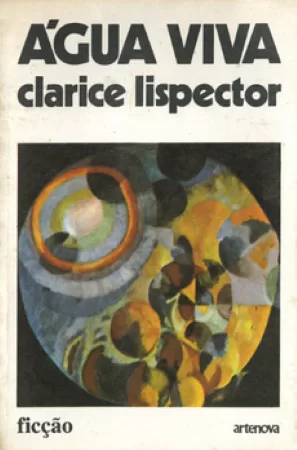
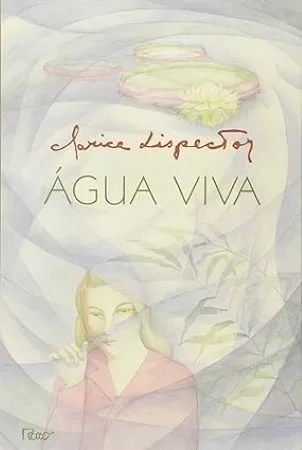
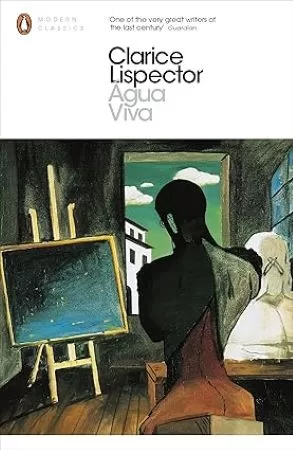
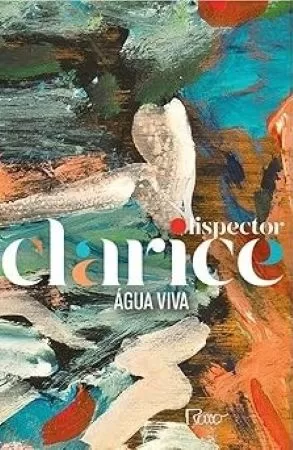
LISPECTOR, Clarice. Água viva. Rio de Janeiro: Artenova, 1973.
Pâmela Nogarotto
Illustrated by Catalina Chervin
Translated by Annika Prickett
Even though it unfolds in a potent poetic flow of the now-instant, Água viva was reworked and retitled three times over three years before its publication in 1973 by Clarice Lispector (Chechelnyk, Ukraine, 1920 – Rio de Janeiro, Brazil, 1977). The first version, from 1971, was titled Behind Thought. Monologue with Life. The second, Screaming Object. With the help of Olga Borelli, a close friend of the author, the work was cut in half and finally became Água viva. The search was for a text increasingly impersonal and universal, as highlighted by Alexandrino Eusébio Severino (2015), to whom Lispector entrusted the translation of the first typewritten version of the text. Published four years before her death and thirty years after her debut as a novelist, the book marks a mature stage in her authorship. The process involved a kind of grafting of fragments from previously published newspaper columns and texts from The Foreign Legion (1964). On March 6, 1972, a year before the book’s release, Clarice Lispector told Correio da Manhã: “— Yes, it’s already finished, but I think I’ll only publish it next year. You see, I’m very sensitive these days. Everything people say about me hurts. Screaming Object is a book that will surely be heavily criticized. It isn’t a short story or a novel, nor a biography, nor a travel book. And right now, I’m not willing to put up with abuse. You see, Screaming Object is a person speaking all the time.”
This short fiction — and calling it fiction, in this case, is to settle for lack of a more precise term — is, as the author defines it, a slippery book, a book that is not. Benedito Nunes (2004) characterizes Água viva as a liminal and unclassifiable text, while Hélène Cixous (1990) describes it as “a book outside the laws of narrative.” Without a conventional plot, the narrator — who is also the protagonist and only character —writes as thoughts arise. Little is known about her: she is a painter who now ventures into writing. Her writing is addressed to an unknown “you” (the reader?).
Time and space are minimally or not at all delineated in the text. The flow of words simply sprouts. If there is a time, it is the time of all human history through which the narrator wanders while seated at her typewriter—the Triassic, the Medieval Inquisition, the other side of life.
Thus, each reader must find their own way of making Lispector’s text legible. One of the approaches is hinted at by the narrator herself: through the body, since the painter’s method is to create “with the whole body.” In the same way, the writing is explicitly with the whole body: “It is also with my whole body that I paint my pictures and on the canvas I fix the incorporeal, I body-to-body with myself.”
It is a matter, then, of making the absent appear in writing, a writing-painting that fixes the incorporeal. Only through painting and writing, putting one’s whole body into it, would it be possible to approach that which has no body, the it.
The protagonist of Água viva, who remains unnamed, can be linked to two other Clarice Lispector characters who are also artists: the sculptor G.H., from The Passion According to G.H. (1964), and Virgínia, from The Chandelier (1964). Although Virgínia is not explicitly presented as a sculptor, she creates small figurines, a gesture that echoes the act of molding. Initially, sculptors were those who shaped and gave form to formless material. If shaping raw material is G.H.’s profession, she undergoes a disintegration of her form in the novel. Virgínia, on the other hand, when she is brave enough, goes to the riverbank and finds the best clay there: white, malleable, pasty, cold. She collects it, and it is from this substance that her figurines are molded. Writing, in this way, tries to shape, or further deform, the amorphous mass at the river’s edge.
In Água viva, the painter seeks to move beyond her language — canvas, paint — to approach this formless matter through words. Writing, like molding, becomes an effort to give form to chaos, or perhaps to deform even further that which lies at the edge of the river, on the margin of the unnamable.
The text breathes, vibrates, and it is in the logic of breath, of one great breath, that it may be read. In line with Cixous’s reading (1990), there is no architecture, no “novelistic box,” no containment of the narrative flow. It is the narrator’s (or writer’s?) body — and the reader’s — that determines when to pause and when to go on. It is a narrative of breath, not only in the figurative sense of something grand, though it is that too — but primarily in the literal sense. As the protagonist says, “Is the next instant made by me? Do we make it together with breath.” And also: “The world has no visible order and I have only the order of breath. I let myself happen.”
Água viva is, in short, composed of “thematic non-themes.” Without plot, fragmentary, onomatopoeic, a convulsion of language, it is a text to be seen from above and with distance. The appeal is not to read with the linearity of traditional narrative, but “quickly, as when one looks.” It is a writing of “signs that are more gesture than voice.” The search for the now-instant — a central theme of the book — produces an elusive text, as it occupies an in-between place in time: neither what was nor what will be, the now-instant is what slips through the fingers. The now-instant, therefore, is the impossibility of time. In the desire to “possess the atoms of time [and] capture the present which by its very nature is forbidden to me: the present flees from me, the present escapes me, the present is always me in the already,” what is claimed is a non-existent time, a creation, a forging. It is the margin of past-future; it is to be in the gap.
If there is a central point in the book, it is the it. The “thing,” the “core,” the “object,” the “unspeakable”—the it, finally, that thread running through Lispector’s work and taking on different names. Its first appearance can be traced to “thing” in the first chapter of Near to the Wild Heart, Clarice Lispector’s debut novel. Difficult to describe, the it is the ungraspable, that which eludes language and yet only insinuates itself through it.
In the 1973 book, the desire is to seize the word with one’s hand. Not because the word is the it, but because it weds it, approaches it as closely as possible. It is the line, visible, palpable, allowing a glimpse of the between-the-lines, the blank space, the silence — as we read at one point: “The best has not yet been written. The best is in the interlines.” Invisible and intangible, the it vibrates in Água viva and, paradoxically, can be felt between the fingers.
In the pursuit of a word, one might say the book proposes estrangement. More than that, it proposes moving through this estrangement. One reads: “When I find a painting strange, that’s when it is a painting. And when I find the word strange, that’s when it reaches meaning. And when I find life strange, that’s when life begins. I take care not to go beyond myself. There is great restraint in all of this.” The narration invites the reader to detach from signification, to return to sound, to the body, to the cry. “What you will know of me is the shadow of the arrow that hit the target. I will only ever grasp, uselessly, a shadow that takes up no space, and what truly matters is the dart,” that is, something is launched at the tender point of the word and leaves its shadow. That shadow is what the narrator will attempt to touch. The shadow is the it. What remains is the dart. The shadow occupies no space, incorporeal; the dart does— it is the word, concrete, corporeal. Elsewhere, we read: “I want to write you as one who learns. I photograph each instant, I deepen the words as if I were painting not so much an object, but its shadow.” On this revelation of the incorporeal, Cixous writes: “Clarice works with language itself and its relation to the body, the paradox that allows incorporeal and unreal things to be more easily found and spoken because they are nothing more than words.” Thus, that which belongs to the order of the body (the text, the word, the book) brings forth the incorporeal, the it.
Água viva is a post-word world, but one that seeks to reach the primitivity of the word — or, in time, to pass through it, go beyond it. It is to write as one paints, as one sings. It is to die and be reborn, to return as one who speaks the first word or the last, as one who takes the word in their hands and, at the same time, is seized by it. As one who accepts entering the cave, who wants to be on the walls. It is the cry of transgression. The cry of the thing.
Further Reading
CIXOUS, Hélène (1990). Reading with Clarice Lispector. Tradução, edição e introdução de Verona A. Conley. Minneapolis: University of Minnesota Press.
NODARI, Alexandre (2018). O indizível manifesto: sobre a inapreensibilidade da coisa na “Dura Escritura” de Clarice Lispector. Revista Letras, UFPR, Curitiba, v. 98, p. 83-113. Disponível em https://revistas.ufpr.br/letras/article/view/66898/39721. Acesso em: 04 ago. 2024.
NUNES, Benedito (2004). A narração desarvorada. Cadernos de Literatura Brasileira, n. 17-18. São Paulo: Instituto Moreira Salles. p. 292-301.
PENNA, João Camillo (2018). Das ding. Revista Letras, v. 98, p. 31-55.
SEVERINO, Alexandrino Eusébio (2015). As duas versões de Água Viva. Remate de Males, Campinas, v. 9, p. 115-118.
SOUZA, Carlos Mendes de (2000). Figuras da escrita. Braga: Editora da Universidade do Minho.
STIGGER, Veronica (2016). O útero do mundo. São Paulo: Museu de Arte Moderna de São Paulo, 2016. Disponível em: https://mam.org.br/wp-content/uploads/2016/10/outerodomundo. pdf. Acesso em: 04 ago. 2024.
Iconography