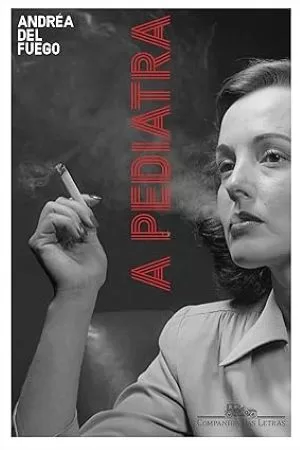
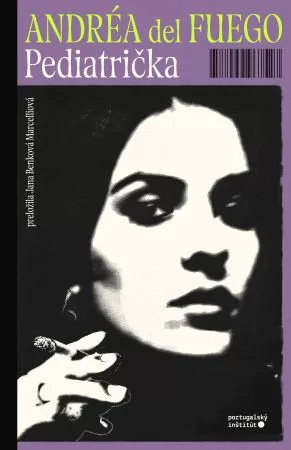
DEL FUEGO, Andréa. A pediatra. São Paulo: Companhia das Letras, 2021.
Renata Fernandes Magdaleno
Illustrated by Léo Tavares
Translated by Shaina Thelen
In Por uma crítica feminista (2020), Eurídice Figueiredo argues, through an analysis of books by women authors from different eras, that it is possible to perceive a kind of collective imaginary in the literature they produce. The resulting panorama, however, is not homogenous, but rather a mosaic made up of a set of beliefs and knowledge that permeate groups within a particular socio-symbolic space. The argument does not advocate for a simple intertwining of fiction and reality, but instead calls for a meticulous observation of the themes addressed by women writers throughout history, the reception their writings received, and the way in which female characters are portrayed and behave in the books they produce. When analyzing the 2021 novel A pediatra (The Pediatrician) by Andréa del Fuego (São Paulo, SP, 1975), these issues emerge, not only through the setting and construction of the plot, but also through the composition of the protagonist and the reception that the work has received in literary media.
With touches of humor, del Fuego constructs a cynical and self-centered character, without judging her behavior. Written in first person, the novel tells the story of this pediatrician, Cecília, who contradicts everything that the collective imaginary of Brazilian society associates with that profession. She does not like children, does not care about their parents, prescribes in a perfunctory manner, and always refers the chronic patients and most serious cases to other professionals. To the reader, she admits her lack of talent: “No one noticed that I had little vocation or patience to be a doctor, my good education guaranteed that I wouldn’t be sued and I did the basics well. Procedures that any pediatrician performs hid my ineptitude.”
Reaching the public at a time when the world was awakening from the Covid-19 pandemic, in 2021, the construction of this professional character takes on political contours. Just as doctors were losing their way in prescribing treatments — writing prescriptions more out of political beliefs than medical knowledge — the fictional character Cecília appears, putting into practice throughout the plot the unimaginable (lack of care for patients, coldness when receiving news of worsening conditions, and dismissal of ethics in different areas of life). Her behavior highlights the human nature of the professional, with multiple flaws and distinct personalities, and emphasizes the superficial judgments of society: “Celso informed the school that a friend of the family would pick up his son and gave them my name; he should have told them my profession which, in that environment, was a flamethrower capable of incinerating any obstacle — no teacher would shut the door on a pediatrician”.
The novel is also well situated in time and space. The story takes place in São Paulo, where the author herself lives, in an upper-middle-class neighborhood with its “special” daycares, full of extra activities and curated decor and architecture. These also have specialized services for expectant mothers, in line with the latest trends in the sector, such as doulas and integrative pediatricians.
What the author does is lift the glossy veneer, revealing what marketing strategies and appearances attempt to hide: the pediatrician with a lover, unethical strategies, and a dread of children; the man who cheats on his wife while she is in labor in the next room; the courses and natural-birth techniques that try to hide the many possible complications, the spikes of pain, and the tearing that can occur during childbirth. All of these characters and scenes are present in the novel, written in direct, dry, and unembellished language (one of the author’s hallmarks), with a thread of humor running through every scene. And, although the exact period in which the character lives is not specified, the entire context described — valuing natural childbirth and questioning the excessive number of cesarean sections performed in hospitals — leads the reader to the discussions that took over the press and the services and institutions linked to pregnant women in the first decades of the 21st century.
During the book’s release, the novel received good reviews in the press. The positive reception of an author like Andréa del Fuego suggests a greater freedom in writing and a growing appreciation of Brazilian women authors, something that did not happen in the past. Analyzing the literary production of women writers over time means observing a succession of erasures (Júlia Lopes de Almeida, Narcisa Amélia, and Nísia Floresta are just some of the women writers who produced work at the end of the 19th century and beginning of the 20th century, were well-received by readers, but were later forgotten due to the devaluation of women writers), of prejudices (which defined, for example, the term “women’s writing” as pejorative, synonymous with a delicate and intimate style of writing, developed in a domestic setting), and of limitations placed on themes and on the very actions of the characters.
Looking to the past reveals countless indications of this devaluation. The national canon, with the country’s literary classics, is filled with male authors and includes very few women. The first woman writer to enter the Academia Brasileira de Letras (Brazilian Academy of Letters), for example — a renowned and traditional institution dedicated to the literary world and established in 1897 — was Rachel de Queiroz, only at the end of the 1970s.
Sexual education and the liberalization of social customs since the 1960s have brought about changes in societal behavior that were reflected, little by little, in the work and reception of women writers. The number of women who dedicate themselves to literature has increased significantly since the end of the twentieth century, although it still does not equal that of men. The freedom of themes explored indicates a more egalitarian landscape in the 21st century, where prejudice, violence, women’s suffering, and sexuality are addressed more freely.
If A pediatra (2021) had been written during the 19th century, the protagonist Cecília probably would not have been able to escape the tragic end — a kind of punishment reserved for female characters who rebelled (in the style of Madame Bovary by Gustave Flaubert). In 19th-century publications, for example, it was common to see female characters suffering terrible consequences for deviating from their social roles or for overstepping the boundaries of marriage, as if the bad example was something that should be punished, most often with death, since women were the primary readers. The tragic ending often occurred even when a woman’s name appeared on the cover, claiming authorship.
A pediatra is proof of how questioning social norms and achieving greater freedom are reflected in 21st-century literary productions. Cecília betrays her husband; they separate; she takes a married lover. She has no problem with locking her office door to be with her boyfriend while patients wait in line. Working as a neonatologist, she feels threatened when a holistic pediatrician who works with the doulas captures a large part of her neighborhood’s clientele. To reclaim her position, she is willing to investigate without limits, lie, impersonate someone else, and invent stories. In romantic relationships, she does not get emotionally involved and only values the moments of sex. When she wants something, she sees no obstacles. And what she wants, at any cost, is Bruninho, her lover’s son. In many scenes, she considers firing her pregnant maid and secretly thinks about stealing her boyfriend. And, after all this, she comes out largely unscathed.
The protagonist of the novel, therefore, completely deviates from the behavioral standards expected of women in the 19th century and much of the 20th century. Marriage, caring for her husband and children, valuing family, and attending to household duties are far removed from Cecília’s daily life. She is financially independent, lives alone, and cultivates her own space.
A pediatra is the third novel of São Paulo-native Andréa Fátima dos Santos, who has already made her defense of feminist values clear through her chosen pseudonym. She adopted the name Andréa del Fuego when she first began writing in the late 1990s, at a time when she wrote columns for a media outlet and answered readers’ questions about sex. The inspiration came from Luz del Fuego, a naturist and feminist from Minas Gerais who lived in the first half of the 20th century and suffered severe consequences from her family for her transgressions.
Del Fuego is the author of nine books: the young adult novels A sociedade da caveira de cristal (The Crystal Skull Society, 2008) and Quase caio (I Almost Fall, 2008); the children’s book Irmãs de pelúcia (Plush Sisters, 2010); and the short story collections Minto enquanto posso (I Lie While I Can, 2004), Nego tudo (I Deny Everything, 2005), and Engano seu (Your Mistake, 2007). She won the José Saramago award in 2011 for her first novel Os Malaquias (The Malaquias, 2010), which was also published in other countries, including Germany, Italy, France, Israel, Romania, Sweden, Portugal, and Argentina. In 2013, she published her second major novel, As miniaturas (The Miniatures), which was also translated and published in other countries such as Argentina and France. A pediatra completes the list, pointing to a body of work that promises continued success and has been well received by both readers and critics.
Further Reading
AMARANTE, Dirce Waltrick do (2021). A pediatra: em ótimo livro, Andréa del Fuego apresenta médica incapaz de criar laços. O Globo, 4 dez.
BERNARDI, Tati (2021). A pediatra, de Andrea del Fuego, está mais para um ser-humano complexo e interessante do que para um monstro. Folha de São Paulo, 1 nov.
BRITO JUNIOR, Antonio Barros de. (2024). As elites brasileiras nos romances de Michel Laub, Andréa del Fuego e Clara Drummond: uma revanche contra o bolsonarismo. Anuário de Literatura, Florianópolis, v. 29, p. 1-22.
CRUZ, Magda; DEL FUEGO, Andréa. (2024). Andréa del Fuego: “O mês em que escrevi A pediatra foi de absoluta escrita. Às vezes me sentia quase febril escrevendo”. Comunidade Cultura e Arte. Ponto Final, Parágrafo, episódio 70.
RIZZI, Hiago; DEL FUEGO, Andréa. (2021) “Vilã de Novela”. Entrevista. Cândido, Curitiba, n. 141.
Iconography