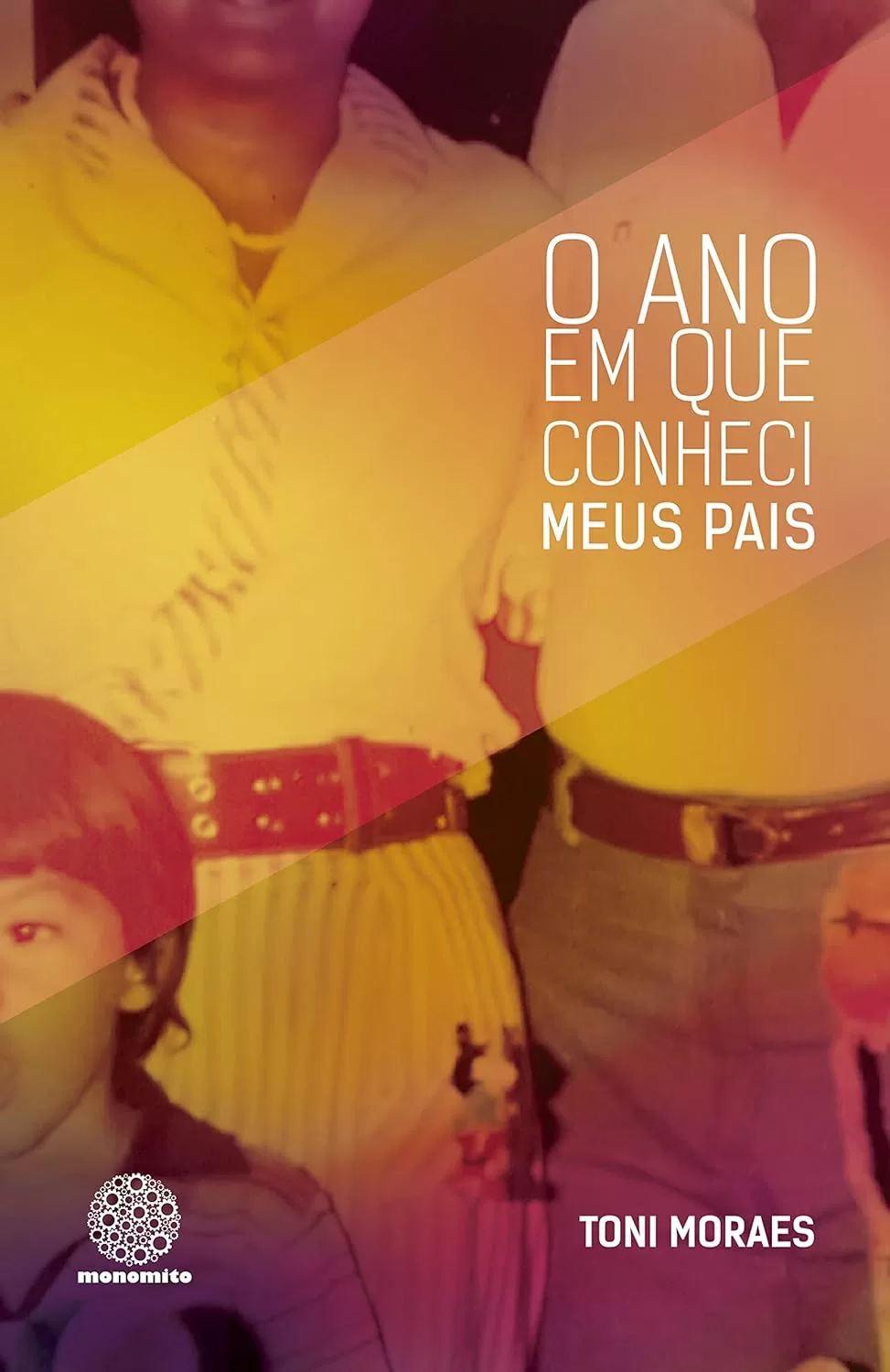
MORAES, Toni. O ano em que conheci meus pais. São Paulo: Monomito, 2017.
Samara Lima
Illustrated by Dona Dora
Translated by Shaina Thelen
It has been more than three decades since we witnessed the return of democracy in Brazil, following the military coup of 1964, yet the oppressions endured by all those whom the regime called subversives still remain latent in our collective imagination. For a long time, it fell to families and victims to record their experiences and testimonies of the atrocities committed against human rights. Likewise, literature and so many other artistic and cultural productions, as a kind of ethical will, have played and continue to play a fundamental substitutive role in relation to national history. In doing so, they have not only contributed to the process of building collective and individual memories and exposing the dangers engendered by silencing, but have also established themselves as a space for processing grief.
It was precisely with these questions in mind, as well as the capacity of fiction to deal with unspeakable themes and experiences, that Toni Moraes (Belém, PA, 1986) made his debut on the literary scene with the 2017 work O ano em que conheci meus pais (The Year I Met My Parents), published by Monomito. Toni Moraes is an architect, editor, writer, and literary researcher. Born in Pará, he settled in São Paulo in 2010 to pursue a postgraduate degree in real estate. He has already published a collection of short stories, also with Monomito, and released his second novel in 2023, Morto não me serves de nada (Dead You’re No Use to Me), with Folheando. In it, we encounter a narrative set between Argentina and Brazil that seeks, among many other things, to reflect on the social and political context of South America and the rise of reactionary ideas in both countries. In doing so, it points once again to Moraes’s investment in the intersection between literature and politics, reality and fiction, in the composition of his works.
O ano em que conheci meus pais unfolds its central action in 1989, a time of political upheaval in Brazil (the first direct presidential election since the 1960s) and in the world (the fall of the Berlin Wall and the end of the Cold War). The novel addresses the theme of the military dictatorship, focusing on the impact of this historical period on the memory of the protagonist, Jonas Damasceno. The work is narrated in the third person by an omniscient narrator who takes on the protagonist’s perspective, often giving the impression that we are following the narrative from his point of view. Through this narrator, we are introduced to the trajectory of the young journalist born in Belém and raised in the capital of São Paulo by his grandparents, Odílio and Verônica. He wants to tell good stories, to record the facts, even if he does not yet know which ones.
At the beginning of the story, we learn that Jonas only knew his parents through photographs, as they died in a car accident when he was just three years old. The great dilemma of his life, which is also the central theme of the novel, is having grown up carrying “a void in his biography” that not even the efforts of his family were able to fill: “The absence of a past and disinterest in the future held him captive in the present.” It is when he decides to attend a lecture by political activist Ciro Pessanha at PUC-Rio that his trajectory changes, as several doubts about his past come to the surface: questioned about his name—which is the same as his father’s—he learns that his parents were activists during the time of the military dictatorship.
It is interesting to note that the title of the novel, as well as the development of the plot, resembles the 2006 film O ano em que meus pais saíram de férias (The Year My Parents Went on Vacation), directed by Cao Hamburger. The film is a Brazilian drama that, from the perspective of a 12-year-old boy named Mauro who loves soccer, narrates his concern over his parents’ delayed return from “vacation.” The drama in the film is that, in reality, the boy’s parents did not go on vacation, but were forced to flee due to their left-wing political affiliation, having to leave the child with his paternal grandfather. Mauro’s life, then, undergoes a drastic change and what consoles him is following the Brazilian national soccer team’s performance in the World Cup. The dialogue between the two works shows us not only the attention to this theme across different artistic practices, but also the current concern with revisiting a traumatic event in order to reimagine the ruin and narrate a past that still eludes our understanding.
The work unfolds across different settings such as São Paulo, Rio de Janeiro, Belém, and Marabá—spaces meticulously described so as to create a kind of cartography of the places through which the characters move. Alongside his friend Domenico, a visual artist facing his own problems and dealing with his HIV-positive status at a time when treatment was inaccessible and death inevitable, Jonas travels through cities in search of supposed acquaintances of his parents in order to gain information that might help him understand the events that culminated in their deaths, often finding only “questions and uncertainties.”
While the protagonist attempts to recover the missing pieces of his past, Domenico—who embodies the figure of someone who confronts the world in his own way and contradicts social impositions—seeks to live intensely in the present, seeing no possibility of a future. In his search for identity, a network of political and family issues are revealed: false journalistic publications, the oppression of people who fought against the regime in power at the time, and the State’s attempts to conceal the Araguaia Guerilla.
The work features small flashbacks that appear at the beginning of each chapter in the form of letters. With no clear sender or recipient, these letters expose the struggles the comrades faced against the dictatorial regime in the 1970s and for survival. They give more of the main narrative to the reader, as what is told there blends itself with the life of the protagonist. If, on the one hand, the interweaving of characters, narrative timeframes, and resolutions of the plot’s entanglements seems to indicate the author’s skill in constructing a plot with several layers without losing the core of the narrative, then on the other, the work is marked from the beginning by its persistence in weaving all of the elements together to the point of leaving no room for the reader to unravel the mysteries on their own.
In O ano em que conheci meus pais, we are led into the clash between truth and lies, the present and the past, the collective events of the country and the intimate lives of the characters. In this sense, the work takes on great relevance in attempting to portray, through fiction, the period of authoritarian rule—that is, “the cut […] too deep in the Brazilian democratic state”—and the vestiges of authoritarianism that persist in Brazil, especially in Pará, where the consequences of the dictatorship are still erased and silenced. In doing so it exposes one of the most violent episodes in the state’s history, the Araguaia Guerilla. Toni Moraes cites Milton Hatoum as a literary reference, and seems to have inherited from him—beyond the aesthetic descriptions of the spaces portrayed and the interplay between reality and fiction—the desire to make the North visible and, above all, to cast a critical eye on our own history.
Further Reading
MORAES, Toni. Entrevista com Toni Moraes da Monomito Editorial // Criador de Mundos. [Entrevista concedida a Juliano Alves]. São Paulo, 25 out 2018. Disponível em: https://www.youtube.com/watch?v=mAfuWTFy3UA&t=497s. Acesso em: 22 jul. 2023.
Iconography