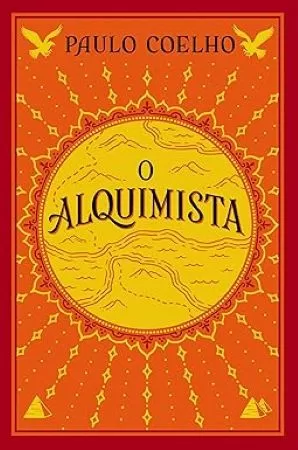
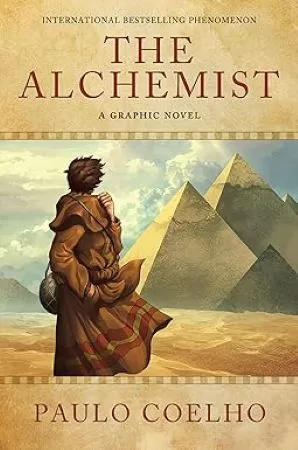
COELHO, Paulo. O alquimista. Rio de Janeiro: Eco, 1988.
Ana Rüsche
Illustrated by Léo Tavares
Translated by Annika Prickett
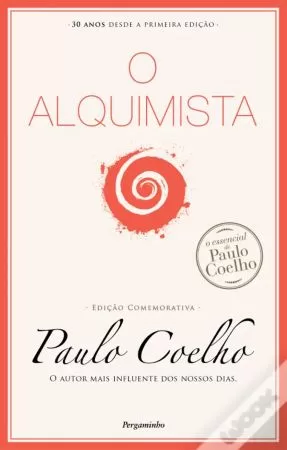
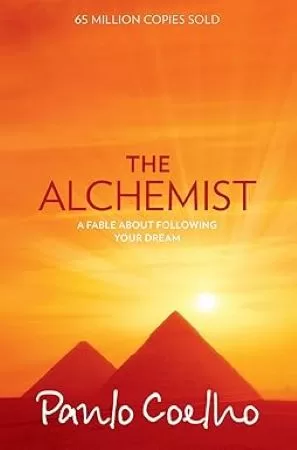
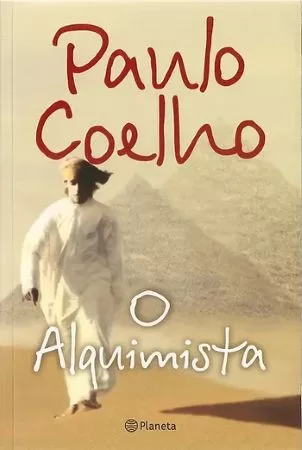
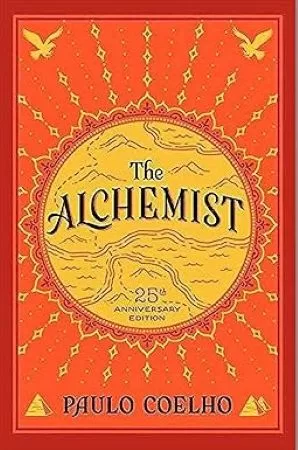
O Alquimista (The Alchemist, translated by Alan R. Clarke, HarperCollins) is the landmark work in the career of Paulo Coelho (Rio de Janeiro, RJ, 1947), with over 85 million copies sold in 170 countries. Among its enthusiastic readers are Barack Obama, Malala Yousafzai, and Umberto Eco. This 1988 book, which had all the potential to elevate Brazilian literature on the international stage, ultimately took a different path. A fixture of popular culture, it remained a shadow in literary production, but it may provide some keys to understanding both Brazilian culture during redemocratization and certain literary questions of the 21st century.
The Alchemist aspires to be a coming-of-age novel, employing both an educational and moralizing tone, as it narrates the story of the shepherd Santiago from youth to adulthood. The plot unfolds chronologically in a time outside of history (it can be roughly placed at the end of the 19th century). At the beginning, the young protagonist seemed content with his sheep in Andalusia but was haunted by a recurring dream of finding a hidden treasure near the pyramids of Egypt. After visiting a Romani witch and having an unexpected encounter with the mythical King of Salem, Santiago decides to embark on a journey across the Mediterranean.
The plot of The Alchemist reinforces the classic self-fulfilling prophecy — a prolepsis found in narratives like the Bhagavad Gita (from the epic Mahabharata), Oedipus Rex by Sophocles, or the folk tale The Pedlar of Swaffham. Coelho’s inspiration comes from the episode “The ruined man who became rich again through a dream”, from One Thousand and One Nights.
This story has been recorded by Richard Burton (The Book of the Thousand Nights and a Night, vol. 3, 1894), by Jorge Luis Borges (A Universal History of Infamy, 1935), and even by Clarice Lispector (“The Story of the Two Who Dreamed,” Jornal do Brasil, 12/27/1969), with variations in the starting and ending locations (in Burton, Baghdad and Cairo; in Borges and Clarice, Cairo and Isfahan; in Coelho, Andalusia and Egypt). In all three versions, a man dreams of a hidden treasure in a faraway city. He travels, suffers various misfortunes, and when he arrives, finds nothing — but when he tells a guard about the dream, the guard replies enigmatically that he had dreamed of a treasure in the man’s hometown. The traveler returns and finds the treasure at home. The ancient tale uses an interesting structure: the prophecy is fulfilled through three allegorical acts — traveling, listening to others, and returning.
The language in The Alchemist is direct, with few inversions of standard sentence order, and usually short: “The boy’s name was Santiago.” The vocabulary aims for a didactic, direct, and unambiguous expression: “Popcorn vendors have houses, while shepherds sleep in the open. People prefer to marry off their daughters to popcorn vendors than to shepherds.” With bucolic and orientalist settings, the novel’s space follows the Levant wind, crossing southern Spain and the Sahara Desert, amid ships, bazaars, and caravans.
Exploring an ecumenical spirituality that accommodates both Christian and Muslim faiths in its alchemical quest, the book emphasizes the power of belief. The marvelous merges with New Age imagery — a new, holistic spirituality without the mediation of a centralized institution, such as a church. It presents a belief system, the Lenda Pessoal, (Personal Legend) well-suited to the neoliberal era, summarized in the widely known phrase: “When you want something, all the Universe conspires in helping you to achieve it.”
Historian Maria Rita Guercio confirms Coelho’s adept use of references — from the Renaissance thinker Cornelius Agrippa to modern-day alchemy, where the transformation of the human psyche offered a new perspective, as in the work of Carl Gustav Jung, who is also cited in the novel. The historian also highlights clear New Age influences in the book’s strong emphasis on the individual’s mission in the world. In the prologue, presumably nonfictional, Coelho recounts telepathic teachings received from his master, making a secular reading of the novel perhaps one of the greatest challenges for literary critics.
The author’s biography reflects the spirit of each decade: from the hippie movement to the repression of the dictatorship, from the early internet to the rise of social media. The son of an engineer and a homemaker, in the 1960s, defying family expectations, Coelho worked as a playwright and educator, publishing O teatro na educação (Theater in Education) with Forense-Universitária (1973). During the dictatorship, he immersed himself in the hippie movement and met his famous partner Raul Seixas; together they wrote iconic countercultural songs, such as those on the album Gita (1974). Coelho was imprisoned more than once and tortured, eventually seeking refuge in London. As a lyricist, he penned more than 100 songs recorded by artists such as Elis Regina, Fábio Jr., Rita Lee, and Vanusa.
During the period of redemocratization, Coelho published The Pilgrimage (1987), followed by The Alchemist (1988), initially with Eco, a publisher whose books were distributed in religious bookstores and esoteric shops, according to a thesis by Cláudia Gonzaga. Soon after, he moved The Alchemist to Rocco. During the financial instability of the Collor era, with its moral message and its affinity with soap operas and popular music, the book resonated with readers less represented in the traditional book market, particularly those from outside the intellectual elite.
Brida (1990) and The Valkyries (1992) followed soon after. Coelho’s skill in leveraging connections in the music and television industries translated into sales, culminating in his rise during the internet age, where he was once among the hundred most-followed people on the platform formerly known as Twitter.
This author, however, did not seem inclined to approach literary criticism. Despite citing Jorge Luis Borges and Oscar Wilde in The Alchemist, he constructs an anti-intellectual discourse, particularly embodied in the character of the Englishman, who is portrayed as naïve for seeking wisdom in books.
On the other side, literary criticism distanced itself from the materials Coelho dealt with — the phrase “I didn’t read it and I didn’t like it” by Davi Arrigucci Jr. (Veja, 08/15/1998) became famous. This hostility resulted in “a refusal to consider a cultural object placed, from the outset, beyond the boundaries of what is properly considered a literary text,” as emphasized by sociologist Fernando Pinheiro in his book The Magician, the Saint, the Sphinx (2024). Pinheiro also points out that translations did not “improve” the original — a false but common claim. Perhaps in the Global North, where book ownership carries a different symbolic meaning, the object itself is understood differently.
Most existing research focuses on the reception of the work, for example, its use in the classroom, as analyzed in an article by Maria Helena Câmara and Fernanda Busnello (2024), or a study of reading the novel in a prison, in a thesis by Ivan Luiz de Oliveira (2007). Sociologist Fernando Pinheiro argues that the taboo against engaging with Paulo Coelho is unhealthy. It prevents a broader understanding of the country and its aspirations, including his more recent works like O Zahir (2005), Aleph (2010), and O caminho do arco (2023), which continue to be read. These three books were translated by Margaret Jull Costa, with the respective titles: The Zahir (Harper Perennial), Aleph (Knopf), and The Archer (Knopf). Has this undeniable success not influenced Brazilian literature in some way? And if it has, how?
These provocative questions may bear fruit in the future. They will likely return to us an image of a country often forgotten, battered by neoliberal dreams — a mirror from which many would rather look away. Perhaps it would not be a bad idea to take a bit of advice from the book itself. After all, The Alchemist would say there is only one way to learn: “It’s through action.”
Further Reading
BASTOS, Maria Helena Câmara; BUSNELLO, Fernanda (2004). O Alquimista, de Paulo Coelho. Leitura obrigatória na escola? Educação, Porto Alegre, v. 27, n. 52, p. 201-209. Disponível em: https://revistaseletronicas.pucrs.br/faced/article/download/379/276/1394. Acesso em: 17 jun. 2024.
GONZAGA, Cláudia Assumpção (2007). Paulo Coelho em cena: a construção do escritor pop star. Dissertação (Mestrado em Letras) − Pontifícia Universidade Católica do Rio de Janeiro, Rio de Janeiro.
GUERCIO, Maria Rita (2023). Alquimia e Magia: uma linha do tempo passando por De Occulta Philosophia de Cornelius Agrippa ao O alquimista de Paulo Coelho. Tese (Doutorado em História) − Universidade de São Paulo, São Paulo. Disponível em https://www.teses.usp.br/teses/disponiveis/8/8138/tde-27022024-210515/publico/2023_MariaRitaGuercio_VCorrig.pdf. Acesso em: 17 jun. 2024.
OLIVEIRA, Ivan Luiz de (2007). A liberdade vigiada: estudo sobre os modos de recepção da obra O alquimista, de Paulo Coelho, pelos detentos da Penitenciária Estadual de Maringá. Dissertação (Mestrado em Letras) – Universidade Estadual de Maringá, Maringá. Disponível em: http://repositorio.uem.br:8080/jspui/handle/1/4024. Acesso em: 17 jun. 2024.
PINHEIRO, Fernando (2024). O mago, o santo, a esfinge. São Paulo: Todavia.
Iconography