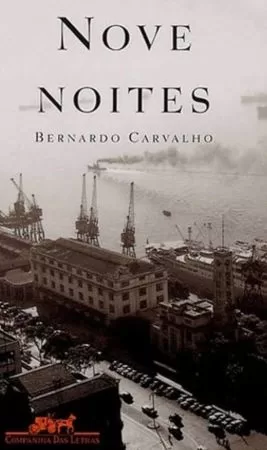
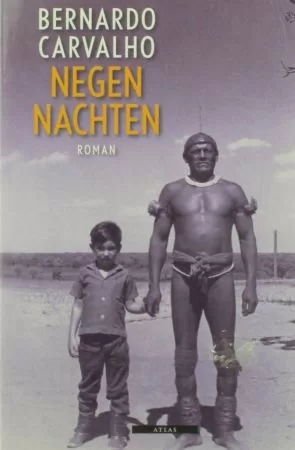
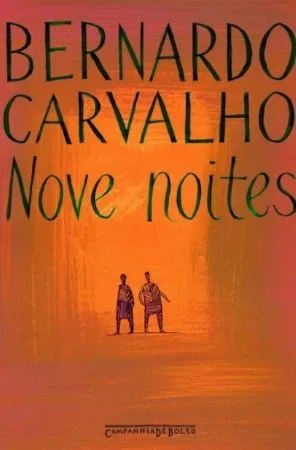
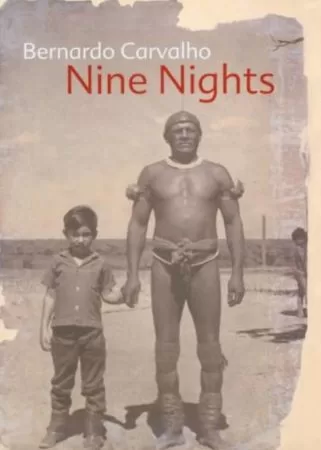
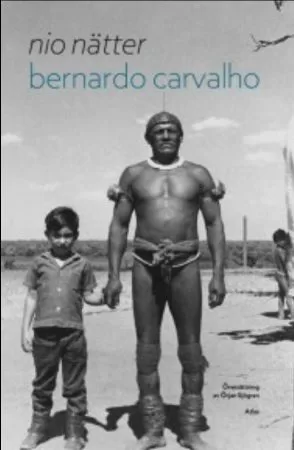
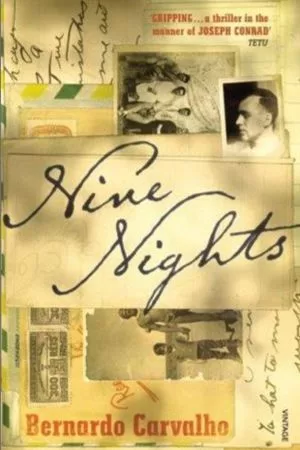
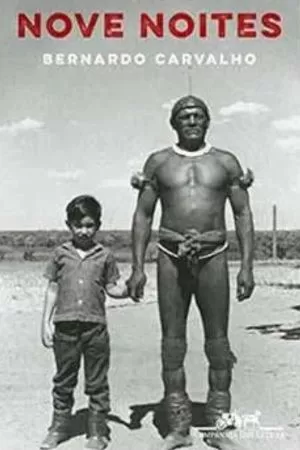
CARVALHO, Bernardo. Nove noites. São Paulo: Companhia das Letras, 2002.
Carlos Wender Sousa Silva
Illustrated by Léo Tavares
Translated by Kennedy Moen
Bernardo Carvalho, born in 1960 in Rio de Janeiro, is a writer and a journalist. He made his debut as a fiction writer with Aberrações (1993) and wrote, among others, the novels Onze (1995), Os bêbados e os sonâmbulos (1996), Teatro (1998), Reprodução (2013), and most recently O último gozo do mundo (2021) and Os substitutos (2023). Nove noites (Nine Nights, translated by Benjamin Moser, William Heinemann) was published in 2002 and received the Portugal Telecom Prize of Brazilian Literature (2003) and the Machado de Assis Award (2003) given by the National Library. The author’s style is marked by fragmented narrative and by tension and movement between reality and fiction.
Nine Nights is based on the true story of an American anthropologist, Buell Quain, who committed suicide at 27 years old when he returned, accompanied by two Indigenous people, from a visit to the village of the Krahô, located in what is now the state of Tocantins. It is a historiographical metafiction of sorts, given the cultural and political aspects that emerge as byproducts of the literary form itself. Bernardo Carvalho was inspired by an article written by an anthropologist who cited the case. Curious about the story, the author researched the man and sought, through fiction, to find a motive for his suicide. The narration is marked by a duality between the real and the fictional.
The novel is divided into 19 chapters in which two narrative voices are interspersed: Manoel Perna, fictional narrator and friend of the protagonist, whose text is written in italics in the first and most recent edition from Companhia das Letras, from which some clues, albeit vague, about the experiences and struggles of the main character are formed; as well as a first-person autobiographical narrator who seeks to include elements of his own personal experiences into the text. Maneol Perna, an engineer, was Buell Quain’s interlocutor, and it was to his house that the Indigenous people headed to announce the suicide and deliver the objects of the anthropologist. The second and main narrative voice is of the journalist-narrator who — as he fills in the gaps left by the other narrator with elements that were investigated, raised, imagined, verified, and fictionalized — also becomes part of the story by bringing his autobiography to the center of the narrative.
In the construction of the text, Bernardo Carvalho used a field diary that contained many of the psychological and emotional characteristics of the anthropologist, as reported in the interview Um escritor na Biblioteca (2024). The author included photographs, information from public archives, memories, and elements from other texts that involve real and imaginary characters in the construction of the novel. In this sense, it is a narrative formed from precariousness, from uncertainties, and from fragments of memory, aspects of which the reader is already aware of from the beginning. After his suicide, Quain left behind some belongings such as clothes, photographs, and letters. The local, Manoel Perna, who since childhood lived among the Indigenous people, also later attempted to find the motives for the ethnologist’s suicide and asked himself about the interests behind those, which directly or indirectly contributed to the reconstruction of the story. “Or do you think that when we look at ourselves we don’t recognize in others what we try to hide in ourselves?”
The autobiographical (main) narrator, in turn, also discovers his profound interest in the history of the ethnologist. He heard about Buell Quain for the first time in 2001, almost sixty-two years after the death of the anthropologist in 1939. He learned about the character’s story in an article that included letters from another anthropologist who also died among Indigenous people. But what would bring someone to become interested, decade later, in a story of suicide? While putting together the puzzle, this narrator created an image, similar to his own, of the anthropologist who killed himself: “upon saying that name out loud, I heard it for the first time in my own voice.” The historical and political context of the events is that of the Estado Novo in Brazil. Many intellectuals were persecuted and arrested by the regime, accused of being communists. The letters left behind by Buell Quain, in turn, do not say anything about the reasons for his death. The narrator then becomes interested in other letters that were not found, for a reason that the character tried to hide. The mystery acts as a stylistic and literary component of the novel.
The narrator searches for some documentation or evidence that reveals the desires and feelings of the dead ethnologist. But, in the letters, he finds only practical information about the character’s passage through Brazil and bureaucratic questions regarding civil life. During his research, the name of a possible female emotional partner of the young anthropologist surfaces, but, even though he had presented himself as being married upon arriving in Brazil, there was not “any other indication or reference to any woman in any other document or correspondence before or after his death.” So, the narrator begins to question: “What did Buell Quain want to hide so much?” In the search for the impressions that the figure of Quain had left on people, the narrator obtained only bits and pieces of the character. He heard, for example, reports that nothing was known about the enthnologist’s private life, neither that it was anything special nor that he tried to keep it private. But, the journalist-narrator “Was searching for any clue that confirmed or denied what seemed to me to be the crucial point.” But he does not find any element that provides a conclusion, even an incomplete one.
In turn, Manoel Perna says he shared nine nights with Quain after the two got closer. The retelling mixes accounts of personal experience and psychological and imagery projections. “What I’m telling you now is the combination of what he told me and my own imagination over nine nights.” It is revealed that Quain watched, with friends, a love story at the cinema that was “prohibited by the laws of a society of Natives. A love condemned by the gods. A taboo.” The character did not know how much of this prohibited love he carried within himself. Furthermore, he sought, in his research into the experiences of Indigenous peoples and other cultures, to question the norms and laws of his own society, perhaps finding a world in which he could reserve some space for himself. However, this search also imposed contradictions, dilemmas, and escapes.
The narrator remembers that Buell Quain carried with him a feeling of having lived outside of himself, like a stranger. He claimed that Quain traveled so that he could return back to himself. The trip appears as a metaphor of a mirror: it was necessary to get to know the other in order to then recognize oneself, one’s desires, and one’s feelings. The trip was also an escape — one that the narrator concludes was a result of Quain’s own failure. The death of the main character possibly reveals a desire to stop seeing himself in a world he no longer recognized himself as a part of. To some degree, seeing yourself requires facing fears, uncertainties, and incomplete ideas formed by yourself and by others. This incomplete and sometimes contradictory unrest persists in the entire narrative. Manoel Perna, self-defined as a humble country man (sertanejo), points out these discontinuities and the construction of maps and images by someone “that does not know the world and never saw the snow and now can’t separate his own memory from what he heard.” The autobiographical narrator, in turn, while attempting to draw his own maps and conclusions, questions if Quain was just running away from a personal ghost or from something objective and concrete. It is certain that, from the traces that say little to nothing about the reasons for a human’s attitude, the main narrator concludes: “People read poems to the best of their ability and in them understand what they want to. They apply the meaning of the verses to their own experiences that are accumulated up until the moment when they read it.”
The autobiographical narrator also talks about himself, about his relationship with his father, and about the visits the two of them had to the farms in Mato Grosso and Goiás. The father, in Brasília in the 1970s, arranged the purchase of large estates in the countryside and the receipt of subsidies to implement his agricultural project. These ambitions were in line with the military government’s program, “which, under the pretext of developing the Amazon, not only subsidized the purchase of hundreds of thousands of bushels at a bargain price, but then lavishly financed the occupation projects by farmers.” The narrator recounts this experience of the Brazilian dictatorial regime’s developmentalist economic-political project, which his father benefited from: “in general, all it took was cutting down the forest, planting grass and filling the farms with cattle. My father must have had the right contacts.”
The autobiographical elements mix with the fictional structure, leading us to what are just as much projections of memory as they are fictional constructions. The journalist-narrator concludes that this interest in someone’s past — and in his own — will not have concrete consequences since they are merely points of tension between fragments of personal memory and invented stories. But it is precisely in these sites of tension that literature works as a tool capable of inspiring in us the creation of a critical consciousness of human experiences and interests. Nine Nights takes this stance. On one hand, an autobiographical-narrator attempts to find, in a stranger, answers to his own experience. On the other hand, a fictional narrator assumes that he brings with him a mixture between fact and imagination, proposing to the readers that they imagine what he, the narrator, cannot tell or write about us. This double-biography approach exposes a narrative in which the multiplicity of stances and perspectives are adjusted to create a whole.
The responsibility of filling the gaps and making sense of the story is given to the reader, marked by one’s own experience and vision of the world. “Only you can understand what you want to say, because you have the key that I am missing. Only you have the other part of the story.” And it is precisely this multiplicity of voices, sounds, images, and perspectives that develops Nine Nights, forming a dimension for human reflection, be it real or fictional.
Further Reading
BEAL, Sophia (2005). Becoming a Character: An Analysis of Bernardo Carvalho’s Nove Noites. In: Luso-Brazilian Review, Vol. 42, n. 2, p. 134-149.
BIBLIOTECA PÚBLICA DO PARANÁ (2024). Um escritor na Biblioteca – Bernardo Carvalho. Cândido 149. Disponível em: https://www.bpp.pr.gov.br/Candido/Pagina/Um-Escritor-na-Biblioteca-Bernardo-Carvalho. Acesso em: 6 maio 2024.
COSTA, Claudia (2020). Nove noites desconstrói as estratégias da narrativa realista. In: Jornal da USP. Publicado em 05 de jun. 2020. Disponível em: https://jornal.usp.br/cultura/nove-noites-desconstroi-as-estrategias-da-narrativa-realista/. Acesso em: 6 maio 2024.
MATA, Anderson Luís Nunes da (2005). À deriva: espaço e movimento em Bernardo de Carvalho. In: Fênix – Revista de História e Estudos Culturais, Abril/Maio/Junho, Vol. 2, Ano II, n. 2, p. 1-20.
MICALI, Danilo Luiz Carlos (2008). A viagem de Nove noites rumo ao “outro”. In: Travessias – Educação, Cultura, Linguagem e Arte, v. 3, p. 1-22.
Iconography