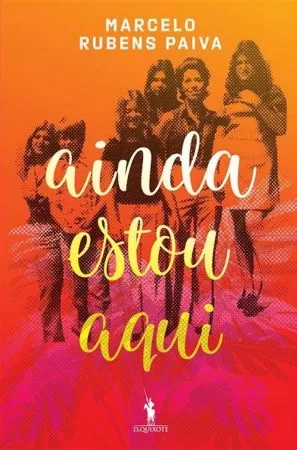
PAIVA, Marcelo Rubens. Ainda estou aqui. . São Paulo: Alfaguara, 2015.
Maria Eduarda Brum Silva Gomes
Illustrated by Léo Tavares
Translated by Martha Denton
The film adaptation of the novel I’m Still Here (2015), directed by Walter Salles and starring Fernanda Torres, launched Brazilian cinema into the international award spotlight. The film owes its critical acclaim to its masterful composition, memorable performances by the actors, and the thoughtful direction by Salles. Its positive reception earned the film the Oscar for Best International Feature Film in 2025.
As a result, the feature film magnified the discussion surrounding the book that inspired it, whose editorial success reached significant levels. Beyond the wave of sales and translations commissioned by other countries, the novel resulted in the discussion of its subject in the country’s most important judicial institutions. The novel’s impact was so significant that the Federal Supreme Court decided, in February 2025, to once again take up the case of the assassination of Rubens Paiva (1929-1971), reopening the debate over the Amnesty Law of 1979.
The book, however, did not limit the discussion to literary questions, but in many cases expanded it. Arriving at an important time, the work helped refresh Brazil’s memory. Just as the author wove the plot of the book, Brazilians were called to reckon with the country’s recent history. Through this effort, they perceived the gaps resulting from forgetting or denial. What lingers, long after reading the book, is its unparalleled poignancy in the current political moment.
The author, Marcelo Rubens Paiva (São Paulo, SP, 1959), is a playwright, columnist and writer of works of fiction and nonfiction. Of his works, his first, Feliz ano velho (1982), stands out, and upon its debut established Paiva as a well-regarded author. The book was adapted for theater and cinema, leaving a mark on the youth of the 1980s. Of his other works of fiction, Blecaute (1986), Malu de bicicleta (2003) and Do começo ao fim (2022) stand out as works of critical acclaim.
I’m Still Here, published in 2015, one year after the publication of the final report of the National Truth Commission, composes a biographical account using the results of investigations that led to the interrogation of agents, victims, and witnesses of the dictatorship (1964-1985). Among the reconstructed crimes was the assassination of deputy Rubens Paiva, father of Marcelo. In the book, information from the report and public archives is combined with the author’s memories. Merged together, the project is constructed. It is the second work of the writer, following Happy Old Year, which had already investigated his own history and that of his own family in his 20s, focusing on the accident that left him paraplegic.
However, in his 2015 work, the focal point of the novel is not the murder of his father Rubens, but the life of his mother, Eunice. Upon observing the memory loss of the family’s matriarch, attacked by late stage Alzheimer’s disease, Marcelo decides to document the process, culminating in the book in question. It is notable that the birth of the author’s son, in the same period, created the opportunity to simultaneously observe the baby’s acquisition of memories. I’m Still Here emerged from the synthesis of these factors.
The work is composed of observations about the nature of memory, interspersed with digressions. Details of the life of the Paiva family are learned through non-linear jumps in time that follow the paths of memory. The account integrates ellipses, reflections, and historical data to tell not only the story of the arrest and murder of Rubens, but also the family life of the author, during his childhood in the old Praia do Pinto, in the neighborhood of Leblon in Rio de Janeiro.
The Paivas are portrayed as a happy nuclear family. Until the trauma that would mark the family, the life of the Paiva family consisted mainly of get-togethers, beach days, travel, and foosball games. On January 20th, 1971, undercover agents arrived at the family home and took the former congressman to prison. Unjustly accused of connections to subversive guerrilla forces, Rubens Paiva was detained without the right to a trial. This moment initiated the trauma that would never cease to transform the family. On the following day, Eunice and Eliana Paiva, the oldest daughter, would be detained and interrogated. Eunice was tortured and, when liberated, would never find her husband, who died in the first days of detention. Considered to be disappeared, and with the information about his whereabouts withheld by the dictatorship, the death certificate of Rubens Paiva was not issued to the family until 1996. The book brings these events to light.
Driven by mourning, by the necessity for subsistence, and by the fight for recognition, Maria Eunice earned a law degree and went on to practice human rights law, with a focus on Indigenous rights. Throughout the book, Eunice is portrayed as a woman with a strong presence, an iron bond that unites the family. At the same time as she kept her children in the dark about the condition of her disappeared husband, leaving each, in their own way, to discover and process their grief, Eunice resigned herself to the difficult work of moving on, to the extent possible. Enveloped by heartbreaking grief, the matriarch never allowed her family to succumb to tragedy.
What draws attention in Marcelo’s narration is the honesty with which he discusses his mother. Portrayed in her contradictions, in moments of silence, distance, and privacy, Eunice is a complex figure, a symbol of family unity. Strengthened by the multitudes of her character, she searches for justice. Her fight endured through impairment from Alzheimer’s disease. The loss of memory of the mother, who in this moment of searching, is an indispensable figure in recording the family’s memories, is what motivated the book’s writing and Marcelo’s creative force.
Immortalized by literature, Eunice resists the institutional, legal, and cultural erasure to which she had been subjected. Her memory is restored through Marcelo’s writing. The book has become a cornerstone of the reclamation of memory, gathering momentum in a country accustomed to neglecting its history. Memory, if elaborated, presents an opportunity to bandage open wounds, to allow mourning, to formulate new questions, to reimagine future horizons. Language’s gaps and complexities open up space for elaboration, debate, and democracy.
I’m Still Here is a fundamental book for the interpretation of Brazil. And it is strengthened by the fact that, being an intimate and private story, it gains universality through the power of its narration. Through its film adaptation, it has moved audiences around the world. As a work of literature, it makes space for the details and minutiae that the film medium cannot accommodate. It is an invitation to Brazilians, above all, to explore the country’s past that continues to reappear in the present.
Further Reading
AINDA estou aqui (2024). Direção: Walter Salles. Produção: Maria Carlota Fernandes Bruno; Walter Salles; Rodrigo Teixeira. Distribuição: Sony Pictures Releasing. Brasil. Filme.
ALVES, Cristiane da Silva (2020). A história (não) acabou: Algumas notas sobre Ainda Estou Aqui, de Marcelo Rubens Paiva. In: GOMES, Gínia Maria (Org.). Narrativas brasileiras contemporâneas: memórias da repressão. Porto Alegre: Polifonia. p. 63-84.
CONTE, Daniel; PAZ, Demétrio Alves; SCARTON, Mithiele da Silva (2022). A elaboração do trauma e a luta contra o esquecimento em Ainda estou aqui, de Marcelo Rubens Paiva. Fólio – Revista de Letras, v. 14, n. 1, p. 329-346.
FERREIRA, Eliane Aparecida Galvão Ribeiro; BULHÕES, Ricardo Magalhães; BURGO, Vanessa Hagemeyer (2022). Literatura e memória como farol para o leitor: uma análise de Ainda estou aqui, de Marcelo Rubens Paiva. Literatura e autoritarismo, n. 26, p. 85-94.
SILVA, Maricelma da; TELLES, Luís Fernando Prado (2019). Sobre como não ir embora: memória e metanarrativa em Ainda estou aqui, de Marcelo Rubens Paiva. Raído, v. 13, n. 32, p. 130-155.
Iconography