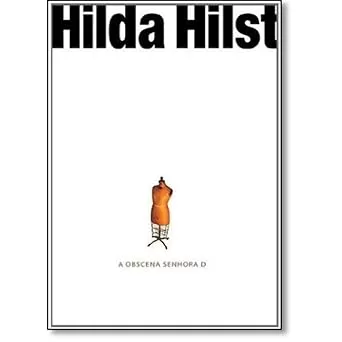
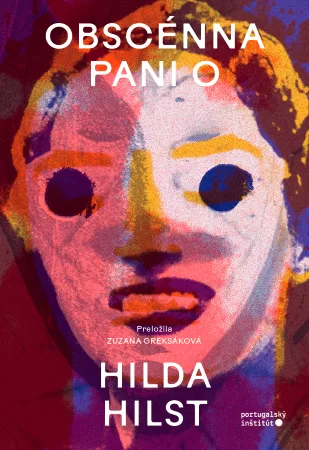
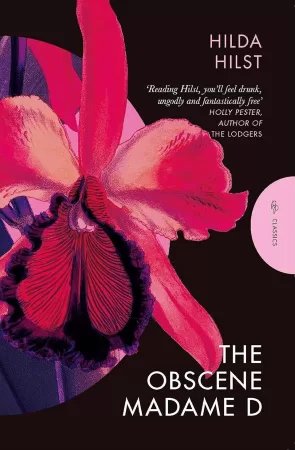
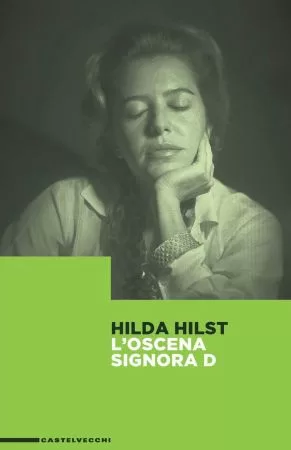
HILST, Hilda. A obscena senhora D. São Paulo: Massao Ohno, 1982.
Gabriel Pinezi
Illustrated by Léo Tavares
Translated by Svea Morrell
After her death, the São Paulo writer Hilda Hilst (Jaú, SP, 1930 – Campinas, SP, 2004) received international recognition as one of the most important female authors of contemporary Brazilian literature. In addition to having written critically acclaimed plays, she was specifically praised for her hermetic and experimental narratives and her exquisite modernization of medieval lyricism. In life, she used to complain publicly about the little attention paid to her by specialized critics or the general public, who knew her less from reading her and more from her extravagant biographical anecdotes: her failed attempt to seduce Marlon Brando; a reclusive life with her dogs at the famous Casa do Sol; the seven years she spent recording voices unexplainable to science which, according to her, came from “beyond.”
At first glance, a trained eye could recognize a sort of legendary exaggeration in this description. In the end, it might be easier to accept a biography in Hilst’s very own literary style, marked by tragicomic dispossession, acrid humor, blatant obscenity, and the frantic search for the meaning of invisible things. But there is no need, in this case, to force the issue, Hilst really was an odd individual. Once, the poet Claudio Willer explained in a lecture that his colleague Roberto Piva would go to Hilst’s house to discuss ufology and extraterrestrial life until late in the night. An astonished spectator asked, “but do they actually believe in it?” and Willer, before the question could dissipate into silence: “YES! SERIOUSLY!.”
While she never ventured into the genres of autobiography or autofiction, the amalgam of fiction and life is a characteristic feature of Hilst’s work which aligns itself with a romantic tradition that is not a Brazilian one of nationalist indianisms, but an existential-philosophical one of F. Schlegel. How can we fail to recognize in her characters’ fragmentary search for absolute knowledge Hilst’s own obsession, whose life was almost exclusively dedicated to writing? Everything that indicated the existence of “another” world, of a “beyond” that has not yet been experienced or known, interested not just the reclusive writer, but also the countless philosophical characters that inhabited her fiction.
Reading A obscena senhora D. (The Obscene Madame D, translated by Rachel Gontijo Araujo, Pushkin Press Classic), a novella originally published in 1982, reveals the unmistakable philosophical character of the work: when you read the narration of the main character, Hillé, you almost hear the voice of Hilda Hilst herself enunciating the infinite unanswerable questions that accumulate page after page, as if they fell abruptly from a high idealistic crane onto the hollow materiality of this world. Again, do not treat it as an exaggeration, in a book with barely more than 80 pages, there are exactly 355 question marks!
If only the actions are considered, the plot of The Obscene Madame D is shockingly simple: a sexagenerian woman, Hillé, vividly recalls conversations had with her deceased husband, Ehud, as she tries in vain to work through her grief. In these dialogues with a dead man, death itself becomes a theme repeatedly called upon: “one day I will understand, Ehud | understand what? | this question of life and death, these whys.” The complexity of the plot, therefore, is not exactly that of intrigue, of the causality of facts, but rather that of the experience of a mystery: it is about a search for the unattainable meaning of life, or as Hillé desires: “an obscene adventure, remarkably lucid.”
In her memories, Hillé is described as marked by the expectation of reaching this impossible understanding, subjected to the aesthetic experience of exile from the world while she lives underneath a staircase. While waiting, she systematically rejects the sexual advances of her husband, nostalgic to love her carnally, like they did when they were young. In fact, the funniest passages in Hilst’s prose result precisely from this striking incommunicability between two characters, which multiply in the innumerous dichotomies that structure the novella: if Enud is a man, Hillé is a woman; if Enud translates from “love” in Hebrew, Hillé translates from Ancient Greek to “the matter”; Ehud sees the world in a simple manner, he is pragmatic, does not question why, and Hillé questions everything, turns the truth into histeria, dethrones knowledge, renounces actions in the name of mere contemplation.
In summary, Ehud is a typical sad person, conformed to the clear borders between life and death, while Hillé is a melancholic who has always been understood as the surviving Lazarus: alive, but pregnant with death. That is why she laments under the stairs (like Dante in the dark wilderness, or Hamlet in a grave, or Faust in his study, or Baudelaire in the streets of Paris…) the inevitable and terrorizing passing of time, whose mystery is at once obscure and clear, evident and unknowable. Finally, nothing is as certain and logical as death: every man is mortal, Socrates is a man, so… what even is death?
Time and death are two keywords of the book, two that mix with ancient melancholic topos such as Cronus-Saturn who devours his own children: if the divine gave life to humans, it was only for power, following the violent removal of life. It is the realization of this ambivalence that motivates Hillé’s obsessive “desire to speak”: “I wanted to tell you, to tell you of the death of Ivan Ilitch, of the loneliness of this man, of the day-to-day nothingness that consumes the better part of us, I wanted to tell you about the burden of growing older, of disappearing, of this thing that already does not exist but is raw, alive, Time.” On the other side of this infinite lament, of this longing for the unnamable, Ehud appears as a man with simple, carnal, frustratingly unambiguous desires: “fuck, you hear Hillé? I love you, you hear? before you chose that damn stairwell, we fucked, didn’t we Madame. D.?”
If Bakhtin had read The Obscene Madame D, he would have certainly criticized the lack of historical and social anchoring of the characters, the limited description of the setting, the narrative flow that corrodes the borders between the voices instead of clearly demarking them. Let us say that it is not a polyphonic novel, which compartmentalizes a plurality of ideological positions, but — forcing an expression rarely approved of in literary theory — of a “dysphemic” narrative, in which the ghostly dialogue between the crazy old woman Hillé and her dead husband Ehud is marked by stutters: repetitions, cacophonies, redundancies that twist into falsities around a point in itself unrepresentable.
If Jakobson said that the poeticity of a text is recognizable by parallelisms, by circular structures, he could in fact recognize the poetry in Hilst’s prose not only in the genius utilization of metaphors, in the careful construction of rhythm, and the deliberate use of assonances, alliterations, and rhymes, but also in its annular narrative structure: if there is a stream of consciousness in Hilst, it is not a prosaic one that escapes in a straight line at a tangent escaping its center, it revolves around an unreachable void. The writing is infinite: because it falls forever, it cannot actually fall.
It is not an exaggeration to say that the structural narrative of The Obscene Madame D is identical to Samuel Beckett’s famous play, Waiting for Godot: in both pieces, the characters “wait” for something that never presents itself and, however, returns insistently as a subject, theme, central void; in both, the recognition of the absurd leads to sad laughter and comic tragedy. If at times the readers catch themselves laughing with Hilst’s book in hand, it is because they have slipped on the banana peel of despair and ended up falling with their mouth open wide and full of teeth into the void of existence.
Nevertheless, while Zarathustra’s prophecy is completely fulfilled in Beckett’s work, in Hilst, God’s negativity is felt less as death and more as abandonment: Hillé’s other name is D., as in Deus, but also as in “Dereliction”: “from now on I’ll call you Madame D. D for Dereliction, you hear? Helplessness, abandon, forever the soul in loneliness.” Critics may not yet have paid attention to the importance of Hillé’s ambivalent love for God, which expresses itself in the narrative structure of the novella as maybe one of the most extravagant love triangles of Brazilian literature: there above, at the top, the God-boy-pig indifferent to humanity, at the base, to one side, poor Hillé abandoned by her dear unreachable God and, on the other side, the cry of poor betrayed Ehud, incapable of touching his crazy wife whom he loves: “I, a man touching you because I love you and because the body was made to be touched, touch me too without this trouble, it’s beautiful and carnal, don’t bring the Other into this, don’t look at me this way, the Other nobody knows, Hillé.”
It is not accurate that Hilst was fair in complaining that, despite being famous, she was little read. We already can see, between 1989 and 2004, various dissertations and theses about her fiction, aside from the innumerous academic articles that tried to decipher the hermeticism of her narratives — a hermeticism that, by the way, becomes relatively clear when one knows the work of Ernest Becker, to whom Hilst dedicated The Obscene Madame D. It is even more probable that she had perceived that the metaphysical anxiety characteristic of his work generated resistance from an audience accustomed to a literature that believed itself to be all the more Brazilian and intelligible the more it flirted with realist aesthetics or social romance, in the style of writers such as Graciliano Ramos and Jorge Amado.
Breaking free from this tradition, just like Clarice Lispector and Machado de Assis, Hilda Hilst is an atypical case in the canon of Brazilian literature for having forced the highest recognition from specialized criticism so averse to irony, to hermetism, obscenity, and the tragicomic impetus. Its reading, today, as in its time, serves as an antidote to the most moralizing and realist tendencies that always seem to dominate the Brazilian literature system. Critics continue to be stupid, not understanding her work completely, it is true. But wouldn’t that still be understanding it well?
Further Reading
ANDRÉ, Willian (2016). Entre gaguejos:Hilst, Beckett e os limites da linguagem. Tese (Doutorado em Letras — Estudos Literários) — Universidade Estadual de Londrina, Londrina.
FOLGUEIRA, Laura Santos (2018). Eu e não outra: a vida intensa de Hilda Hilst. São Paulo: Tordesilhas.
DINIZ, Cristiano (org.) (2013). Fico besta quando me entendem: entrevistas com Hilda Hilst. São Paulo: Globo.
PÉCORA, Alcir (org.) (2010). Por que ler Hilda Hilst. São Paulo: Globo.
PÉCORA, Alcir (2018). Notas sobre a fortuna crítica de Hilda Hilst. Disponível em: https://unicamp.br/unicamp/sites/default/files/2018-07/Notas_sobre-a-Fortun-critica_Hilda-Hilst.pdf. Acesso em: 14 out. 2024
Iconography