LOUZEIRO, José. Infância dos mortos. Rio de Janeiro: Record, 1977.
Rafael Bonavina
Illustrated by Théo Crisóstomo
Translated by Shaina Thelen
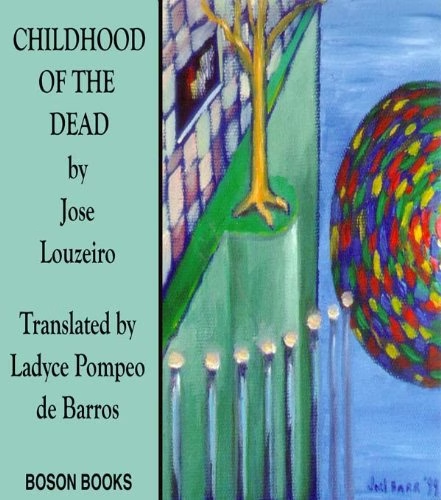
First published in 1977, Infância dos mortos (Childhood of the Dead, translated by Ladyce Pompeo de Barros, Boson Books) is the seventh book by José Louzeiro (São Luís, MA, 1932 – Rio de Janeiro, RJ, 2017). It is important to note that the novel was published three years after Operation Camanducaia, a real event that served as inspiration for the book. This operation was a tragedy that occurred during the Military Dictatorship (1964-1985) in which 93 children and adolescents living on the streets were removed from São Paulo, stripped, beaten with batons, and attacked by police dogs. After this assault, the boys were thrown off of a cliff near the city of Camanducaia, in the state of Minas Gerais, about 130 kilometers from the capital of São Paulo. Despite press reports and investigations, there were no legal repercussions and the case was quickly closed with those responsible acquitted. José Louzeiro, a journalist at the time, wrote an article on the subject, but its publication was censored. This greatly influenced him to write Childhood of the Dead—a novel in which the protagonist is one of the nearly one hundred victims.
The novel follows the lives of a group of marginalized children and adolescents who seek ways to survive in a society that denies them participation on various fronts—represented in the novel by the police, who constantly assault and persecute them, and by civilians, who mistreat and belittle them. Unable to find a place in society, steady work, or housing, these boys are eventually forced to take part in illicit activities, which, while minor initially, become increasingly serious throughout the narrative. Amid this process, the youths soon encounter organized crime and find themselves before a parallel power that also ends up exploiting them and, ultimately, denying them a place in its own structure.
In terms of the plot, the reader follows Dito’s journey, a young man who takes on a leadership role within his group of friends. At first, Dito insisted to the others that it was better to work honestly at the markets to earn a living than to resort to petty crime, which would eventually lead to trouble with the police. However, their earnings are very small and barely enough to survive on, which leads him to search for other ways to make money, some successful and others less so.
During this struggle for survival, Dito is arrested after killing a person who had turned him in to the police. In jail, the police do not believe his revenge story and torture him physically and psychologically in an attempt to force him to confess that the murder was ordered by someone above him. This incident leaves deep psychological scars on Dito, as well as some physical ones, such as a scar on his eyebrow. This remnant of torture becomes a very important element in the story, as the scar begins to burn and itch at various moments of intense irritation, indicating a physical, bodily manifestation of the indignation experienced by the character in the face of the various injustices he is forced to endure as an outcast. Combined with the tragic fate of some of his companions, this moment in the narrative can be understood as a kind of turning point, splitting Dito’s life in two: on one side, the street child who sought ways to survive; on the other, a young man revolted by the abuses he has suffered and continues to suffer without cause. From this moment on, the protagonist becomes fixated on the idea of taking revenge on all those who have wronged him.
From an aesthetic point of view, the novel incorporates several modern features of prose, such as descriptive minimalism and a dynamic tone, giving the narrative a movement that, combined with the structuring of the chapters as scenes, brings Childhood of the Dead closer to a film script. This, perhaps, is one of the characteristics that drew Hector Babenco’s attention to this book, on which he based his feature film Pixote, a lei do mais fraco (Pixote: The Law of the Weakest), which premiered in 1980. The film was well received by critics and won awards in several countries, even earning a nomination for Best Foreign Language Film at the 1982 Golden Globes.
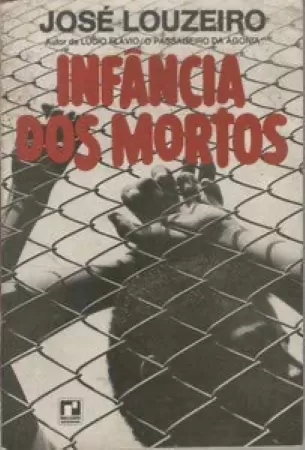
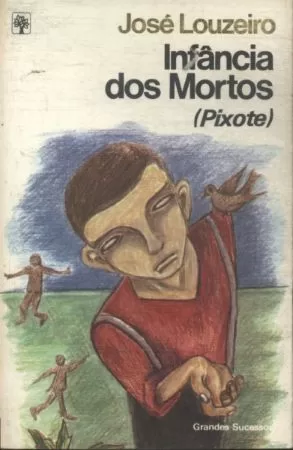
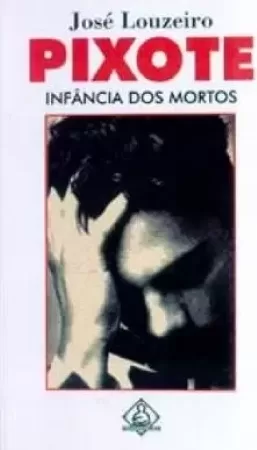
On one hand, the widespread impact of Babenco’s work drew many readers to the book, which is very positive, but this is not to say that the phenomenon did not have a significant influence on the reception of the novel itself. The transformation of the book’s covers illustrates this very well. In the beginning, the books bore the original title, Infância dos mortos, but more recent editions began to capitalize on the film’s success, adding “Pixote” to the cover art, as seen in the 1984 edition by Editora Abril. Over time, this insertion began to take up more and more space on the cover until it eclipsed the original title in editions from the 1990s onward.
In this way, the film’s major success inaugurated a second phase in the reception of the novel, now based on its relationship with the film. This is due in part to José Louzeiro’s participation in the production of the feature film, particularly in writing the screenplay. This creates a tension between his new cinematic language and the artistic foundations of Childhood of the Dead, as well as an intersection between Louzeiro’s style and Babenco’s art. The richness of these aesthetic dialogues explains, at least in part, the considerable attention that specialized critics have given to comparative readings of the works, which have already reached the level of postgraduate research.
Further Reading
CASTELO BRANCO, Bruna Maria Paixão (2020). O protagonismo do anti-herói na obra de José Louzeiro: análise do processo de criação do roteiro do filme Pixote – a lei do mais fraco. Dissertação (Mestrado em Cultura e Sociedade/CCH) – Universidade Federal do Maranhão, São Luís. Disponível em: https://tedebc.ufma.br/jspui/handle/tede/3107. Acesso em: 9 nov. 2023.
OPERAÇÃO Camanducaia (2020). Direção de Tiago Rezende de Toledo. Produção: Dudu Ferreira e Leon Cunha. Santo Estevão/BA: Cambuí Produções, (75 min.).
PIXOTE, a lei do mais fraco (1980). Direção de Hector Babenco. Rio de Janeiro: Embrafilme, 1 DVD (127 min.).
PINTO, Anderson Roberto Corrêa; FERREIRA JUNIOR, José (2017). O romance-reportagem de José Louzeiro no cenário de resistência à ditadura militar. Comunicação & Sociedade, São Bernardo do Campo, v. 39, n. 1, p. 69-93, abril. Disponível em: https://portalintercom.org.br/anais/nacional2015/resumos/R10-0295-1.pdf. Acesso em: 8 nov. 2023.
Iconography