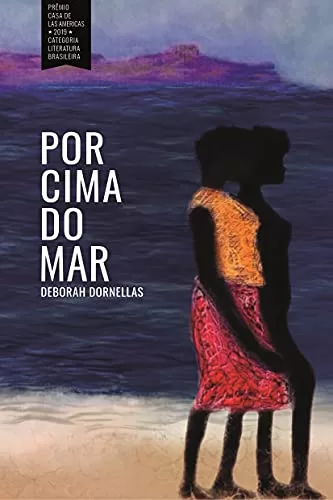
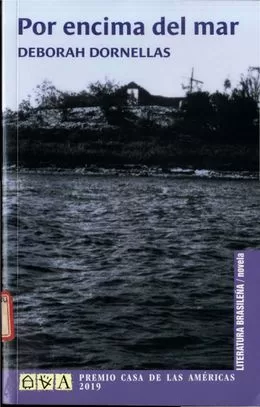
DORNELLAS, Deborah. Por cima do mar. São Paulo: Patuá. 2018.
Allysson Augusto Silva Casais
Illustrated by Malu Montenegro
Translated by Shaina Thelen
In the poem “Vozes-mulheres”, by Conceição Evaristo, the speaker traces the lineage of women in her family. Beginning with her enslaved great-grandmother and ending with her daughter, the speaker proclaims how the latter’s voice would be able to echo the silenced laments of past generations. The words of the youngest hold “the mute, silenced voices/choked in throats” and “the echo of life-freedom”, the result of women’s struggles across generations.
The sense of lineage expressed by Evaristo’s lyric speaker is similar to the relationship that the narrator of Por cima do mar (Over the Sea), by Deborah Dornellas (Rio de Janeiro, RJ, 1959), has with her ancestors. Published in 2018 and winner of the Casa de Las Américas prize for best Brazilian novel the following year, the work is Dornellas’s fictional debut. Previously, the author had published Triz, a collection of poems, and participated in publications by the Coletivo Literário Martelinho de Ouro.
Por cima do mar tells the story of Lígia Vitalina, a young woman born in Brasília. She is the daughter of a mother from Minas Gerais, who works as a housekeeper, and of a father from Ceará who became a candango, a term used to designate the laborers who worked on the construction of the federal capital, almost always originating from Northeastern Brazil. Black and poor, the family is marked by social exclusion. The capital that her father helped build forced the family to the outskirts, perpetuating the well-known pattern of marginalizing Black and poor people in Brazilian cities. Faced with this constant hostility, Lígia is driven to explore her ties to her ancestors, who were kidnapped from Africa to be enslaved in Brazil.
The first element that stands out in Por cima do mar is the spaces explored by the narrative. In contemporary Brazilian literary production, the city has special significance. It is often said that, starting in the 1970s, the authors of the country turned their gaze to the urban experience. Thus, works set in São Paulo, Rio de Janeiro, Porto Alegre, and other large metropolises, stand out. Brasília’s landscape, however, has been little explored by fiction writers. In Dornellas’s hands, the Brazilian capital is shaped as a hierarchical place, in which access to certain spaces are denied to specific people based on class conditions or skin color. In this sense, the portrayal of the University of Brasília (UnB) plays a prominent role in the novel as a representation of the exclusion suffered by part of the Black and poor population.
As a History student at UnB, Lígia feels like a foreigner at the university. While waiting in line for the bus to campus, she notices how people are “almost all white, or nearly white; they look at me, but I’m certain they don’t see me.” On campus, she takes refuge in discreet corners, using invisibility as a tool for survival in a hostile environment. It was only in the last decade, with the Quota Law, that the profile of the student body at Brazilian public universities, which are historically elitist, began to change. The greater inclusion of poor and racialized people in an elitist space did not occur without violent backlash from the Brazilian elite. Although the novel’s plot does not coincide with the period of history in which quotas were implemented at UnB, Dornellas nevertheless explores the resentment of the elite faced by Black and poor students at public universities.
In the novel, this is depicted in the clash between Lígia and Virgínia. Marta, Lígia’s aunt, works as a maid in Virgínia’s house, and a friendship is formed between the two girls. However, issues tied to class differences mark their relationship, even if in subtle ways. The principal conflict is the role Marta plays in Virgínia’s life. With maternal overtones, the bond between Marta and Virgínia sparks intense jealousy in Lígia. The scenes involving the three characters echo the problematic situation of how domestic workers in Brazil are separated from their families to play an emotional role in the lives of their employers’ children, assuming a responsibility that is not theirs to bear.
After the end of their friendship, Lígia and Virgínia only meet again years later at a university party. It is during a breakfast scene between the two women and Laura, Virgínia’s mother, that Dornellas touches on the conflict represented by UnB. “The question I remember most is that classic one,” Lígia narrates, “about how I managed to get into UnB.” Laura’s discomfort with the protagonist’s position in relation to Virgínia, who has been unable to get into college, is evident in the interaction between the two women. In this way, the resentment of the elite appears encapsulated in her character.
Beyond UnB, the hierarchical structure of Brasília is also present in other aspects of the novel. There is the relationship between Lígia’s father and the city, for example. Despite having helped build the capital with his own hands, the protagonist’s father does not have the freedom to frequent all of its spaces. As the narrator puts it, for the families of the candangos, life “was never easy in the city they built.” There are also historical events in the narrative, such as the raid on the Quarentão black dance party, which occurred in 1986 in Ceilândia, a satellite city of Brasília. Known for the police order “whites out, Blacks stay,” the event is a striking example of the violence inflicted for centuries against the Black population in Brazil. Even today, the killing of young Black people at the hands of the police is a recurring reality in the country.
One of the most impactful scenes in the narrative, however, does not take place in Brasília, but in Rio de Janeiro. Now an adult and a professor at UnB, Lígia travels to Rio de Janeiro for a conference. It is there that she meets Zé Augusto, an Angolan man whom she will later marry. Their relationship deepens during a visit to the Memorial dos Pretos Novos (Memorial of the New Blacks). Staring at the mural of names of kidnapped and enslaved Africans, Lígia realizes that “those poorly buried dead, my dead, were more alive than ever,” and becomes emotional. As a result, she connects not only with her family’s legacy, but also with the African continent. Equally moved, Zé Augusto points out the kinship between Lígia and himself, a “painful, deep, and ancient link that connects what is now called Angola to what was already then called Brazil.” From the Africans who were kidnapped, enslaved, killed, and discarded in the Cemitério dos Pretos Novos (Cemetery of the New Blacks), to the young people murdered by the police in Quarentão, to the manual labor of her parents and aunt, there are generations of suffering and struggle in Lígia’s history.
The second half of the novel focuses more on the Angolan setting. Dornellas, however, does not present a stereotypical Africa, avoiding an essentialization of the continent—a form of representation common in American narratives. Lígia draws direct parallels between the Angolan and Brazilian landscapes. “Many times, walking through the streets of Benguela,” she recounts, “although the environments are very different, I have this sense of familiarity.” Likewise, “the places and the people of Angola remind me a lot of certain small towns and the Black people of Minas Gerais.” Through Zé Augusto’s family, Dornellas writes about the history of Angola. Lígia’s mother-in-law, Dona Lali, is the one who recounts the marks the war left on the family. “We are a family of survivors, Lígia. Here in this land, in one way or another, we all are.”
Por cima do mar is a novel in which the women take center stage, especially the struggle of Black women. If, in the first part of the narrative, the strength of Lígia’s mother and aunt is highlighted, then in the second half, Dona Lali affirms that women are responsible for the survival of Angolan families. While Zé Augusto was in Portugal and his father was at war, it was his sisters and mother who fought against the chaos. “In Zé Augusto’s family,” Lígia narrates, “it was always Dona Lali who decided what, when, and how things would be done. In the midst of the seemingly endless chaos, she ensured their livelihood and held the reins of the family.”
In a novel about family history, the future is also important. Besides exploring the connection with her ancestors, Lígia looks to future generations as she experiences motherhood, which manifests both through adoption and pregnancy. The difference between the two is presented poetically by Lígia: in the first case, “a flower appeared in my garden one sunny morning,” while “the other, the man planted in me, and I give her shelter.” It is with the flower from the garden, Flora, that the narrative departs from a realistic tone. Together, mother and daughter fly over the sea, connecting Angola and Brazil. The crossing of the Atlantic, therefore, takes on a new meaning. From a painful rupture, the displacement between the two countries comes to be understood as a link—a union of different spaces and times that, despite their pain, continues to look to the horizon of a better future.
Further Reading:
CHIARELLI, Stefania (2022). Do navio-túmulo ao nome-escudo. In: CHIARELLI, Stefania. Partilhar a língua: leituras do contemporâneo. Rio de Janeiro: 7Letras.
ESPALLARGAS, Teresa (2021). Consciência atlântica: repensando identidades diaspóricas femininas nas contranarrativas de Um defeito de cor e Por cima do mar. Dissertação (Mestrado em Artes) – Universidade da Georgia (EUA), Athens.
Iconography