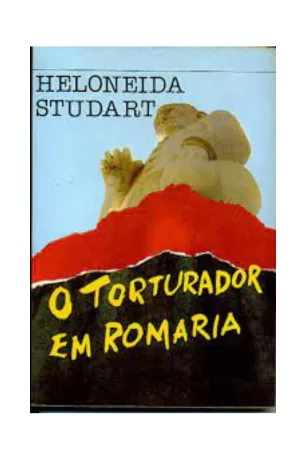
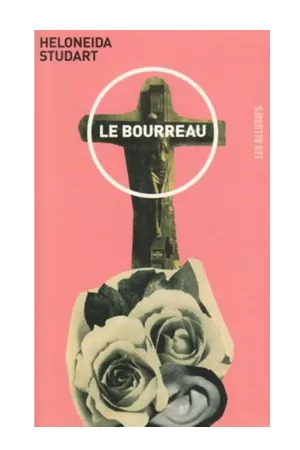
STUDART, Heloneida. O torturador em romaria. Rio de Janeiro: Rocco, 1986.
Leonardo da Silva Claudiano
Illustrated by Francisco Dalcastagnè Miguel
Translated by Annika Prickett
O torturador em romaria (1986) (The Torturer on Pilgrimage) concludes Heloneida Studart’s (Fortaleza, CE, 1932 – Rio de Janeiro, RJ, 2007) series known as “Trilogy of Torture,” which also includes O pardal é um pássaro azul (1975) (The Sparrow is a Blue Bird) and O estandarte da agonia (1981) (The Banner of Agony). Despite being part of a trilogy series, each novel is autonomous and can be read independently and in any order. The thread that binds each story into a fragmentary unity is the weight and excessive violence inflicted by the Brazilian civil-military dictatorship (1964-1985). By fictionally articulating state violations and the resistance imposed against them, the plots simultaneously provoke and put pressure on both the official discourse and the cultural environment that has sustained (and continues to sustain) it. This pushes the conversation, therefore, in the direction of a forced reconciliation based on memory politics that are guided by the desire to forget.
Heloneida’s works reconstruct state terrorism and its mechanisms of disciplinary fear—of violence inscribed on bodies. They recreate the grammar of indescribable horror and transform readers into witnesses. Thus, the novel adds to readers’ awareness of what transpired. The responsibility for the reproduction of violence, stemming from silence and a lack of punishment for state agents, is transmitted from generation to generation. Literature itself is transformed into a living archive to keep us alert.
In the work O torturador em romaria, the reader is introduced to the torturer Carmélio—or rather, Carmélio makes himself known. He has no qualms and dispenses with disguises. His presence is pervasive, seeping into every space—almost always with the arrogance of someone aware of the power he wields, the force he mobilizes, and the careful competence with which he executes the tasks delegated to him. Principally, he identifies himself and confesses to his crimes with the certainty of being above and distant from any legislation that could punish him, whether in the present or future. We are presented with a familiar and slippery narrator-character. In the first person, the narrator leads us through basements, the Casa da Morte (House of Death), bars, brothels, and the romaria de Padre Cícero (an annual pilgrimage to this priest’s statue in Juazeiro do Norte, Ceará)—always immersed in pain, blood, and death.
This is a curious narrator. Sadly and cruelly curious, he unsettles the reader, even removing the theoretical basis with which one tries to capture him. Far from realistic omniscience, Carmélio, unlike many narrator-characters, does not seem to care about gaining the reader’s trust. He abandons any subtle subterfuge and dispenses with pretenses of calculated weaknesses, typical of his character type. He discards, one by one, all known attempts at building empathy between the storyteller and the reader. He also shows no remorse for his actions, not even when he ventures into the backlands of Ceará on the path of religious sacrifice.
Everything happens in reverse: he does not harbor silences or reticense and he proudly displays the millimetric precision, the scientific nature with which he conducts his torture sessions. Even when the victim succumbs before a forced confession, he overflows with satisfaction because he carries within him immense destructive potential. He displays it. He does not seem to lie, nor does he seem to require the reader to participate in the subtle game between belief and disbelief that is regularly established with a narrator who presents himself in the text, whose story unfurls through his own actions as a character. Carmélio does not stumble in his speech, nor does he intentionally camouflage or affirm his perspective.
There is a feeling that he has no consideration whatsoever for the readers. Seeking approval? None. He does nothing, or very little, to convince through words. Carmélio imposes his truth on the reader, as usual. He is too mechanical for elaborate farces, incapable of the abstract. He speaks directly, which is to say he speaks through force. Uniform, homogenous surface, smooth. Not even the small rough edges that are created (the maternal abandonment, Dorinha’s contempt—the only woman who seems to have awakened something in him beyond objectification—and the Padre Cícero pilgrimage) lead him to sincerely question the role he plays in the structure of torture and disappearance.
Thus, Heloneida presents the reader with a narrator-character who defies customary categorization: to the same extent that he is meticulously integrated into the text, he seems not to belong to it—detached, yet aware of everything, such is the bureaucratization and monopolization of the surveillance and aggression he exerts. Furthermore, by constructing the plot from the perspective of the torturer, the author perturbs the reader beyond the subject matter, since she elaborates, through the narrator’s enunciation and metonymic device, the entire repressive machinery of the Brazilian civil-military dictatorship. There is no escaping Carmélio. No one escapes. And the tortured bodies multiply with each page.
It is interesting to note how the shift in narrative perspective opens up new possibilities of understanding. New aspects emerge and broaden the scope of analysis, further intensifying the debate about memory, truth, and justice. Many accounts are presented through the lens of the victims. Fundamental novels and testimonies reveal the confrontation with defeat during the exile or isolation of militants. One becomes aware of the dreams shattered by electric shocks and the pau de arara torture method; one sees the often futile attempt to resist, to prevent the undoing of the self, the rupture of the body/flesh with the subject— understood here as will, sensation, thought—in an almost always fruitless attempt to avoid being objectified before the one who inflicts torture.
These narratives seek, in some form, reconnection through language, in the transmission of experience and the consequent reworking of trauma. In the novel O torturador em romaria, on the other hand, Heloneida Studart uses the voice of the repressive agent. In doing so, she unveils the impersonal, all encompassing structure of violence, diluted by the social environment and accepted by it, implicitly or explicitly—because torture only exists through the relationship between the power that exerts it, the body on which it is marked, and the society that makes exceptions for it.
As the story progresses, the aggressiveness of the torturer raises questions: what drives a man to torture his fellow man? Why subject an individual to so much pain? Is it sadism alone? No. That does not seem to be the case, not the singular reason at least. If it were, the military justifications that excesses were committed by individuals in defiance of the law and without the general-president’s knowledge would have been justified. Carmélio, at various moments, seems to go beyond morbid pleasure in the pain of others. The perverse dimension where he finds himself places him in a kind of cold indifference to the suffering he unleashes. There is satisfaction, to be sure. But it comes much more from the activity he performs with care and the power of life or death he holds than from the amount of blood he sees spilled. Upon close analysis, it is a form of disconnection because torture breaks fundamental bonds of humanity in both the victim and the perpetrator.
In Carmélio’s case, the body/flesh is not dissociated from the subject, as it is for the tortured individual. Language is present. The unspeakable, the absence of expression, does not exist on his part. He is the one who causes pain, and technically, speaks about it. The rupture occurs between equals. The disarticulation, as Maria Rita Kehl tells us, occurs between a man (the torturer) and his fellow man (the tortured): it is the depersonalization of the one who receives the full burden of institutionalized violence; it is the body as an object devoid of life and will, as something at the mercy of, available, dehumanized—the amorphous mass delivered to the work of murderers. It can be said, therefore, that one does not torture one’s fellow man. First, disidentification is promoted. Then, the violation is exercised over a handful of skin, muscles, and bones—often naked, at other times hooded, but always broken and stripped of human dignity.
Finally, it is also necessary to acknowledge the desubjectivation of the torturer. Diluted within an immense apparatus that murders and disappears, he sees himself as part of it, as a mechanical being. He does not participate willingly—he does not possess the will to choose anymore—but rather, given how impersonal the task is to him, he performs it like any other.
He does not recognize himself in the pain he causes, immersed in the mechanical trance of the torture sessions. His trance remains through pleas for mercy or confessions, broken only by the silence of death that follows them. It is in this quietude that the pride of duty fulfilled manifests itself, robotically; it is the complete disarticulation of the subject, the dissolution of man in the repressive structure of which he is a part. He does not feel responsibility for the beatings he inflicts, nor for the burns he causes. He does not relate his actions to the inhuman screams he elicits from the throats of his victims. He is merely the one who executes orders within the organizational chart of state terrorism.
He is an employee, a cog in the machine, who is nothing special and, despite the horror he is capable of, leads a routine life, on quiet street corners and in a peaceful neighborhood. He is not the monster, but the man with a small farm and gardenias on his porch. He is not the exceptional case, the deviation from the system, but a part of it.
Heloneida Studart encapsulates within Carmélio and his victims all of these issues. Understanding them in their symbolic and concrete dimensions is fundamental. There is no complete democratic transition without truth, memory, and justice; without knowledge of the repressive mechanisms used by security forces and supported by parts of civil society. Only in this way is it possible to identify and overcome the practices of torture still in use and active against marginalized populations. In this dispute, literature plays a relevant role in the critique of the politics of forgetting and the pretense of normality.
Further Reading
KEHL, Maria Rita (2004). Três perguntas sobre o corpo torturado. In: KEIL, Ivete; TIBURI, Marcia (Orgs.). O corpo torturado. Porto Alegre: Escritos.
SOUZA, Ioneide Maria Piffano Brion de (2022). Entre o lembrar e o esquecer: a ditadura civil-militar brasileira a partir da Trilogia da Tortura de Heloneida Studart. Tese (Doutorado em História) – Universidade Federal de Juiz de Fora, Juiz de Fora.
TARGINO, Renata da Silva (2019). Poder, violência e subversão em O Torturador em romaria, de Heloneida Studart. Dissertação (Mestrado em Letras) – Universidade Federal do Amazonas, Manaus.
Iconography