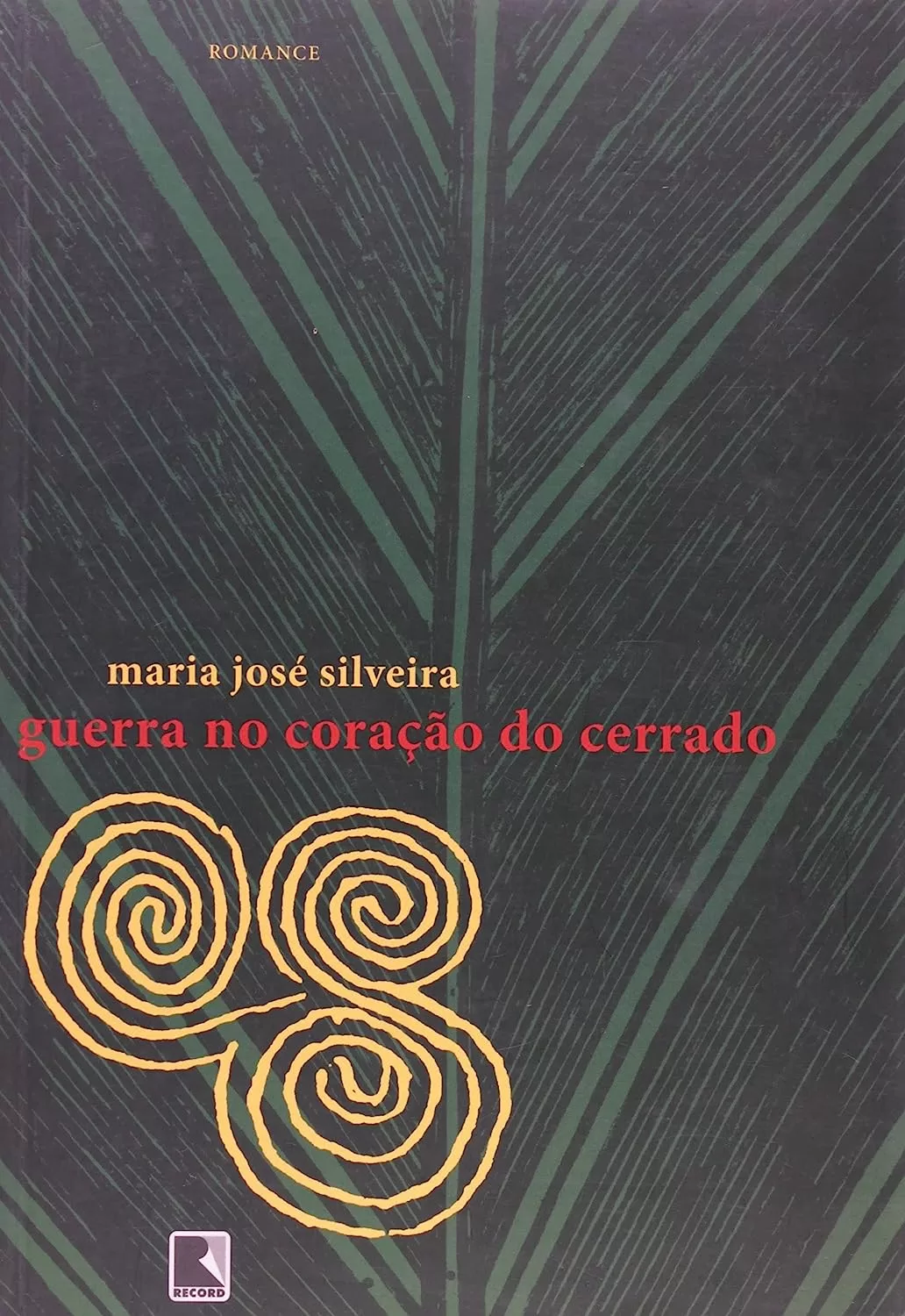
SILVEIRA, Maria José. Guerra no coração do cerrado. Rio de Janeiro: Record, 2006.
Maya Falks
Illustrated by Cláudio Rodrigues
Translated by Kennedy Moen
For anyone familiar with Maria José Silveira’s (Juaragua, Goais, 1947) previous works, the quality of the writing in her novel Guerra no coração do cerrado will come as no surprise. The Goianan author gained notoriety with her first novel, A mãe da mãe de sua mãe e suas filhas (The Mother of the Mother of Her Mother and Her Daughters), in which she utilizes impactful female characters to tell the history of Brazil.
A master of simple language that respects the subjectivity of her characters, Maria José Silveria is recognized by the thorough research she conducts in order to tell her stories. Upon situating her characters in the heart of historical events, the author is able to skillfully balance factual accuracy with the creative process, giving rise to the characters who are born from her own perception; this is what occurs with Damiana da Cunha, the protagonist of Guerra no coração do cerrado.
Damiana da Cunha is a real figure, an indigenous person of the Panará ethnicity—known as the Cayapó by the white population—who was treated as a hero by both her own people and white people. The author utilizes the prologue to point out this discrepancy: “Each side of a war has its heroes. What’s strange is when the two sides have the same hero. When this happens, something is wrong or out of place.”
Damiana, who was acclaimed as a legend in the Goianan territory, was raised among white people after the pacification, which was promoted by the then governor of the captaincy: Dom Luiz of Cunha Menezes. The narrative begins with Damiana’s arrival in Vila Boa, where Dom Luiz, frustrated with the scarcity of gold and hoping for a transfer to Minas Gerais, aims to pacify the Cayapós, a feared indigenous community in the region. After hosting the old chief Romexi as a guest, the governor convinces him to call the remaining of his people to settle in the town alongside the white people.
The story begins on a morning marked by a beautiful description of the sunrise, as the great leader Angraíocha and his people arrive in the town. Among his people are his grandchildren, who are baptized by the governor as Damiana and Manoel da Cunha. Between the two of them, only Damiana is welcomed to live in the governor’s house. There, she lives a childhood filled with rejection and discrimination by both the white members of the household and the enslaved black people, a product of the fear and legends that spread about the violence of her people.
Damiana receives a mission from Romexi to be the eyes and ears of their community alongside the white people, learning their language and culture and becoming a spokesperson for the two populations. The mission is successful, and she in fact does become that connection, earning the respect and admiration of both sides.
It is important to point out that there was never in fact a pacification; the Panará accepted a truce with the sole objective of rebuilding themselves after so many wars and getting more powerful weapons from the white people. At the beginning of this journey, the situation is portrayed in an almost comical manner, with the governor in constant conflict with the vicar. Damiana, in turn, was sanctified by the vicar for reacting to the passion of Christ with the same expressions that her people use to react to the suffering of others.
Damiana’s fascination with Christian celebrations contributed to her acceptance by white people, but it remains evident to the reader that it is not Christianity itself that captivated her. It was not about a genuine conversion, but rather about the connections the girl made between Christian celebrations and those of her people. The comparisons she, now a woman, makes that especially stand out are between the indigenous scarifications and the white scourge.
Even with notable similarities between the cultural expressions, the indigenous demonstrations were considered violent and savage. It becomes evident that ignorance about the culture of these people was not the only reason for this; there was a profound underlying hatred. The book frequently addresses a common debate at the time: are the indigenous considered human beings? Additionally, while Damiana is already experiencing a period of exhaustion from fighting for the survival of her people, she is confronted with harsh words that directly confirm that the land does not belong to her people. Therefore, it is not their right to reclaim it.
Throughout the trajectory of her life, despite being seen as converted by the white people, Damiana sought the survival of the Panará, undertaking an expedition on her own to search for relatives and bring them to the village Maria Primeira, where they had been living until then. Her idea was to increase and strengthen the population and to eventually have the ability to fight against the white people to reclaim their land. But, her actions ended up being seen by the white people as an opportunity for more manual labor and better control over the actions of the indigenous population. This resulted in the submission of the Panará into a situation similar to slavery, without actually protecting them from violence, especially considering that whenever a crime was committed in the region, the blame systematically fell on the Panará.
One notable case presented in the book was when a farmer entered the village and distributed clothes to the indigenous residents, forbidding the white guards stationed there from touching them. The indigenous people held a party wearing these colorful clothes, despite the fact that most of them were threadbare. It was a trap; the clothes were contaminated with smallpox, and the result was a true massacre. However, Damiana continued to believe the white people’s lies and carried out expeditions in search of relatives scattered throughout the Planalto Central to repopulate the villages. She first concentrated her efforts on Maria Primeira, and later, on Mossâmedes, where her people were forced to move due to the depopulation of the two previous places.
Even though Damiana was considered a hero among the white people due to her conversion and ease at which she brought the people to the villages and promoted their baptism, she, for her whole life, sincerely believed that she was fighting for her people. She viewed her actions as the crucial difference between life and death for her compatriots. It was only when she saw with her own eyes what the white people imposed on her people with each new invasion that the indigenous woman understood that no promise would ever be kept. It was at that moment that she understood that her ancestors were right to fight in every way possible to preserve their space and their culture. Unfortunately, for the Panarás, as the author states at the end of the book, it was already too late. The Cayapó ethnic group was declared extinct in the mid-20th century.
It is impossible to read this novel post-January 2023 and not notice parallels between it and what was discovered in the Yanomami lands; hundreds of indigenous—mostly children—dying of hunger in the heart of the rainforest. This loss was due to the establishment of illegal mining and the breakdown of health policies for this population. The mining contaminated the water and the soil, scared away the game, exploited workers, abused the people and brought them illnesses against which their organisms did not have defense, creating a legitimate genocide in the 21st century.
This easy comparison is possible because Maria José Silveira’s work is told through Damiana’s story, but other similar stories happened all throughout Brazil: the invasion of territories, “pacification,” cultural imposition, and many deaths. Damiana’s own brother, Manoel da Cunha, ends his life imprisoned; he was organizing a mass escape of the remaining indigenous at the request of Damiana, who decided not to return from her last expedition. The situation described suggests a paradox, since Manoel was not planning an attack, but instead only planning to abandon the space designated for his people, seeking to return to their ancestral lands. The main question is: if there is the promise of freedom, why would the leader of a departure be imprisoned as a criminal?
Maria José Silveira exposes the kind of work the Panará were subjected to, describing the punishments they endured, the hate from the white population, the cruel and murderous attacks, as well as the personal relationships themselves, made clear in the white woman’s reaction to Manoel’s marriage proposal—she did not just reject him, but acted with scorn—and in Damiana’s second marriage with an abusive man who tried to take advantage of her good reputation. He even tried to profit from her disappearance and faked her death. Furthermore, there is no shortage of everyday and unusual situations in the author’s narrative, which occasionally uses sarcasm to deal with the abundance of absurdities present in the story.
Despite Damiana having been a real person who played the historical role of the spokesperson of her people, the author highlights that the work is fictional, relying solely on real facts to present a fictional version of Damiana. The historical context, however, only diverges from reality because the reality portrayed in the story is, in fact, even more challenging.
Further Reading
COELHO, Damiana Antonia (2016). Representações de Damiana da Cunha na história e na literatura. Dissertação (Mestrado em Territórios e Expressões Culturais no Cerrado) – Universidade Estadual de Goiás, Anápolis.
JULIO, Suelen Siqueira (2015). Damiana da Cunha: uma índia entre a “sombra da cruz” e os caiapós do sertão (Goiás, c. 1780-1831). Dissertação (Mestrado em História) – Universidade Federal Fluminense, Niterói.
LAPIDUS, Ângela Maria Álvares (2020). Cayapós, caminhantes da história e da ficção em Guerra no coração do Cerrado, de Maria José Silveira. Dissertação (Mestrado em Língua, Literatura e Interculturalidade) – Universidade Estadual de Goiás, Goiás.
Iconography