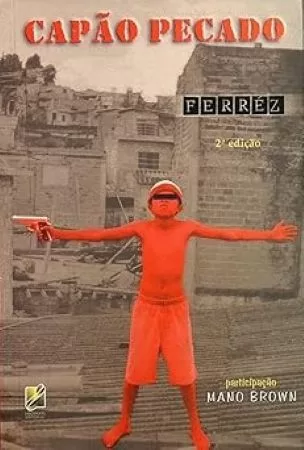
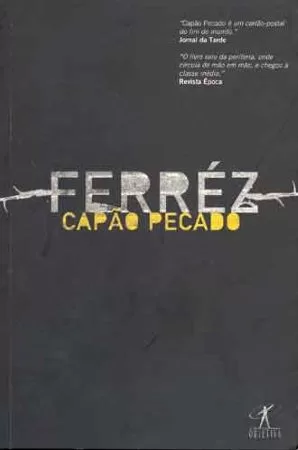
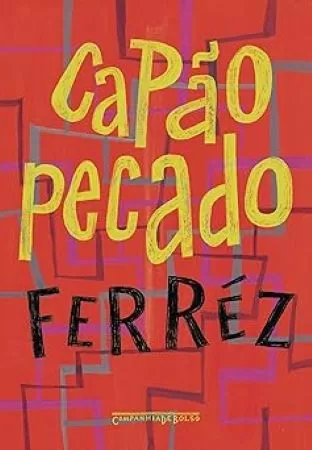
FERRÉZ. Capão Pecado. São Paulo: Labortexto, 2000.
Irene López Batalla
Illustrated by Théo Crisóstomo
Translated by Svea Morrell
Ferréz is the pseudonym of Reginaldo Ferreira da Silva (Capão Redondo, SP, 1975). His first published book was the poetry collection Fortaleza da desilusão (Fortress of Disillusion), which he self-published in 1997. He only became well-known, however, after the publication of Capão Pecado (2000), which has been revised and republished various times and translated abroad. The first edition was published by a small publisher from São Paulo called Labortexto, and 20 years later, in 2020, Companhia das Letras published a commemorative pocket edition of the book, which shows the continued interest in the novel.
The edition consulted for this review (Planeta, 2012) is composed of five parts and an afterword, with a brief text that introduces each of the parts. This edition, however, does not include the photographs published in the first edition (Tennina, 2019, p. 78). Nonetheless, the plot remains unaltered in the book’s different releases. The book recounts the life of the protagonist, Rael, alongside the stories of secondary characters, and is narrated in the third person. Much of the plot revolves around the relationship that Rael starts with his best friend Matcherros’s girlfriend, which has consequences both in Rael’s family and work environment, and in his relationships with his friends.
The texts that introduce each part do not obviously relate to the primary narrative. The first introductory text is a message from the author himself to the “system”. The second is a text by Ratão (from 1dasul, a brand associated with the low-income outskirts and founded by Ferréz); the third, from Outraversão (a band); the fourth, from Negredo (a musical group), the fifth, from Garrett (also from 1dasul); and the afterword is written by Ferréz. These texts come from people who are well acquainted with the novel’s setting: the neighborhood of Capão Redondo, on the outskirts of the southern zone of São Paulo. The references to rap and hip-hop in the novel are prominent, appearing as much in the introductory texts as they do throughout the narrative, alongside the mention of various names from the 1990s, which situate the novel within a specific era as well as reinforcing the spatial context.
Ferréz, as an author, is usually first introduced in paratexts of his work as a resident of Capão Redondo, highlighting the fact that he lives in this low-income neighborhood, noting other types of jobs that he had before his professionalization as a writer. However, it should also be noted that he has worked as a composer, screenwriter, singer, founder of the Selo Literatura Marginal, and organizer of three special editions of the magazine Caros Amigos (2001-2004) focused on “Marginal Literature. The Culture of the Periphery.” By editing these magazines, he was able to define a literary and aesthetic movement he identified with, defined by the author himself as “marginal literature”. In this way, Capão Pecado distinguishes itself from other works of the time through its differentiating aesthetic, in which contents and the ways of presenting them stand out as characteristics, in addition to the use of a language that reflects peripheral culture.
Capão Pecado, like later works such as Manual prático do ódio (Practical Manual of Hate) (2003)or Deus foi almoçar (God Went to Lunch) (2012), stands out as a creative work partly because the writing plays with references presented as reality/fiction, diluting the distinction between them. For example, some of the names used in the book, such as “Cebola,” appear in other works by the author and it is known, because of different sources and statements from the author himself, that they reference real people. Also, references to television shows and music allow the work to be situated in relation to a defined space and period, reinforcing the play between what is real and what is not.
The plot addresses, through a narrator in third person who observes reality from the inside, the life of the protagonist, Rael — anagram of Real (Penna, in Tennina, 2017, p. 285). The story starts with the main character moving to a new neighborhood, where he is introduced as “chubby, hair all curly, with large black glasses that he already had been using for a long time”. A few other brief references to Rael’s old neighborhood are made in scenes set in Capão Redondo where he gets a new job, which provokes a love story that has consequences for his daily life, and ultimately, for his relationships with friends and family.
In the first chapter, Rael compares the new neighborhood with the old, perceiving them as similar, imagining “in his small black and white television… a better reality”, in contrast with the environment he lives in. However, the novel does not have thorough descriptions of the setting or daily life, highlighting instead the love story as well as other parallel tales from other characters that end up converging or relating to the protagonist’s life. This is unlike the language that appears in violent scenes, particularly of a sexual nature, which is more detailed, where Ferréz describes the colors of the clothes worn and, on some occasions, the step-by-step actions.
Physical and psychological violence is as much present in interpersonal relationships as it is in interactions with physical spaces and the routines that take place within them. The narrator, on occasion, tries to explain or justify the violence, appealing to reasons such as characters’ need for cash or revenge, which serves as the background for deeper discussions about their surrounding reality. The narrator avoids oversimplifying these agressions. Instead, the narrator opts to offer different perspectives and points of view, not always in an explicit way, which invites the reader to reflect constantly on the events and their causes.
The number of characters in the novel contributes to a multiplicity of voices and perspectives — of friends, family, acquaintances and even strangers — that, aside from enriching the text and plot, offer different perspectives of events, making interpretation even more complicated. The novel’s 23 chapters demonstrate episodes that have more or less relevance to Rael’s central trajectory, including parallel stories that merge throughout the chapters. This segmented and interwoven construction favors polyphony and reinforces the idea that it is difficult to represent a story as singular. At the same time, it lets the author explore the novel’s language in a richer and more diverse way.
The different ways the author uses language, alternating between narration and dialogue, documents the different realities that the work seeks to represent. In the dialogues, it is possible to identify a speech closer to that used in peripheral spaces, full of references to the the environment in which the characters live and the way that they communicate with each other. These references deviate from standard vocabulary and construction, like referring to the police as “gambés”. This term is associated with slang from Racionais MC’s, a musical group from Capão Redondo, which was the inspiration for the Capão Dictionary project that uses the group’s lyrics to explain local slang. This bond with rap, however, is perceivable already in the construction of phrases itself: direct, with short and clear messages and punctuation that allow us to glimpse characters’ emotions when they speak, which sometimes makes it difficult to read the narrative, which is neither simple nor continuous.
In this way, one of the principal “difficulties” associated with the novel is that the language with which it is constructed is not accessible to everyone. Those who are not familiar with the reality of the periphery and the language of its citizens may face some obstacles in reading, even if they manage to follow the essential part of the love story. This “difficulty”, though, should not be seen as an insurmountable obstacle to reading, but instead as a valuable addition, contributing to greater representation within literature. The language also makes the literature more accessible to the public of these peripheral spaces who are more familiar with this way of speaking, rather than communicating with norms and vocabulary foreign to their reality.
In relation to setting, note that not only the neighborhood of Capão Redondo is represented, but also other peripheral and central spaces where people face hardships for survival, like the incident with the police in Rio de Janeiro. Furthermore, a cyclical structure is identifiable in the work, which starts by introducing the neighborhood and concludes, in the afterword, by explaining the change of name from Capão Redondo to Capão Pecado. Likewise, the timeline is cyclical. It starts with a memory from the protagonist, eager to read, reading a Christmas card that the company sends to his illiterate father. The book concludes, in the last chapters, with this same image, now contrasting that situation with an experience in an upper-class home.
To conclude, the metaphor in the afterword should also be considered. In the beginning and end of the book, an image presents the characters as trees: “everyone comes by and yanks a bit off of the unprotected tree”. The tree, “protected by the owner of the bar, who puts a wooden frame around it; […] it is safe, but its beauty is hidden”. Capão Pecado, like this tree, should continue to be read, not just to achieve better representation in terms of language and characters, but also to understand the aesthetic and themes of “marginal literature” in all its nuances, catalyzed by this pioneering novel.
Further Reading
BEAL, Sophia (2013). São Paulo’s Failed Public Works in Ferréz’s Capão Pecado and Luiz Ruffato’s Eles eram muitos cavalos. Brazil under Construction: Fiction and Public Works, by Sophia Beal, Palgrave Macmillan, p. 121-136.
OLIVEIRA, Vera Lúcia de (2017). Outros retratos, outras vozes na narrativa brasileira contemporânea. Estudos da Literatura Brasileira Contemporânea, Brasília, n. 50, p. 237-253. Disponível em: https://periodicos.unb.br/index.php/estudos/article/view/10179. Acesso em: 20 maio 2024.
RODRIGUEZ, Benito (2004). O ódio dedicado: algumas notas sobre a produção de Ferréz. Estudos de Literatura Brasileira Contemporânea, Brasília, n. 24, p. 53-67. Disponível em: https://periodicos.unb.br/index.php/estudos/article/view/9005. Acesso em: 20 maio 2024.
TENNINA, Lucía (2017). Ferréz: más allá del documentalismo. Estudos de Literatura Brasileira Contemporânea, Brasília, n. 50, p. 277-292. Disponível em: https://periodicos.unb.br/index.php/estudos/article/view/10181/9023. Acesso em: 20 maio 2024.
TENNINA, Lucía (2019). Ferréz: entre la propuesta colectiva y el proyecto individual. Anclajes, Argentina, v. 23, n. 1, p. 75-92.
Iconography