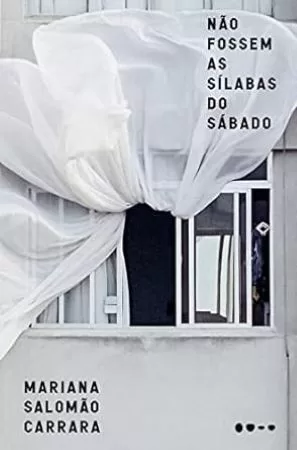
CARRARA, Mariana Salomão. Não fossem as sílabas do sábado. São Paulo: Todavia. 2022.
Ludimila Moreira Menezes
Illustrated by Catalina Chervin
Translated by Shaina Thelen
São Paulo-born writer and public defender, Mariana Salomão Carrara (São Paulo, SP, 1986) has an extensive and award-winning body of fiction in her biography. In addition to a collection of short stories, there are also novels such as Se deus me chamar não vou (Editora Nós, 2019), É sempre a hora da nossa morte amém (Editora Nós, 2021, finalist for the 2022 São Paulo Prize and among the 10 nominees for the 2022 Jabuti Prize), the 2022 novel Não fossem as sílabas do sábado (If It Weren’t for the Syllables of Saturday, published by Todavia and the winner of the 2023 São Paulo Prize for Best Novel of the Year), and A árvore mais sozinha do mundo (2024). She also won second place at the Prêmio Guiões screenplay awards (Portugal, 2019) for the screenplay of the feature film É lá que eu quero morar.
In the works of Mariana Salomão Carrara, death appears as a driving force that activates a first-person female narrative voice. Another stylistic feature of Carrara’s novels is the portrayal of friendships between female characters, which, within their domestic and subjective microcosms, reveal tensions that permeate the intimacy of children, adolescents, adult women, and elderly women. Beyond the female perspective being a stylistic device to explore themes of memory, puberty, racial tensions, and illness; it also delivers diction and spatial constructions that center the subjective experiences, dilemmas, and elaborations of a female universe grappling with family conflicts, absences, psychological suffering, and death.
Another hallmark of Carrara’s fictional universes is the long titles of Se deus me chamar não vou (If God Calls Me, I Won’t Go, 2019) and É sempre a hora da nossa morte amém (It’s Always the Hour of Our Death, Amen, 2021), which evoke a kind of fracture or joke with the religious universe. Even in Não fossem as sílabas do sábado there is something liturgical, and the staggered sentence structure, in addition to blending dizzying rhythm and lyricism, also draws on the reminiscences we have of Chico Buarque’s song Construção, in which a construction worker, who falls or jumps from a building under construction, “died going the wrong way, disrupting Saturday.” From this intersection of mnemonic traces, a lyricism of dramatic impulse, and an appeal to the tragic, the titles point toward the plots, their characters, and the agonistic temporality that shapes the novels.
If time and memory are metaphysical markers in the 2019 and 2021 novels, then in Não fossem as sílabas do sábado, grief and sisterhood catalyze a revaluation of the relationships of family and friendship and drive reflections about the effects of loneliness on two women who discover, early in the narrative, that they are neighbors and widows. It is a fiction grounded in the lyrical voice of a woman — widow and mother — who transforms the effects of the tragic event in her life into a language that transcends the work of mourning. From this, a story unfolds about the possibility of an absolute female friendship and other forms of parenthood, beginning with the presence of a child who lost her father.
Single motherhood, suicide, and two dead men form the core of a plot that explores the stagnant time of grief and the incomprehension, however veiled, of suicide. The city of São Paulo and a building in a middle-class neighborhood emerge as more than just settings, acquiring a sensory concreteness throughout a narrative marked by self-absorption and negative affects such as guilt and anger. The 28-year old narrator, Ana, upon finding out she is pregnant, decides to frame a poster from a film dear to the couple and, on returning home, asks her husband for help carrying it. Her husband, André, takes too long. As he leaves the building, he is struck and killed by Miguel and, in a twist of synchronicity and fate, this fall will forever affect the lives of the two widows, Ana and Madalena.
In Não fossem as sílabas do sábado, a traumatic thickness takes hold: the confessional voice of the narrator, Ana, forges a possession of loneliness, pain, and a kind of social anomie in the face of the tragic death of her husband, André, on the very morning she was going to tell him about the pregnancy. A double death overturns the notion of an ideal destiny, of symbiotic parenthood: the neighbor from the tenth floor, Miguel plummets to his death in a suicidal fall, which initially places his wife, Madalena, as a stranger and intruder within this new, shattered configuration of family.
Guilt and grief, like wandering beings, settle into a domestic dynamic of digressions, memorabilia, and Ana’s failed attempts to map the steps preceding the cataclysmic event. Madalena emerges as the one who Ana bills for the event, with the unspoken subject of Madalena’s husband, Miguel, hovering ghostlike in Ana’s speculations. Through a narrative attentive to the minutiae of the building’s architecture, the arrangement of the apartment’s furniture, Ana’s gestures of silence and anger, and the details of this paradoxical friendship with Madalena, the novel relies on bifurcated temporal flows. One, a time of writing (something between a diary and a testimony), and the other is a time of narration (a mixture of more detached reporting) that deals with the transformation of the characters in the face of their pain, memories, and desires.
The novel is constructed from a melancholic language and a narrative control that, in addition to revealing the stagnant plasticity of the apartment in the face of grief, fear, anger, and guilt; also manages to fuse the substrate of past recollections (the fear of forgetting her dead husband) and the painful ambivalence of an impossible friendship through scenes that sculpt the temporalities and intimacies of a decade. Stream of consciousness and an overlap of present and past guide us through Ana’s hypervigilant subjectivity, which reverberates with sensitivity and class consciousness as she examines domestic dynamics across a 10-year narrative cycle. Within these dense snapshots, the discomfort and relief evoked by the nanny’s presence delineate a plot that spirals between pain, self-criticism, existential emptiness, motherhood, and Catarina’s journey of growth.
In a city composed of a syntax of noises, bodies, and vehicles in transit, the narrator — an architect — finds herself stripped of the familiar spatiality and lived experience she once knew, and deprived of the ability to control her inner and outer worlds. Stunned by the promise of a baby’s arrival, the daughter, Catarina, finds a spark of otherness in her interactions with Madalena. Within this other spatiality of body and self, Ana finds herself facing a nightmarish journey involving the coroner’s office, the police station, and a tragic, epiphanic return to the new home — now marked by André’s absence, the pain of finding herself alone, the fear of raising a child by herself, and anger towards her suicidal neighbor. This anger will be directed towards her neighbor, Miguel’s wife, the Portuguese teacher Madalena. Although the story gains traction through Ana’s perceptions and moods, Madalena’s presence extends beyond the seemingly intrusive figure initially constructed by the narrator. Madalena ignites the spark of otherness in a minefield of depression and loneliness.
Although Madalena is the person who reawakens the memory of the fall and death, and sparks an urge in Ana to assign blame, Madalena — initially seen as an intrusive force — becomes the one who shares, to an extreme degree, the domestic, psychic, and emotional aftermath of the pregnant narrator. From a symbiotic grief and a diffuse, ambivalent hostility — which sometimes makes Ana feel like a better widow than her neighbor, and at other times makes her see in these circumstantial exchanges with Madalena a bond of care and a promise of acceptance — the novel redefines this paradoxical friendship, full of silences and distinct phases.
The birth of Catarina transforms Madalena’s previously unpredictable visits into something Ana desires, albeit unconsciously. In this new domestic microcosm encompassing the postpartum period, the arrival of a nanny and Madalena’s steady presence as a guide on this new journey resonate with Lygia Fagundes Telles’s epigraph, “If it is difficult to bear loneliness, it is even more difficult to bear companionship”. The primacy of the other two women’s gestures (holding the baby, cleaning, preparing food) echoes through Ana’s depressed language, as she grapples with a fragmented body that almost dissolves under the fear of what is to come.
The dramatic arc of the novel is forged both through the symptoms of Ana’s psychological suffering and through the complexity of a coexistence that merges friction, grief, and trust. Ana’s loneliness and the distancing of her friends reinforce the tacit pact of unity and communion between the two neighbors. It is an abrupt union, far removed from those shaped by traditional familialism or the support networks derived from consanguinity, but one that is formed under the sign of helplessness and the mobilization of loving forces for raising a child.
Mariana Salomão Carrara’s novel, even as it invests in a realistic, non-negotiable appeal regarding death, mourning, and grief, also carries in its wake an almost tactile and sonorous — therefore, poetic — imagery of motherhood in its exhaustion, in its agonizing calculations of the future, in a body that dissolves into milk, sleep, lethargy, and fear. The extreme experience of the pregnant body, of the subjectivity of a postpartum woman, of a child growing up with death as a part of the family, of two widows who sculpt a friendship amidst the damnations of a legal process and generous exchanges shaped by absence, allow for the emergence of a muted lyricism that does not lend itself to catharsis or lamentation. All the language in the novel flows toward an other (recollections, complaints, melancholy), largely due to the urgency of listening, of an incessant sharing of oneself, and of the pain of continuing to live.
Further Reading
PROENÇA, Giovana (2022). Não fossem as sílabas do sábado: ficção de afetos marcada pela tragédia. Pensar-Estado de Minas. Disponível em: https://www.em.com.br/app/noticia/pensar/2022/12/09/interna_pensar,1431299/nao-fossem-as-silabas-do-sabado-ficcao-de-afetos-marcada-pela-tragedia.shtml. Acesso em: 28 mar. 2025.
ARAÚJO, Cynthia Pereira de (2022). É sempre a hora da nossa morte. Folha de São Paulo. Disponível em: https://www1.folha.uol.com.br/blogs/morte-sem-tabu/2022/06/e-sempre-a-hora-da-nossa-morte.shtml. Acesso em: 28 mar. 2025.
Iconography