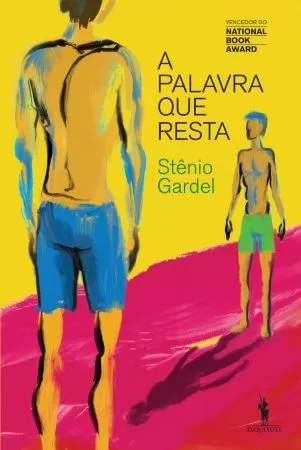
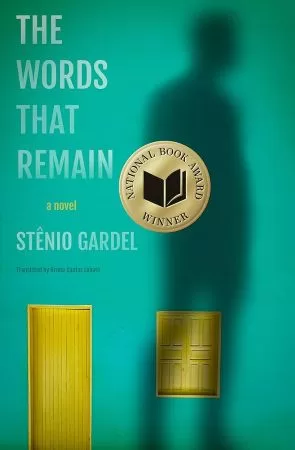
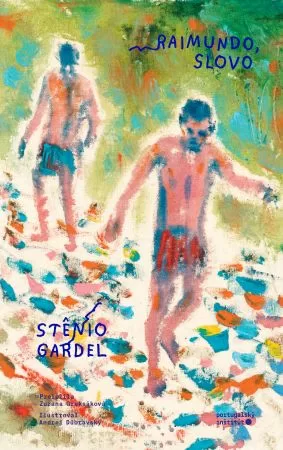
GARDEL, Stênio. A palavra que resta. São Paulo: Companhia das Letras, 2021.
Juliana Florentino Hampel
Illustrated by Cláudio Rodrigues
Translated by Shaina Thelen
Published in 2021, A palavra que resta (The Words That Remain, translated by Bruna Dantas Lobato, New Vessel Press) is the first novel by Stênio Gardel (Limoeiro do Norte, CE, 1980), a writer from Ceará. It was awarded the National Book Award for its English translation in 2023, which brought the author international recognition. The central plot is focused on the difficult love story of Raimundo and Cícero, set in the sertão (arid backcountry in Northeastern Brazil). In the background, the narrative explores Raimundo’s struggles with learning to read and deciphering the contents of the letter that Cícero left him when they parted ways.
In the present moment of the story, Raimundo Gaudêncio de Freitas is 71 years old and writes his name with difficulty, with “a tentative stroke, barely touching the paper”, having only recently summoned the courage to learn to read and write —“getting ideas, as he likes to say, about learning…as an old man.” His greatest wish was to be able to read the letter that his beloved had left for him 52 years earlier, “a whole letter. […] A lifetime kept in that letter”. Meanwhile, as the narrative unfolds, the reader will witness the acceptance and understanding of an identity that is born from writing.
Raimundo and Cícero lived in the same sertão community, and their families were neighbors. They had known each other since childhood and, with the arrival of adolescence, a passion blossomed — one that continued as a secret love affair until it was disrupted when both families discovered what they considered an “impure” act. Punished by his father and rejected by his mother, who even blames his “filth and impurity” for having caused the deaths of his twin brothers a few years before, Raimundo decides to leave his family home. He begins working as a cargo handler, traveling with truck drivers across Brazil, with no goal other than to survive. During one of these trips, he meets the trans woman Suzanný, with whom he begins to live, and he finally publicly embraces his sexual orientation.
Breaking away from a chronological narration of events, The Words That Remain possesses a dizzying narrative flow, interweaving Raimundo’s thoughts, his back-and-forth between past and present events, and the other voices that emerge in the plot through direct or free indirect discourse. According to Diego Barbosa (2021), in an article about the novel, this explains the constant presence of orality in the work, which reveals a “cartography of prejudice and silence”, exposing an “omnipresent and ferocious machismo, as well as painting a portrait of Brazil’s heart”.
The Words that Remain deals with failings: of words, of understanding, of acceptance of a universe that is unknown to us, and of the possibilities of love that are still condemned in our society. The protagonist’s search for the body of the word is equally a search for himself — to understand his own story and be able to tell everyone that he is in love, even if “there are no words, I got to find the few I got and tell them”. If those words are not enough, “we’ll fight if we have to because nothing can keep us apart anymore, they’ll have to literally cut us off, our flesh, to tear us off piece by piece”.
Raimundo’s pieces of flesh are truly torn off in the continuous beatings his father gives him, attempting to purge this evil and “filth” from his body. Yet the desire for Cícero and for words, which are intertwined throughout the narrative, only grows despite the frustration of not being able to experience them: “and that’s how school passed me by, my wish so close, the school getting closer and farther again”. The incessant effort to elaborate his story is built through thoughts that search for the right words, but cannot leave his mouth, because they continue to “resist and scream inside me […] I do like Cícero, my body begs for his, strong, manly, hard, riding on top of me”.
The novel is composed of four chapters. In the first, present and past are interwoven to tell Raimundo’s story in the rural community where he was born. The second returns to a more distant past, when Raimundo learns of the tragic story of his paternal uncle. In the third, Raimundo’s life unfolds after leaving his parents’ house and his meaningful encounter with Suzanný. In the fourth and final chapter, Raimundo delivers a long monologue addressed to his family and to Cícero, after returning to his family home for a visit, explaining that loving someone of the same sex is “not a death sentence, it’s a life sentence”.
One of the main turning points of the plot is the encounter with Suzanný, a figure who threatens the truth that Raimundo insists on hiding. The hybrid body of the trans woman allows Raimundo to question his own sexuality; yet, it is her courage that encourages him to come out and move forward to write his own story. While in the present of the narration Raimundo feels ashamed to return to school to learn to read at his old age, she explains to him that shame “is a useless emotion”, and that the only time she ever felt ashamed was when she tried to explain to her father her mismatch as a woman in a male body, using the image of a glass full of stones. The stones, she says, do not fit in the glass like water does, they leave empty spaces and “I feel like my body is filled with stones”. Because she lacked the courage to come out to her father, she ended up being kicked out of the house: “He could only see the shame […] Who wants to live with shame at their house? He kicked it out and it dragged me along, that’s it, what did shame ever do for me?”
Suzanný becomes the roommate who advises and guides Raimundo, and whom he looks to as he begins to change the course of his life. The decision to embrace his homesexuality is likened to becoming literate, “like the way I want to learn how to read and write, I made the decision to see the world differently, to feel more like I’m part of it, because ignorance does that, excludes, isolates, and didn’t I live in isolation?” Being able to speak openly with Suzanny is liberating, because “my words, they sounded different when they were the same as the words I had inside me”.
As liberating words take shape in his own thoughts, the protagonist of The Words That Remain begins to weave his own narrative. The visit to his childhood home and the reunion with his sister Marcinha after decades uncover dialogues with the past in which he searches for his identity, always carrying the letter that, in Natalia Timerman’s (2021) reading, holds the future of an entire life that has already become the past. The “silence carried by an unread letter becomes emptiness” (Timerman), an emptiness that can only be filled by the words of the novel that overflow like the river floods in his hometown. As the site of the furtive encounters of lovers and of the great tragedy suffered by the Freitas family, this river marks both life and death.
The waters of the river, as well as the floodwaters that inundate the paternal home, mark the before —represented by the cross, death, and the impossibility of living a love that repeats itself in every generation of Raimundo’s family — and the after, with the possibilities of dialogue between the lovers that are being expressed. A void that is being filled by writing in the new notebook Suzanný gave him, in which he records different versions of their reunion, and the voice of an absent Cícero emerges, referencing the letter: “he’ll come for me one day, when he hears the letter, he’ll look for me and he’ll find me and I’ll be waiting for him, because there’s no one else for me in this world”.
The Words that Remain transcends any classification as a genre novel or queer literature by penetrating the essence of multiple beings, broadening our understanding of humanity through a poetically crafted text that evokes the most beautiful universal images of literature to address themes of love, self-acceptance, violence, and social exclusion. In this way, the letter, the river, the cross, the cinema, and the bodies are materialized in Raimundo Gaudêncio de Freitas’s writing through a gaze that reveals both tenderness and pain, but above all, the courage to embrace one’s true self.
Further Reading
BARBOSA, Diego (2021). A palavra que resta, de Stênio Gardel, e a força da carta que guarda uma vida. Diário do Nordeste, Fortaleza. Disponível em: https://diariodonordeste.verdesmares.com.br/verso/a-palavra-que-resta-de-stenio-gardel-e-a-forca-da-carta-que-guarda-uma-vida-1.3074140. Acesso em: 30 abr. 2024.
BEZERRA, Thátilla Ruanna Dias (2023). Homofobia familiar em A palavra que resta de Stênio Gardel. Revista Educação e Contexto, Goiânia, v. 2, n. 2. Disponível em: https://revistaseduc.educacao.go.gov.br/index.php/rec/article/view/109/67. Acesso em: 30 abr. 2024.
SUZARTE, Eduardo Mezzavilla (2022). A fragmentação do romance em A palavra que resta, de Stênio Gardel. Trabalho de Conclusão de Curso (Graduação em Letras) – Universidade Federal do Rio de Janeiro, Rio de Janeiro.
TIMERMAN, Natalia (2021). As tantas margens do rio. Quatro cinco um, n. 46. Disponível em: https://quatrocincoum.com.br/resenhas/literatura/literatura-brasileira/as-tantas-margens-do-rio/. Acesso em: 14 jun. 2024.
Iconography