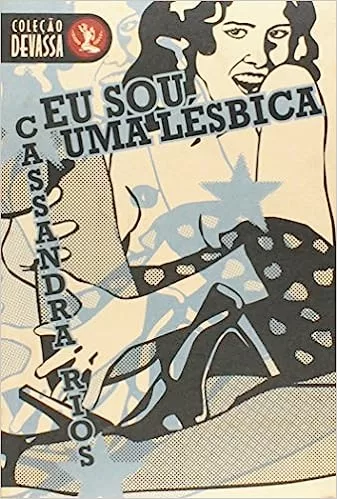
RIOS, Cassandra. Eu sou uma lésbica. Rio de Janeiro: Record. 1981.
Juliana Borges Oliveira de Morais
Illustrated by Mariângela Albuquerque
Translated by Rachael Fraser and Taryn Purchase
The first edition of Eu sou uma lésbica (I Am a Lesbian), written by Cassandra Rios (São Paulo, SP, 1932 – São Paulo, SP, 2002) was produced as a serial in the now discontinued “men’s mag” (or “revista masculina”, as it is called on the magazine’s cover) Status, between January and April 1980. In that version, the narrative is divided into four chapters, with one published in each issue of the magazine during the aforementioned period (issues 66-69). At a later date, the work was launched by Editora Record, in 1981, having been reworked into nine chapters with some revisions, which were kept in all subsequent editions. The second edition, also by Record, was published in 1983. The novel has seen various editions, the most recent published by Azougue in 2006 as part of their Devassa series.
Cassandra Rios is the pseudonym of the São Paulo-born Odete Rios. Born to Spanish parents, she grew up in the Perdizes district and released her first book, A volúpia do pecado in 1948 at the age of 16. The biggest challenge facing those who take an interest in Rios’s works is the difficulty of getting hold of them – even though, in the 1960s and 70s, she sold around 300 thousand books per year, making her “the most successful female book seller in the country,” according to Nilza Pereira. The novel Eu sou uma lésbica, out of print nowadays, is not an easy book to find even in the second-hand book market. For that very reason, when a copy is found, it tends to come with an equally inaccessible price tag.
This situation seems contradictory, bearing in mind both the author’s sales records during her lifetime and the fact that Rios “was the first woman writer to enjoy real popularity. Often invited onto TV programmes, she would frequently appear at parties sporting a tuxedo, hobnobbing with the local politicians of the time. She was both pop and cult at the same time” (Pereira). One would expect, therefore, greater recognition of her name nowadays, or at least greater evidence of her legacy on bookshelves. In this regard, the back cover of the Azougue edition of the novel contains the following provocation: “If you are under forty, you have probably never heard of Cassandra Rios. But she is simply one of the best-selling female writers in Brazil.”
The lack of availability of the author’s works on the market, including Eu sou uma lésbica, forms part of a wider phenomenon regarding the erasure of Cassandra Rios, which can be explained by the culmination of several factors, such as the choice of themes, which pervade all her texts, including this one. From her very first published novel, Rios wrote on taboo topics, such as lesbian relationships and female pleasure, at a time when these subjects were not written about so openly. In this context, Eu sou uma lésbica is regarded as the most controversial of the author’s works: the plot portrays not only female sexual desire, but also a girl’s growing realisation that she is a lesbian, upon falling in love with her mother’s friend, Kênia. In a scene which takes place when she is seven years old, the novel’s protagonist, Flávia, narrates how this infatuation began: sitting underneath a table, she is mesmerised by Kênia’s legs and feet. Looking back, as an adult, Flávia ponders how, even as a child, she understood how that feeling signified more than mere admiration. In no time, the girl grows close to Kênia and, at a certain point, seduces her. It is clear that Flávia, who is still a young girl, is first of all seduced by her own senses, by the sensations she experiences every time she meets her beautiful neighbour. Soon, Kênia, a married woman, ends up surrendering to these games of seduction, despite the strangeness she feels when faced with the child’s attentions. As previously mentioned, there are obviously several taboo themes present in the text, among them the sexual desire experienced by women and between women, as well as a child’s discovery of their sexuality.
In one iconic scene from the novel, Flávia has to stay the night at her neighbour’s house and, at one point, tells her that she wants to “play pussycats.” They play and, as part of the game, Flávia licks Kênia. Reading between the lines, a playful physical exchange does take place between the two. It is worth noting that it is when they are engaged in “playing pussycats,” that Flávia feels free to express her desire for her neighbour. The book, since the first edition, with Record, underwent a few textual edits and included chapter titles, making it different from how it first appeared in the magazine. In the earlier version, the text was separated into sections without titles. The first chapter in the book is entitled: “Shall we play pussycats?”, directly alluding to this episode.
As the novel progresses, alongside the theme of childhood discovery the protagonist also weaves in observations of and challenges to the society she lives in and its restrictions and prejudices. The narrator says: “I am a lesbian. Should society reject me?” The book’s title makes direct reference to the protagonist’s outspoken assertion of her identity. As for the plot, it explores and follows Flávia’s experiences as a lesbian, from childhood to adulthood. Reading Eu sou uma lésbica means being confronted with a narrative which explores still-existing taboos and provokes contemporary reflections upon the roles of gender and sexuality. Moreover, merely having a physical copy of the novel in your hands is already proof of the effort that went into finding it, since it is out of print, for a myriad of reasons: a fact which could be viewed as an “erasure.”
As for the writer’s erasure, beyond the nature of the themes that she chose to write about in a country marked by its conservatism, another important factor is the persecution she suffered under Brazil’s military regime (1964–1985). Kyara Vieira states that “by writing easy-to-read books, in simple, everyday language, which did not correspond to the aesthetic criteria that characterised the literary canon of the period, the author managed to attract thousands of readers in a country marked by illiteracy, without the need for much advertising. This meant that she also began to attract the attention of the press, literary critics, censorship regulators and the courts.” Rios’s style, considered too simple and crude, and dealing with the issues it dealt with, put her in a vulnerable position within a judgemental and repressive society.
According to Pedro Amaral, the Brazil in which Cassandra Rios was writing was conservative and hypocritical towards almost everything related to sex, meaning that her books were seen as outrageous, with their simple language and front covers which almost always portrayed a half-naked woman (Amaral). The writer was considered pornographic, and 36 of her 68 published books were censored by the military regime (Pereira). Rios was given the nickname “escritora maldita” (from the French ‘écrivain maudit’, meaning accursed writer) and had to deal with that stigma throughout her career. It is well known that sexual subject matter was the main target of censorship and, therefore, publications which explored such topics were deemed pornographic, and thus banned (Londero). The sexual revolution, which was emerging during that era, was seen as a great threat to society and to the institution of the family.
Finally, another motive which has contributed to the ‘memoricide’ of Cassandra Rios (here using a term coined by Constância Lima Duarte to refer to the erasure of Brazilian female writers, forgotten over time), is the attitude of intellectuals during that period. They disapproved of the language Rios used in her works; it was uncomplicated and lacked flourishes and imagery. This helps to explain the number of illustrations created by Darcy Penteado for the chapters of Eu sou uma lésbica in the four issues of Status magazine.
Rios was, therefore, looked down upon by intellectuals (especially literary critics) as much for her language as for her best-seller status, which provoked the accusation of her being complicit with a publishing industry which was viewed as lacking substance. However, Rios published mostly with firms on the fringes of the publishing industry, which was in the process of modernising at the time. It was only with the repeal of Law nº 1.077 in 1980 that she would be published by mainstream publishers, such as Record and Global (Londero). The repeal of the law in question helps to contextualise the initial, serialised publication of Eu sou uma lésbica, which took place at the start of the same year. Only in 1981, without these restrictions, did Record publish the first edition of the novel.
To conclude, the name Cassandra Rios was outlawed (by conservatives, intellectuals and the regime itself), despite her booming sales and the relevance of her work as a pioneer in terms of the representation of female desire in Brazilian literature and the visibility she gave to lesbian identities. Reading Eu sou uma lésbica, as well as Rios’ other works, therefore is a way of rescuing and redeeming this author, who was one of the most commercially successful and simultaneously persecuted female writers in the history of Brazilian literature.
Further Reading
A Safo de Perdizes (2013). Direção: Hanna Korich. Youtube. 62 min. Disponível em: https://www.youtube.com/watch?v=sSZu0dcHnpQ&t=790s. Acesso em: 11 mar. 2023.
AMARAL, Pedro (2006). Prefácio. In: RIOS, Cassandra.Eu sou uma lésbica.2. ed. Rio de Janeiro: Azougue. (Coleção Devassa).
LONDERO, Rodolfo Rorat (2016). Pornografia e censura: Adelaide Carraro, Cassandra Rios e o sistema literário brasileiro nos anos 70. Londrina: Eduel.
VIEIRA, Kyara Maria de Almeida (2014). “Onde estão as respostas para as minhas perguntas?”: Cassandra Rios – a construção do nome e a vida escrita enquanto tragédia de folhetim (1955-2001). Tese (Doutorado em História) – Universidade Federal de Pernambuco, Recife. Disponível em: https://repositorio.ufpe.br/bitstream/123456789/11869/1/TESE%20Kyara%20Maria%20de%20Almeida.pdfAcesso em: 18 maio 2023.
PEREIRA, Nilza (2004). Na contramão do cânone. A Tarde, Salvador, 30 out. Caderno Cultural, p. 8-9.
Iconography