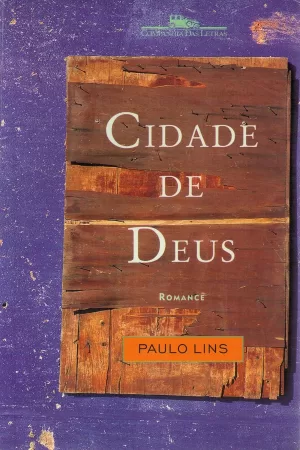
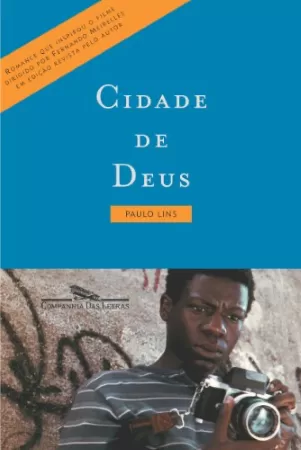
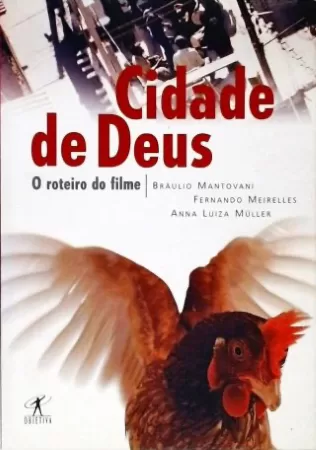
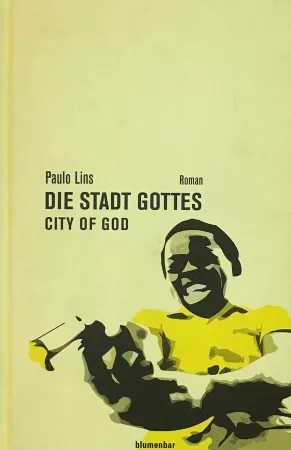
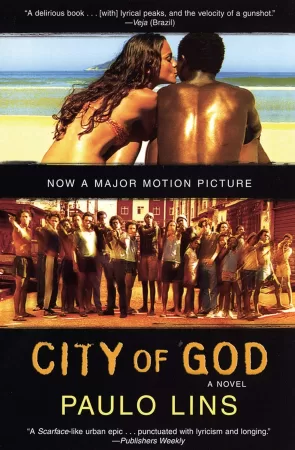
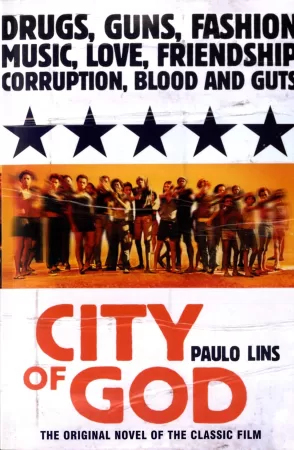
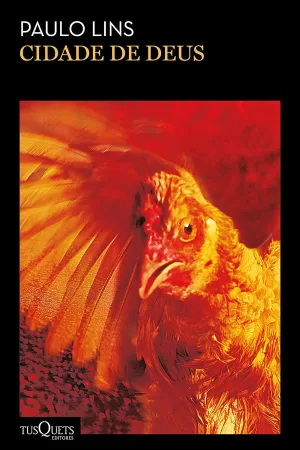
LINS, Paulo. Cidade de Deus. São Paulo: Companhia das Letras, 1997.
Paulo Scott
Illustrated by Cláudio Rodrigues
Translated by Claire Williams
Cidade de Deus (City of God), by Rio-born author Paulo Lins (Rio de Janeiro, RJ, 1958), published by Companhia das Letras in 1997, transfigures into fiction the violent social reality for people the State has rendered subaltern. The plot revolves around the site-specific series of events that marked the first twenty or so years of an urban housing estate in the Western region of the Rio de Janeiro municipality: a neighbourhood established in 1966, called Cidade de Deus. This period coincided with the regime of the Military Dictatorship which took control of Brazil in 1964. Although it was built to house working people, the neighbourhood quickly became known for social marginalisation. This was a topic which, until 1997, had not been sufficiently analysed in Brazilian literature.
Thanks to its extensive and impactful success with critics and public alike, this novel was soon considered a watershed in Brazilian literature, not only because it was the forerunner for other works, that would also gain attention, but because it paved the way for other authors to use similar ways of dealing with the topic. The book placed new subject matter at the heart of Brazilian literature, and introduced new perspectives from which to approach it. Even though it came out in the 1990s, Cidade de Deus was right at the forefront of what would become known as Twenty-First-Century Brazilian Literature.
The novel is divided into three long chapters: the stories of Inferninho, Pardalzinho and Zé Miúdo. It encompasses multiple successive and intertwining plots, quests and conflicts which, in the general context, end up by feeding into one overarching dramatic plot. It is centred upon a character named Inho, who later starts calling himself Zé Miúdo. This character’s plotline contains the desire which, from the very first pages of the book, drives the action. His story is linked to the representation of time, the passing of time, the time which covers a critical period in the recent history of the city of Rio de Janeiro, and it does so by focusing on a specific location, one that can be read, metaphorically, as a version of hell, as the permanent horror caused by the State-orchestrated confinement of a socioeconomic group.
Present in all three chapters is a strategy of telling stories, a formula which reveals or gains relevance in relation to those characters who yearn for a leading role. These are mostly young black men who become the heads of local crime gangs, always in attrition with each other. They gain power and then, almost invariably, suffer defeat. They gain prominence, but it is only provisional (this also applies to the various policemen who appear during the course of the novel), demonstrating just how transitory life can be in a space and a social environment so deliberately toxic as the Cidade de Deus featuring in Lins’s novel.
Thus, by means of the fictional truth he has chosen to assert, the author sets up a sort of cartography, mapping a territory layered with precarities that are the direct result of a twisted order, a constant chaos, sustained by systematic state oppression (which also reveals itself through intentional, planned omissions; turning a blind eye and letting people kill each other). This is a place where all chances of making an ethical choice have been eliminated and, consequently, ethical solutions are no longer possible.
If we read Cidade de Deus as I have suggested, a cartography, we could see it as the record of an ethical failure overseen by a perverse development project that silenced and eliminated a whole group of people, making them invisible. At the same time, it can be read as a concerted attempt to not give in to this destructive inertia, an attempt to not surrender one’s sense of self and one’s resistance to the apocalyptic project dedicated to maintaining social inequalities. This is what we find in the following passage: “The new residents brought garbage, bins, mongrel dogs, exus and pombagiras in untouchable bead necklaces, days to get up and struggle, old scores to be settled, residual rage from bullets, nights to hold wakes over corpses, vestiges of floods, (…). They also brought love to ennoble death and silence the mute hours”.
This “love to ennoble death” sums up nicely the game of expectations present in the conflict worked (and reworked) to exhaustion in the novel. There are many deaths amid its pages, deaths resulting from a violence that interrupts and shatters all efforts to live a decent life. There is little hope of achieving some kind of dignity in any long-lasting way, so the distinguishing factor between the most significant characters (out of the long list of almost two hundred named characters), ends up by being not only simply managing to survive, but, on top of that, the search for some reason to continue to exist when death is constantly so close by.
There is preparation for hope and for the worst outcome, there is affection and there is love (different ways of demonstrating love), there are characters who have never known love, there are others who have given up on it, and those who insist on preserving it.
One character who becomes the antagonist of Zé Miúdo and who best represents this attempt to preserve love and ethics is Zé Bonito, who does not appear until the third chapter. A victim of Zé Miúdo’s violence (because he is, and has, everything the other will never be, or have), Zé Bonito comes to embody a reactive presence: he is like the ethical opposite to his enemy. The clashes between the two highlight just how a place of so many extremes, like Cidade de Deus, destroys the will to construct a society that is less negatively affected by death.
Understood from this perspective, Cidade de Deus is the presence, the atmosphere, the gravity which conditions all subjectivities, almost definitively: the target of programming by the elite which pulls the strings of the organs of the State until countless similar contexts appear throughout the country. This concept has been astutely identified and captured in the verse-poem-banner created by writer and artist Aline Motta (2022): “PEOPLE DON’T KNOW, BUT PLACES KNOW”.
In this sense, the neighbourhood of Cidade de Deus would be the setting for an “ethics of violence”, absorbing all the fears that turn into the suffocating way the space functions. The third person narrative voice, an absolutely omniscient narrative voice, is sometimes neutral and almost objective, and at other times intrusive, bringing about a permanent dislocation of the narrative focus, what we might call a floating narrative focus. This effect is important, because there are times when it seems as though it is the city of Rio de Janeiro that guides the narrative voice. This produces the impression of bearing witness, almost like the tone of a documentary or a discourse more like that of the newspaper crônica (although it would be difficult to mistake one for the other), as if it were attempting to forge a literature of witnessing.
Paulo Lins grew up in this community, he witnessed young leaders of drug-trafficking gangs emerge and disappear, he witnessed the resurgence of the police presence that then led to the growth of the militias – a phenomenon that gained notoriety in the twenty-first century. He also observed the increasing influence of the neo-Pentecostal churches, the emergence of the Comando Vermelho criminal organisation from the end of the 1970s to the early 1980s, and many other transformations of greater and lesser impact.
For all these reasons, Cidade de Deus has become a milestone in contemporary Brazilian literature, because it brought right up to date the way social conflicts were perceived, and provided a way to read them: through the weaving together of stories. The novel emphasised a truth that could only be constructed and represented through the power of fiction. This was clear from its immediate reception: its stimulation of other forms of art (the repercussions of the film adaptation by Kátia Lund and Fernando Meirelles are well known), and public debate too. Before writing the novel, Paulo Lins had already tried his hand at poetry, publishing a collection called Sob o sol in 1986. After Cidade de Deus, he brought out another novel, Desde que o samba é samba (2012). It is notable for the extensive research conducted by the author into Rio’s music culture during the first third of the twentieth century and its impact on the construction of black Brazilian identity. Then, in 2019, he published Dois amores, another work uncovering the idiosyncratic ways black people and those from the periphery are never allowed to be protagonists in society. Never again, however, has he confronted the theme of violence in such a concerted way as he did in Cidade de Deus.
Further Reading
AMODEO, Maria Tereza; MATTE, Gustavo Arthur (2014). Perversidade, fábula e utopia em Cidade de Deus, de Paulo Lins. Antares, v. 6, n. 12, p. 95-116. Disponível em: http://www.ucs.br/etc/revistas/index.php/antares/article/viewFile/2958/1808. Acesso em: 18 jun. 2018.
BARROS, Sandro R. (2012). Cidade de Deus: entre o testemunho e a ficção. Estudos de Literatura Brasileira Contemporânea, Brasília, n. 40, p. 135-149.
COSTA, Keila Prado (2008). O que é meu é meu, o que é seu é nosso – Questões de/sobre Cidade de Deus. Revista Criação & Crítica, Universidade de São Paulo, n. 1, p. 31-43.
MOTTA, Aline (2022). A água é uma máquina do tempo. São Paulo: Círculo de Poemas.
PELLEGRINI, Tânia (2004). No fio da navalha: literatura e violência no Brasil de hoje. Estudos de Literatura Brasileira Contemporânea, Brasília, n. 24, p. 15-34, 2004.
RIBEIRO, Paulo Jorge (2003). “Cidade de Deus” na zona de contato: alguns impasses da crítica cultural contemporânea. Revista de Crítica Literaria Latinoamericana, Medford, Latinoamericana Editores, v. 29, n. 57, p. 125-139.
ROCHA, Renato Oliveira (2015). O vínculo de Cidade de Deus com a realidade. REVELL – Revista de Estudos Literários da UEMS, Universidade Estadual de Mato Grosso do Sul, v. 2, n. 7, p. 19-32.
Iconography