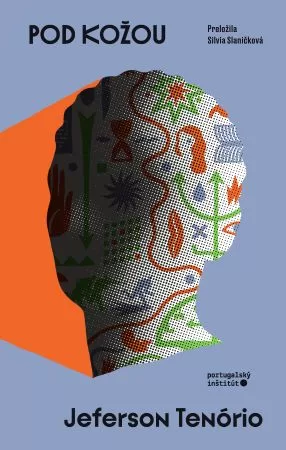
TENÓRIO, Jeferson. O avesso da pele. São Paulo: Companhia das Letras, 2020.
Nicola Biasio
Illustrated by Douglas Ferreiro
Translated by Alice Easey and Juliet Hussell
It all starts with a son, in search of his absent father, in the living room of an empty house. A son in the process of going through the effects of his late father, who was killed by a white policeman in the city of Porto Alegre, in the south of Brazil. Whilst examining these effects, the son also starts to uncover memories of a father who he is only able to get to know after his death. It all starts (or better yet, ends) behind the door of that living room, where, inside an alguidar (bowl used candomblé rituals), an ocutá stone imbued with the spirit of the deity Ogum awaits the boy, to lead him towards the abyss where his father was lost.
Jeferson Tenório’s (Rio de Janeiro, RJ, 1977) first two novels, O beijo na parede (Sulina, 2013) and Estela sem Deus (Zouk, 2018), focused on race, racism, racialisation, exclusion, discrimination, abandonment and systemic violence in Brazil (especially the south). He deals with the same themes in O avesso da pele (Companhia das Letras, 2020) (The Dark Side of Skin, translated by Bruna Dantas Lobato, Charco Press), which, in 2021, was shortlisted for the Oceanos Prize and won the Jabuti Prize.
Narrated in the first person but with access to the thoughts of the other characters — frequently moving between flashbacks and flash forwards — Pedro tries to reconstruct the story of his father, Henrique, and the latter’s violent murder during a police stop-and-search.
Brought up by a single mother, who moved from Rio de Janeiro to Porto Alegre, Henrique never knew his father. He is a poor Black boy who, with the help of a badly paid job and working a night shift, manages to qualify as a Portuguese teacher in underfunded schools on the outskirts of the city. He teaches night classes which are attended by students who are considered “failures” by the rest of society. In Porto Alegre, Henrique experiences first-hand what Ta-Nehisi Coates defines as “fear of losing one’s body” in the face of racist violence: in a predominantly white city, Henrique understands that Black bodies are constantly at risk.
After two relationships with white women, Henrique’s life path crosses with that of Martha, a woman who is Black like him, and also has a tragic family history marked by grief, abandonment, poverty and loss. Pedro recalls, thinking of his parents: “The truth is that you didn’t love each other enough to handle your baggage. You were just two broken people.” He realises that they only married because they shared the one element that united them in their daily fight for survival: the colour of their skin. However, it was not sufficient to save a marriage which was already doomed to fail.
In the wake of this failure, Pedro has to cope with a family that feels like a sinking ship, his parents like two isolated buoys that cannot offer their son a safe harbour. Despite this, Pedro tries to fill the gaps in his family history with his own perspective and with stories that he heard from, and about, his parents —scraps of their lives that he pieces together to bring Henrique’s and Martha’s past back to life. At the same time, this is an attempt to explain the emptiness within his parents and, as a consequence, within himself.
Tenório’s narrative is constructed from a series of absences that, at a narratological level, symbolize the trauma suffered by Pedro at the violent loss of his father. By focusing on internal thoughts and feelings, Pedro manages to attain an up-close understanding of the lives of Henrique, Martha, and even the police officer who killed his father. However, the trauma causes a rupture in the portrayal of reality in the novel, and the repercussions of that trauma make it impossible for Pedro to communicate the violence he experienced. The story he tells is a fragmented one, involving characters who are equally as fragmented, and it represents an unexpressed trauma, a wound that is still oozing blood. Indeed, it is more than a wound: it is a wound that is crying out to be healed. In fact, it is the act of narrating that, according to Pedro, initiates the healing process: “I prefer an invented truth, something that can put me back on my feet. I know that this story might only exist in my head, but it is what’s saving me.” Piecing elements together, inventing stories, refusing to forget: this constitutes a possible remedy.
As well as presenting painful family dynamics, The Dark Side of Skin is a novel which reflects on the concept of racial identity in a society laden with structural violence, due to its ever present and impactful colonial past. Skin and its colour are markers that divide the population into lives that matter and lives that do not. The resulting racial discrimination negatively impacts the destiny of Tenório’s characters. In his disenchanted vision of contemporary Brazil, racism both underpins and is clearly noticeable in social dynamics. What the author stages in this novel is each character’s struggle to hold onto their human dignity, an attribute which is frequently challenged by the discrimination they endure on account of their skin colour — they are perpetually stigmatized by white Brazilian society.
The strength of Tenório’s novel lies in its refusal to offer easy answers, instead prompting readers to reflect on the racial conflicts faced by the protagonists and, in particular, its critical attitude towards the Brazilian police force. By recounting the lives of Henrique, Martha and Pedro, the novel deconstructs the rigid classifications and stereotypes that imprison Afro-Brazilian bodies in Brazilian society’s classist and racist perception of them. In addition to this, Tenório invites the reader to consider how a self-defined Black identity, one that is not imposed by others, could be constructed. What is the relationship between race and identity? Is it possible to evaluate someone’s right to life based on their skin tone? What does the Black body teach us about the past, and present, of a country like Brazil? Which “escrevivências” [writings from lived experience], to quote Conceição Evaristo, are inscribed in this Black body? What are some of the survival strategies that have been adopted by Black people in contemporary Brazil?
Tenório has already addressed racial issues in his previous novels, through his accounts of young protagonists dealing with abandonment by family members. What is emphasised in The Dark Side of Skin, however, that sets it apart from his other works, and, moreover, other Brazilian literature by Black authors, is an element that is already present in the novel’s original title: “o avesso.” This word refers to the figurative or literal underside, the dark side, or to a reversal of perspective, and it is translated in different ways, depending on context, by Bruna Dantas Lobato in the published English version. In the novel, “the underside” brings to light both the Afro-Brazilian community’s vulnerability and the mutual care and warmth within it. The great merit and sensitivity of Tenório’s book involves drawing attention to the link between the vulnerability of African heritage at the same time as it highlights elements of tenderness present here as well. Indeed, The Dark Side of Skin effectively demonstrates the distinction between vulnerability and precarity. The former is a universal condition in which a human being continually faces unpredictable hardships and the possibility of death. The latter, however, is a politically induced condition, which perpetuates the vulnerable status of Black men and women, due to the uneven distribution of wealth and power within society.
In this way, the novel not only depicts the physical exposure to the insidious contemporary violence undergone by the Afro-Brazilian community, but also the perversity of everyday racism that, according to Pedro, “doesn’t let you engage with your own hell.” However, in a precarious existence, the novel demonstrates that vulnerability has the potential to be life-affirming, because it does more than just represent the possibility of being wounded (or even killed): it marks the place where it is possible to heal the wound. This is the lesson that Henrique shares with his son: “You need to protect the inside, you told me. Preserve the part of you no one can see. […] For between muscles and organs and veins there’s a place all your own, remote and unique. And that’s where your love is. And this love is what keeps us alive.” Hence the idea of “o avesso” encapsulates Afro-Brazilian vulnerability beyond skin colour. It highlights tenderness as a vital core for preserving one’s dignity in the face of a society that pushes the Afro-Brazilian community into a state of precarious existence. In The Dark Side of Skin, the focus on the link between vulnerability and tenderness is interwoven with reflections on the past, present and future of the Afro-descendant community in Brazil.
Finally, in Tenório’s novel there is a metatextual feature that shapes the narrative and the way we read it. To capture the attention of the group of “failed” students during his evening classes, Henrique turns to Dostoevsky’s novel Crime and Punishment and vividly recounts the story of the criminal, Raskolnikov. Fascinated by the novel’s symbolic power, the students begin to respect their teacher. Tenório portrays literature as having the potential to re-inspire and redeem both the students and Henrique. In this way, literature becomes a key theme in the novel. Henrique is even thinking about this successful lesson, one of the happiest moments in his professional life, when he is murdered by police officers on the hunt for a Black man who had killed one of their colleagues.
‘The Boat’ is both the title of the fourth part of the novel and what the policemen call the vehicles they use to carry out their operations. It drags Henrique into the abyss that Pedro begins to navigate from the first to the last page of the novel. The cyclical narrative structures Pedro’s mourning process, one which exists outside the fictional world of the novel and is continually mirrored in the cruel, contemporary reality not only of Brazil, but also of other countries. In this novel, Jeferson Tenório foregrounds these voices and stories, so often relegated to the margins of hegemonic society, using them to recount the lives of bodies that matter.
Further Reading
ABRANTES, Francisca Luana Rolim; LINS, Risonelha de Sousa (2021). Corpo negro, corpo em risco: uma leitura das complexas relações raciais em “O avesso da pele, de Jeferson Tenório”. Id on Line – Revista Multidisciplinar e de Psicologia, v. 14, n. 54, p. 478-488. Disponível em: https://idonline.emnuvens.com.br/id/ article/view/2991. Accessed on: 14 Feb. 2023.
BARRETO, Carla Carolina (2022). Racismo e violência policial em O avesso da pele, de Jeferson Tenório. Revista Mosaico, v. 14, n. 22, p. 61-78. Available in: https://bibliotecadigital.fgv.br/ojs/index.php/mosaico/article/view/8559 0. Accessed on: 14 Feb. 2023.
OLIVEIRA, Ariosvalber de Souza (2022). Racismo estrutural e resistência negra: uma leitura do romance O avesso da pele, de Jeferson Tenório. In: NETO AZEVEDO, Joachin Melo (Org.). História, literatura e sociedade: políticas, reflexões e memórias em pesquisa. Guarujá: Científica Digital. p. 147-168.
SILVA, Alen das Neves (2021). Recolher-se: o encontro com a essência estruturante em O avesso da pele, de Jeferson Tenório. Literafro. Available in: http://www.letras.ufmg.br/literafro/resenhas/ficcao/1358-jeferson-tenorio-o-avesso-da-pele. Accessed on: 14 Feb. 2023.
Iconography