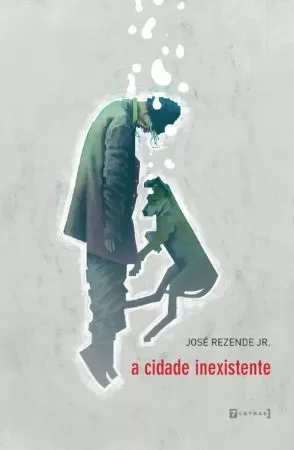
REZENDE JÚNIOR, José. A cidade inexistente. Rio de Janeiro: 7 Letras, 2019.
Ana Paula Gonçalves de Oliveira
Illustrated by Espírito Objeto
Translated by Martha Denton
A city condemned to drown by the construction of a hydroelectric dam, an old man and a dog who refuse to move, the impasses the residents face upon being displaced and moving to a new city, which is a replica of the old one yet entirely different, are the subjects of A cidade inexistente (The Non-Existent City), published in 2019. The work is the first novel of José Rezende Júnior (Aimorés, MG, 1959), a journalist and writer from Minas Gerais but based in Brasília. Rezende became known in the literary scene as a short-story writer after winning the Jabuti Prize in the category of stories and crônicas in 2010, for his book Eu perguntei pro velho se ele queria morrer (e outras estórias de amor). He is also the author of A mulher-gorila e outros demônios, Estórias mínimas, Os vivos e os mortos, and the children’s book Fábula urbana.
In the novel, in which at any moment the city may become submerged in water, an old man accompanied by his dog remains steadfast, refusing to leave the city and the home that housed four generations of his family. Elderly bodies, both human and canine, usually associated with physical fragility, operate as a symbol of resistance. Despite being worn out and fragile, the man and the dog share an unspoken pact that they must remain, that to do so is non-negotiable. Considered subversive by the government, they were committed to their fate, continuing to occupy the city condemned to death by drowning.
The other residents, refugees fleeing water rather than drought, put up small displays of opposition (or pretend to). Nevertheless, the government succeeds in deploying different methods of coercion, whether through a system of compensation and bureaucracy adjusted for legal deception, or through police violence. What separates the city from the tragedy of a flood is simply the button in the hands of the governor, who has never set foot in the city. From far away in the capital, he could push the button at any moment, opening the floodgates of the dam and flooding everything.
The work is composed of short chapters that alternate between an omniscient narrator and the narration of a boy, the grandson of the old man and the previous owner of the dog. The boy assumes the narrative voice at key moments, clarifying details from a point in the future. Within the interwoven stories, characters appear who exist in almost all cities: the madman who talks nonsense but occasionally speaks truth through the absurdities; the priest who sacrifices his body by fasting, requesting divine intervention for the salvation of the city; the traveling circus, which comes from time to time to entertain the dullness of the countryside; a family of little people; and even the usual myths for scaring misbehaving children, like the cabra cabriola — a creature that is half goat and half monster that sets its face and behind on fire.
The author explores some of the painful details usually kept under wraps that constitute the lives and sustain the gossip of almost all small towns. This is the case for the lawyer who commits suicide after being blackmailed by the mayor, leaving his fiancée waiting at the altar, later becoming a suicidal widow and ghost. There is also the priest, who, despite being devout, has a secret affair; and the red-light nightclub, which, on the night of the farewell to the city, becomes the scene of the rape of a sex worker. Such episodes engender interconnected plots that illustrate the secrets and brutalities that are typical of a Brazilian society that is sick, corrupt, and full of hypocrisy. The female characters appear as the weak point of the work, a point of interest. They slip into narratives always connected to suffering, sexual exploitation, and scenes of objectification or projections of the male imagination. This is the fate of the bride who suffers the tragedy of abandonment and meets a tragic end; of the sex worker who becomes a victim of gang rape and fulfills only the narrative function of being the sexual object of the old man; or of Ludmila, who appears as a talented trapeze artist in the circus, but soon becomes merely an object of fantasy for the young boys who live in the cities through which she passes. These female characters appear only in an accessory manner — their existences are not autonomous and are only justified in the narrative if connected to male characters. The latter are the focal point of the work, around which revolve the desire, passion, violence, or tragedy of female characters.
On the other hand, one of the strengths of the novel is the mix of realistic and everyday elements, with fantastical touches, which gain space little by little. One example is the story of the travelers, a woman and a man who dream of each other, and meet by happenstance at the train station. They catch sight of the flooded city and decide to explore it. As the narrative unfolds, they undergo a kind of metamorphosis, transforming into bestial creatures that populate, navigate, and consume the remains of the city-turned-lake. The author masterfully executes this transition, guiding the reader to embark naturally on the unexpected aspects of the novel.
While it is possible to copy almost the entire structure of the city, replicating even the spiderwebs, mold, the old paint on the houses, and other compositional details, there is an aura of authenticity that cannot be copied. The care, the smells, the sounds of the animals, everything is altered and nothing reappears in the new city, which unsuccessfully attempts to be the same as the old. The recording of a sad and out-of-tune song of a non-existent bird is the sound that awakens the residents; the mango trees are fruitless, lacking the messages carved with a penknife by the boy in love; the sad goats no longer react in the same way. Everything says goodbye, everything becomes sad. These details reveal the difficulties of living amidst the deception of a place pretending to be something it is not, a reminder to not only the residents, but also the reader.
In the mix between the real and the fantastical, between that which exists and the non-existent, A cidade inexistente interconnects stories that, through individual and collective suffering, offer an important reflection about the irreconcilable losses a community is subjected to when its land is expropriated in favor of a construction project that disguises itself as pointing toward progress. These losses, beyond the structural, are rooted in a subjectivity of the self that, despite having a roof and a city to call home, remains fractured through a disconnection from its origins. Having nowhere to go or return, it populates a kind of non-place. The work contains a circularity and repetition of the scenes that make up the prologue and epilogue and point to different possibilities for the unfolding of events, depending on the action taken by the community. A choice exists between surrender and resistance, which leaves the reader with a desire to read on to continue learning what this community will do upon becoming aware of what these losses and fractures will cause them.
Further Reading
SILVA, Felipe Teodoro da (2019). Só há labirintos: (des)leituras da ficção de José Rezende Jr. Dissertação (Mestrado em Estudos da Linguagem) – Universidade Estadual de Ponta Grossa, Ponta Grossa. Disponível em: https://tede2.uepg.br/jspui/handle/prefix/3032. Acesso em: 22 dez. 2023.
Iconography