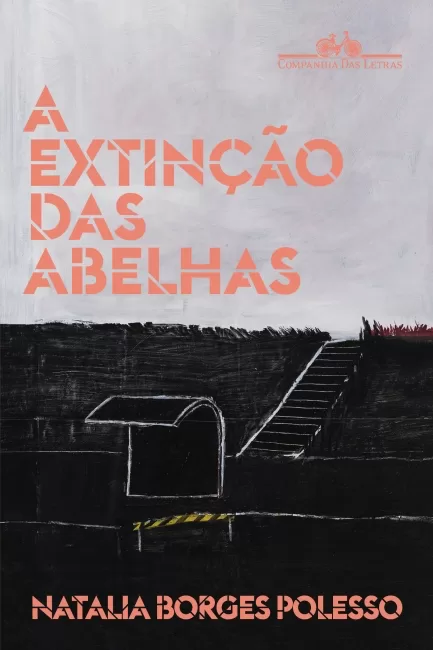
POLESSO, Natalia Borges. A extinção das abelhas. São Paulo: Companhia das Letras, 2021.
Bianca Magela Melo
Illustrated by Isis Gamell
Translated by Shaina Thelen
In recent years, the perception of a red alert in the relationship between humans and the rest of the planet has gone beyond localized scientific discussions and, especially during and after the Covid-19 pandemic, has become prominent in the voices of thinkers, Indigenous leaders, researchers, and writers. It has become an essential theme for reflecting on contemporary times in all their complexity. In writing A extinção das abelhas (The Extinction of the Bees) (2021), Natália Borges Polesso (Bento Gonçalves, RS, 1981) expresses herself from within this landscape of facts and discourse.
The total disappearance of the bees is the main indicator of the collapse of the future society envisioned by the author, measured by the “Colapsômetro” (Collapsometer), an app that allows anyone to follow, in real time, the course of the disaster. Brazil has been transformed into a dystopian territory with widespread shortages, toxic waste, deserted neighborhoods, food scarcity, and the creation of new condominiums for the super-rich. The neglect of animals, plants, and the land coincides thoroughly with the neglect of certain human lives, as the government explicitly abandons needy areas and clears them of people and things.
Women are regarded as the weakest link in the situation, exposed to behavioral regulation and physical and sexual violence, amplifying something already perceived today. It is a book centered on women. The central focus is on Regina, who is 40 years old and stranded by the country’s situation and her intimate relationships: her father died, her mother left when Regina was eight years old, and Regina has not been able to establish herself in any affectionate relationship.
Living with very little, she gets by as a translator, waitress, and at one point, by exploring sexual fantasies on the internet. The protagonist has a master’s degree in literary theory at a time when this means little for her survival. At many times, her mind appears tired and confused as she tries to understand the country she inherited from our generation. Natália Borges Polesso did not want to create a well-adjusted protagonist. Regina has the fragility of someone who feels lost and alienated in a moment of emergency. Although painfully alone, she constantly finds an outstretched hand, always feminine: from a romantic interest, from the family that has cared for her since childhood (the couple Denise and Eugênia and their daughter Aline), or from the revolutionaries that she meets towards the end of the book.
Female protagonism and the lesbian experience are present here as well as in Polesso’s other books — for example, Amora (winner of the Jabuti Prize in 2016), in which all of the short stories feature lesbian women in different stages of life. The recurrence enriches the author’s stylistic and thematic explorations, as it allows the subject to be addressed organically and fluidly, not presenting an issue in any way for the narrative, which unfolds from within the situation. The prejudice and persecution, always portrayed, come “from outside,” from others who are not in the foreground.
Regarding women, A extinção das abelhas projects a small utopia within the dystopia by suggesting that the support networks they have ancestrally woven would become islands of salvation in the midst of collapse. They are spaces in which it would be possible to live without the standard normativity of our times: masculine, heterosexual, and violent. Pietra, one of the women that Regina meets in her search for alternative ways of life, explains: “I want to be part of a new configuration of the world. A world in which I can exist, a world I can like. Not the one we lived in, Regina, that old invention of a world that collapsed in our heads.”
The author handles a large number of topics in A extinção das abelhas: the love between women and the historical-social situation in Brazil, the tragedy of pesticide use, the necropolitics of extermination, the post-Covid pandemic consciousness, the academic who lives precariously, and the utopia of a female community, to name a few. They are almost always well orchestrated. The question here is Guadalupe, or Lupe, the protagonist’s mother, whose experiences with a circus troupe are interspersed with the plot centered on Regina. The mother-sized wound is represented beyond the feelings and projections of the daughter. We know of events that occurred in Lupe’s life after she left the family home, but only as distant occurrences with jumps in the timeline, resulting in minimal engagement. And when, after a life apart, there is a suggestion of a meeting between the two realities, it is fragile and almost dispensable: a reckoning in the face of death, letters written and not sent, a geography in the process of being shared.
It is necessary to highlight, however, how stylistically creative the mode of connection is between the stories about Regina and Lupe in the first part of the book. Instead of a conclusion and full stop, each chapter is abruptly ended — until we discover that the missing word has been placed as the title of the next chapter, in a beautiful seam. In general, the narrative method is one of fragmented writing that attempts to guide itself by what the covered themes suggest. Polesso divided the novel into three parts. The first shows Regina’s present (the future for us) before the great collapse, simultaneously with her mother’s past. The second is a collage of portrayals of the world’s situation: excerpts from the news and scientific reports in which an essayistic and reflective tone prevails. The narrative flow is broken to prepare the ground, finally, for the third part, which is the account of how life functions after the collapse has been fully realized.
What stands out in the second section of the book is its suspension of linearity. Short chapters bring news of the collapse, without a defined narrator, presented through the chaotic and impersonal device of selecting and disseminating information — more or less as we are used to seeing. They come as déjà vu of what we know or hear, like news we scroll past noncommittally: the disasters caused by the mining company Vale or the real names of pesticides banned worldwide but permitted in Brazil. Or even the immensity of over 1.6 million square kilometers of the largest island of plastic waste in the world, mapped in 2015 on an expedition of scientists who sailed a stretch of the Pacific Ocean between Hawaii and California. “We are thirsty. There is more plastic than fish in the sea.”
Selected and inserted into fiction, the facts gain concreteness as the causes of the consequences we see in the world inhabited by the characters. Regina’s and Guadalupe’s existential drama coincides with and carries as much weight as the drama of the planet’s agony, provoked by human action. This perspective of collapse driven by social disregard is also portrayed by the author in Corpos secos (Alfaguara, 2020), a collective work (in conjunction with Luisa Geisler, Marcelo Ferroni, and Samir Machado de Machado) about a devastating illness, the dry body disease, caused by the uncontrolled use of pesticides in Brazil.
In introducing A extinção das abelhas (on her Instagram), the author — who also has a doctorate in literary theory — stated that her writing was influenced by the theoretical readings of Donna Haraway (American philosopher and zoologist), Timothy Morton (British philosopher and literary critic), and Ailton Krenak (Brazilian writer, thinker, and Indigenous leader), all of whom can be grouped under the term “ecocriticism.” Initially, Polesso reported, the plan was to write a novel about the future: “but at a certain point I realized that it was about the present. That’s why I say that it’s speculative realism. Everything is already here, and it will catch up to us sooner or later.”
When reviewing the book, Enio Vieira (2021) reflected on how narrating feelings such as that of imminent collapse would require other ways of telling stories: “I think that in 2020 a new Brazilian sensibility emerged for imagining the future. The first step is, without a doubt, to recognize the collapse of the present.” Alongside Polesso, he names José Falero, Jeferson Tenório, Edimilson de Almeida Pereira, Bernardo Carvalho, Ana Paula Maia, Daniel Galera, and Michel Laub as committed to the same effort.
For these names (or for most of them) mentioned by Vieira, one can affirm that there is at least one procedural coincidence: the essayistic tone, sometimes appearing directly, sometimes as a reflection of characters. When Regina crosses the border between Brazil and Argentina by land, she is simultaneously struck by an awareness of the environment and by the error of humanity in her time. This is a good illustration of the occasional essayistic breath in Natalia Borges Polesso’s writing: “Regina asked herself what determined when or where things began or ended. What? Who? (…) She wished to know nothing about horizons or expectations, she wished for ignorance — partly achieved, partly illusory.”
In Theodor Adorno’s classic text, “O ensaio como forma” (The Essay as Form), we get the opinion that the essay “does not try to seek the eternal in the transient and distill it out; it tries to render the transient eternal.” And perhaps the snapshots these fictions have been taking of the transitory — us, humans? A certain way of being on the verge of collapse? — is indeed a good connection among the authors. This new and simultaneously old approach highlights the relevance of speaking, even today, of realisms as Polesso does — now in the plural, since beyond a literary movement, realism points to recognizable aspects of our social and intellectual dynamics.
Further Reading
LEITE, Karoline Alves; OLIVEIRA, Rita Barbosa de (2019). Amor entre Amoras: a vivência lésbica nos contos de Natalia Borges Polesso. Trama, Marechal Cândido Rondon, v. 15, n. 34, p. 101-109.
POLESSO, Natalia Borges (2020). Sobre literatura lésbica e ocupação de espaços. Estudos de Literatura Brasileira Contemporânea, (61), 1–14. Disponível em: https://doi.org/10.1590/2316-4018611. Acesso em: 17 fev. 2024.
VIEIRA, Enio. (2021). “Em ‘A extinção das abelhas’, Natalia Borges Polesso pensa a vida após o colapso”. Revista Bula, dez.2021. Disponível em: https://www.revistabula.com /46742-em-a-extincao-das-abelhas-natalia-borges-polesso-pensa-a-vida-apos-o-colapso/. Acesso em: 18 fev. 2024.
Iconography