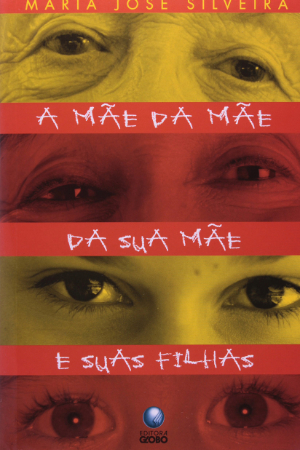
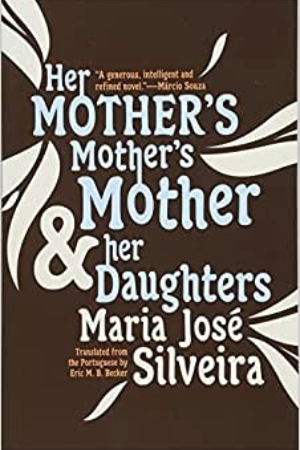
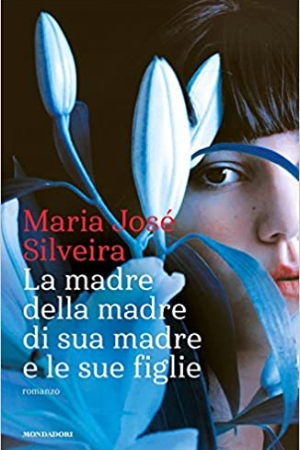
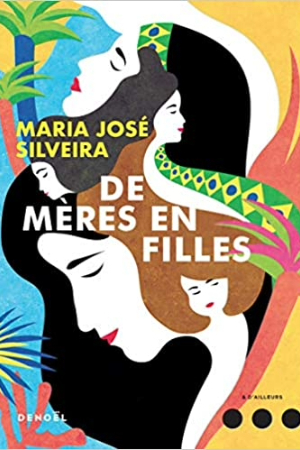
SILVEIRA, Maria José. A mãe da mãe de sua mãe e suas filhas. Rio de Janeiro: Globo Livros, 2002.
Maria do Rosário Alves Pereira
Illustrated by Laura Fraiz
Translated by Shaina Thelen
Published for the first time in 2002, and with a second edition in 2019 adding one chapter, A mãe da mãe de sua mãe e suas filhas (Her Mother’s Mother’s Mother and Her Daughters, translated by Eric M. B. Becker, Open Letter) is Maria José Silveira’s (Jaraguá, GO, 1947) debut novel, which won the São Paulo Association of Art Critics (APCA) Revelation Award. The work presents a genealogy of women from the 1500s to present day (2000s). This is a multifaceted panel of women in which the protagonists are Indigenous, mixed-race, or move between social classes. This is an important novel in Brazilian literature, both because it is written by a woman and because it gives women the leading role in a literary scene that favors narratives unfolding from the male perspective — showing, therefore, the world from a single perspective and experience. Here, in contrast, narratives unfold that show the multiplicity of female experiences.
Divided into five parts, the novel introduces women with strong personalities in the midst of a forming country, a country made up of multiple identities and grappling with its contradictions. The history of the Brazilian woman is outlined, highlighting their various forms of struggle for survival, but above all, for autonomy.
In terms of the construction of the narrative, the way in which the different stories — one serving as a hook for another — are intertwined stands out as the narrative focuses on the passing of generations and on ancestry itself reverberating in the story of each character. There is, therefore, not only an idea of continuity but also of ruptures between the story of each of these characters and, as a backdrop, Brazilian history. Take for example, the presence of the narrator, who stitches together the stories of the “family.” The absence of substantial clues about who this narrator is allows one to read the actual story the novel tells: the story of the women of the great Brazilian family and the way in which it came to be.
The historical novel, as previously highlighted by George Lukács, has the capacity to reveal social forces that are in conflict. This is how the reader comes to comprehend how the women led their lives while in different situations — through which the political, economic, and social interests of the system become clear. It is fundamental here, however, to understand that this is not just another novel about Brazilian history, but rather a novel that focuses on the female perspective: who are these anonymous, rejected, and enslaved women, and how did they live, even those considered free, having certain rights that did not always ensure well-being and happiness?
The book begins with the arrival of the Portuguese in Bahia in 1500. Taking colonization as a starting point, the author appears to indicate — surreptitiously — that many of the evils that we face today are the fruit of an exploitative system whose marks survive even with the passing of time. Inaiá, Tebereté, and Sahy are Indigenous women who see their lives changed by the influx of civilization. Sahy, the product of a relationship with a colonizer — her name meaning “the water of the eyes, the tear”— gets lost in the jungle and becomes enslaved, as the Indigenous people were used for labor. Each time she slept with the “Castelhano,” the girl became pregnant with a stillborn child, as if reiterating all the traces of death left by colonization itself. However, one baby survives: Filipa. And it is she — who knew the stories of her people only through her mother’s accounts — who questions the process of catechizing the Indigenous people and the violence of colonization, as portrayed in relation to other characters, such as Maria Cafuza.
As the years pass, other women parade through the sugar cane mills, marrying New Christians and Portuguese amid land disputes involving the Dutch. The resistance of Black slaves also became prominent, with many conflicts highlighted — from the War of Pernambuco in 1654 to the revolts at the beginning of the twentieth century and the Military Dictatorship of Brazil, which began in the 1960s.
As they travel through cities and towns, the characters make a geographical crossing towards the Southeast, as if to show the process of Brazil’s settlement through its migratory flows. Tropeiros (drovers) and cattle breeding rise to prominence towards Rio das Velhas and in Minas Gerais, as they pass through the trailblazing bandeirantes (colonial explorers and prospectors) and the search for gold. Afterwards, the arrival of the Portuguese royal court in Brazil turns Rio de Janeiro into a “beautiful and feverish” capital. Wherever it may be, in each of these scenes it is the female voice that makes itself heard through invisible and unknown characters that emerge — almost as if to question the centrality of traditional narratives, in which such voices did not echo — as if women had not participated in history.
And what are these protagonists like? They are human women — not always good people, like the perfidious Clara Joaquina, or marked for death like Damiana, who ends up being forcibly confined in a convent by her husband, treated as if insane. How many will have shared this same fate? Additionally, Silveira questions the historical and collective forgetfulness: “This generation of Brazilians, not even two centuries have passed and already they have completely forgotten who they descended from. […] What everyone thought at the time (18th century) was that the world was like this: the white man in charge, the slave at work, the Indian and the animal in the jungle.” In the 21st century, with forests and jungle devastated and Indigenous peoples on the brink of collapse, it is evident that the situation is not so different.
The end of the 19th century and the first decades of the 20th continued this singular sequence of protagonists: there was Açucena, owner of a freer sexuality who witnessed the arrival of abolition; there was Diana and the arrival of photography. All of this was linked to a busy social life in cafés, but also in associations being formed in search of the defense of rights, such as the Women’s Abolitionist Club. The reurbanization of Rio de Janeiro and its political and hygienic implications, Italian immigration, loves that survive (or persist) amid political conflicts — all of these elements mark the trajectory of lives throughout history. It is possible that the peak in this aspect is the character Lígia, a participant in the armed fight against the military dictatorship, who was politically disappeared, tortured, and assassinated — like so many other young people were. Her “clandestine love,” a love-resistance, gives rise to Maria Flor, for whom “no [theory] was capable of giving a true account of the predatory and perverse characteristics of the Brazilian ruling class.”
Through their fragmented memories and traumas, the reader asks: what has become of this generation of children of the politically disappeared? What marks, what gaps are part of their existence? Amanda and Benjamin, Maria Flor’s twins, live not only around the stray bullets fired by the police, the power of drug trafficking, and militias, but also with the decisions they must make — such as a teenage pregnancy, the discovery of homosexuality, and what this represents in an extremely homophobic society. Amanda’s son— from an Indigenous or Black man?— is about to be born and seems to symbolize our own nation, which, in the end, is also the daughter of many cultures, stories, and experiences.
In this way Her Mother’s Mother’s Mother and Her Daughters presents us with many different women: some more eccentric, others more serious; some conscious of their beauty and the fascination they exerted over men, others not so much; some deceived by husbands and family; others, true partners and entrepreneurs alongside them; some well adapted to the status quo; others, more perceptive, challenged the system. And many paid the price for it. Maria Jose Silveira thus constructs a novel that is not at all naive; rather, it is well outlined, in a fruitful partnership of history and fiction.
Further Reading
OLIVEIRA, Patrícia (2019). Entre mulheres, uma história: um olhar literário à colonização brasileira em A mãe da mãe da sua mãe e suas filhas. Dissertação (Mestrado em Letras) – Universidade Estadual do Oeste do Paraná, Cascavel.
PLÁCIDO, Elane; RODRIGUES, Roniê (2018). Representações da loucura feminina em A mãe da mãe de sua mãe e suas filhas. Opiniães, n. 12, p. 261-274. Disponível em: https://www.revistas.usp.br/opiniaes/article/view/143355. Acesso em: 1 mar. 2023.
SANTOS, Layse Dayana Lima (2021). Histórias de mães, memórias de filhas: um estudo das intersecções e confluências entre ficção, história e memória em A mãe da mãe de sua mãe e suas filhas. Dissertação (Mestrado em Letras) – Universidade Federal do Maranhão, São Luís.
SANTOS, Layse Dayana Lima (2022). As vozes do tempo: um estudo sobre as narradoras e a organização temporal em A mãe da mãe de sua mãe e suas filhas. In: SEMINÁRIO INTERNACIONAL DE LITERATURA, ENUNCIAÇÃO E CULTURA, 1., 6 a 7 dez. 2021, [S.l.]. Anais […] São Luís: Edufma, 2022. p. 69-82. Disponível em: https://www.edufma.ufma.br/wp-content/uploads/woocommerce_uploads/2022/03/ANAIS-I-SILECult.pdf. Acesso em: 1º mar. 2023.
TALHARI, Patrícia Bertachini (2005). A mãe da mãe da sua mãe e suas filhas: o passado revisitado sob a ótica feminista. Revista de Letras, Curitiba, n. 7, p. 1-11. Disponível em: https://periodicos.utfpr.edu.br/rl/article/view/2239/1400. Acesso em: 1 mar. 2023.
Iconography