Sophia Beal
Illustrated by Nina Nunes
Translated by Sophia Beal
When Brasília was inaugurated in 1960, it already had an artistic identity: buildings, sculptures, and tiled walls showed off the modernist aesthetic of the Plano Piloto (the original planned city), while woodblock prints, repente improvised poetry, and cordel chapbooks displayed the strong influence of the Brazilian Northeast in the peripheries. The capital’s artistic identity kept evolving. The Federal District was a hub for poesia marginal (countercultural chapbook poetry) in the 1970s and rock music in the 1980s. However, it took time for the capital to become a literary city, both in the sense of the Federal District being creatively represented in books and being seen as a place where award-winning fiction is written.
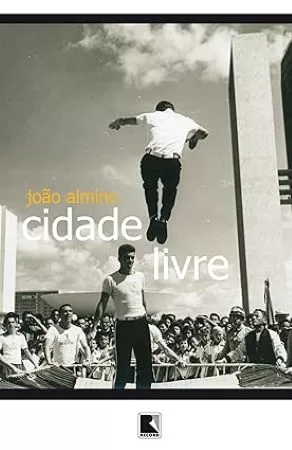
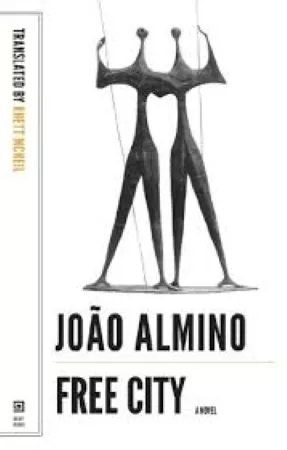
It was only with the publication of the so-called Brasília Quintet, a series of novels by writer and diplomat João Almino (Mossoró, RN, 1950), published by Record, that the capital finally had a “Brasília novelist” (Couto, 2010). The Quintet begins with Ideias para onde passar o fim do mundo (1987), followed by Samba-enredo (1994), As cinco estações do amor (2001), O livro das emoções (2008), and, finally, Cidade Livre (2010). The latter three were all published in English translation with the respective titles: The Five Seasons of Love (Host Publications, translated by Elizabeth Jackson), The Book of Emotions (Dalkey Archive Press, translated by Rhett McNeil), and Free City (Dalkey Archive Press, translated by Rhett McNeil). The series portrays a violent and socially segregated Brasília in scenes set from the 1950s to around 2080, in a future that Almino invents for the Federal District. A member of the Brazilian Academy of Letters since 2017, Almino is the author of eight novels, and his books have been translated into Dutch, English, French, Italian, and Spanish. He is most well known for his novels set in Brazil’s capital.
In the first four novels in the Quintet, the artificiality of the capital functions metaphorically to reflect the superficiality of the characters, but, in Free City, the city plays a more central role. The narrator, João, is a journalist in contemporary Brasília who recalls the experience of growing up living in the workers’ camp Cidade Livre, which arose in 1957 during the construction of the Federal District. Although the plan was to raze it after the inauguration of the capital, Cidade Livre was never destroyed, and now it is known as the administrative region Núcleo Bandeirante. The narrator is trying to understand the death and probable murder of the manual laborer Valdivino, a friend of the family. João interviews his elderly adoptive father, Moacyr Ribeiro, who is in jail. The themes of real-estate speculation and corruption in that sector arise via this adoptive father who made a fortune negotiating short-term leases of lots in Cidade Livre, building homes, and involving himself in corrupt construction projects during the capital’s construction. Moacyr’s financial success was short-lived, however, and he ended up in jail due to his fraudulent dealings.
Valdivino and Moacyr have intersecting romantic lives since they are both in love with the same woman: Lucrécia. Yet, economically their situations diverge since Moacyr became prosperous while Valdivino lived almost nomadically, in part because he was dodging his debt to the man who arranged for his travel from the Northeast to the Planalto Central. Allegorically, Valdivino represents the popular classes in the Federal District, giving voice to their struggles, particularly regarding housing. His mysterious murder intensifies the sensation that the manual laborers are treated as if they were disposable. Although that type of critique is present in the first four novels in the Quintet, it is more pronounced in Free City, a book in which a socially marginalized character has a more central role. The prophetess Lucrécia, also known as Íris Quelemém, appears in all the books in the Quintet and in Almino’s novel Enigmas da primavera (2015), which was published in English translation as Enigmas of Spring (Dalkey Archive Press, translated by Rhett McNeil). Lucrécia’s presence links Almino’s fiction to the strong tradition of fringe religious communities near Brasília, especially the Vale do Amanhecer and the Cidade Eclética. The historical figures Tia Neiva and Mestre Yokaanam, who were mediums in those two communities in real life, were supposedly, in the fictional realm, Lucrécia’s mentors.
Beyond telling the story of the construction of Brasília, Free City calls attention to injustices regarding who has the right to represent and interpret the Federal District in fiction and nonfiction. Alluding to Machado de Assis’s prologues — signed by the author, but with authorship attributed to the narrators — the introduction to Free City is signed by JA, but written by a narrator-journalist named João who thanks João Almino for his revisions. As Free City questions authority, it examines how authors and critics police meaning. The novel includes the contrast between public figures’ interpretations of Brasília, which have influenced public opinions about the city, and members of the popular classes’ interpretations of the city, which rarely were published. Although the content of Free City aligns with that of a historical novel, the style deviates from facts and invites social critiques. The fact that the readers have in their hands a published book, though the narrator claims that they are reading a collective blog of nonfiction, accentuates the novel’s literary features of falsity and invention. The disconnect makes the reader more conscious of the historical ties between novels and elite cultural and ideological control (Beal, 2021).
Almino’s novels combine elements associated with postmodern fiction (metafiction, fragmentation, narrative interruptions, unreliable narrators, pastiche, and literary allusions) and components of pulp fiction (murders, sex work, drugs, lasciviousness, punchy dialogues, and incest). That mixture provokes estrangement because the readers are stuck between two registers, never able to fully immerse themselves in the fictional plot and never certain how to approach the book. That tension in Almino’s fiction questions how dominant elite literature has established false boundaries about what is considered “high” and “low” culture to maintain its status and exert ideological control. Via this type of mixture, in a novel that broaches elitist real-estate speculation, Almino establishes a relationship between the control of the dominant classes over the distribution of land in Brazil and their control over the distribution and interpretation of literature and other forms of art.
Throughout the novel, the reader is aware that housing security and the possibility of sharing one’s ideas widely are social privileges. Valdivino, to the extent that he represents the popular classes in the Federal District, lives a life marked by housing insecurity and the silencing of his convictions (Beal, 2021). In comparison, the blog commentators in Free City are so involved in the small details of the founding of Brasília that they fail to see the big picture evoked by their blog entries: a story of real-estate speculation, inequality, and unregulated violence that haunts the capital.
Interpreted as a book that reflects on who has the right to represent the capital in writing, Free City foreshadows the Federal District’s literature that has received attention in the decades after its release. Often empowered by the collective ethos of poetry slams, saraus, small publishing houses and community centers, writers from underrepresented groups — especially women, Black people, the LGBT+ community, residents of the periphery, and authors holding multiple of these identities — began to publish books of poetry and prose much more frequently, thus amplifying the representation of the capital and insisting on occupying and creating a literary city.
Further Reading
SARAIVA, Juracy Assman; MÜGGE, Ernani (2016). Cidade Livre: reflexão metaficcional. Letras, Santa Maria, v. 26, n. 53, p. 199-214. Disponível em: https://periodicos.ufsm.br/letras/article/view/25090/0. Acesso em: 17 maio 2024.
BEAL, Sophia (2019). Brasília Unsettled in João Almino’s Cidade Livre. In: BEAL, Sophia. The Art of Brasília: 2000-2019.Palgrave. p. 69-88.
BEAL, Sophia (2021). João Almino e o direito criativo à cidade. In: BEAL, Sophia. A arte de Brasília: 2000-2019. Tradução de Larissa Satico Ribeiro Higa. Minneapolis: University of Minnesota Libraries Publishing. p. 71-90. Disponível em: https://umnlibraries.manifoldapp.org/read/a-arte-de-brasilia-2000-2019/section/11019d10-5e7f-4574-b33d-055a7f2c6f9c. Acesso em: 17 maio 2024.
COUTO, Ronaldo Costa (2010). Livro recria o início doido de Brasília. Folha de São Paulo. Disponível em: https://joaoalmino.com/livro-recria-o-inicio-doido-de-brasilia-cidade-livre. Acesso em: 17 maio 2024.
MONTEIRO, Pedro Meira (2010). Todo instante: a ficção de João Almino. Luso-Brazilian Review, Madison, v. 27, n. 1, p. 61-70. Disponível em: https://lbr.uwpress.org/content/47/1/61. Acesso em: 17 maio 2024.
Iconography