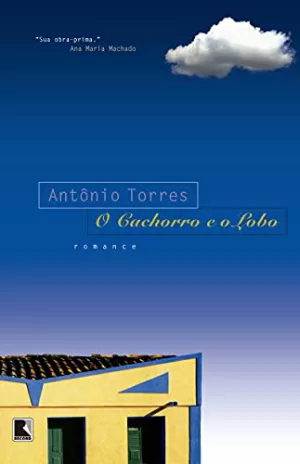
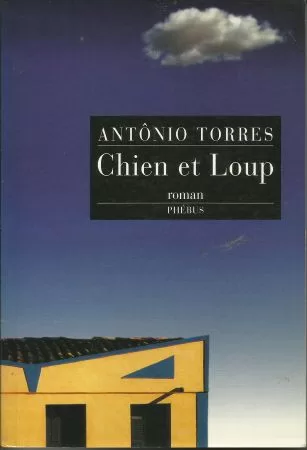
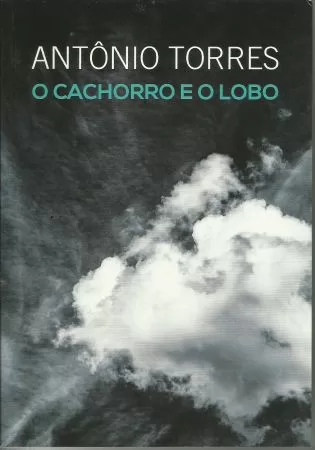
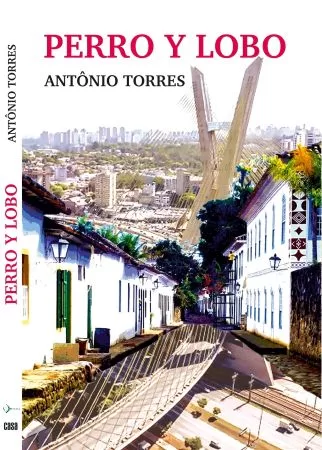
TORRES, Antônio. O cachorro e o lobo. Rio de Janeiro: Record, 1997.
Lilian Reichert Coelho
Illustrated by Espírito Objeto
Translated by Leila Santos
A dog howling at the moon is the title of Antônio Torres’s first novel and is a phrase that holds for other books the Bahian writer has written. The dog is a human gone mad, lost between different fears: fear of Brazilian society that expands, with the illusions of capitalism, to chaotic cities, wearing down people and relationships; and fear of the pressure of a world of work, consumption, and unemployment. Despite everything, the dog recognizes the beauty of the moon.
In various novels, Antônio Torres’s characters are on the subjective threshold of coexisting and contradictory times and spaces. These include the quiet life in godforsaken places that are migrant expulsion points (named or not, the Junco, district of Inhambupe, today the municipality of Sátiro Dias, in Bahia, the writer’s hometown) or the empty comfort of modern life in a big city. They are comforted by their memories.
O cachorro e o lobo (The Dog and the Wolf) is Torres’s eighth novel and the second book of the trilogy of migration, suicide, and memories of Totonhim. The trilogy began in 1976 with the publication of Essa Terra (This Land) and was concluded in 2006 with Pelo fundo da agulha (Through the Eye of the Needle). In 2022, to commemorate fifty years of Torres’s literary activity, the editor Record published the Trilogy Brazil, bringing together the three novels into one volume. At the end of the first book, Totonhim decides to go to São Paulo to follow the fate of his older brother, Nelo, beloved by their parents, who had left twenty years earlier to look for better living conditions, but returned defeated. He feels compelled to leave the Junco for São Paulo for fear of association with his suicidal brother, condemned to never receive forgiveness from the people or God, like the “loony” Alcino proclaimed in the small square of the small town that lives according to the calendar of Catholic celebrations.
O cachorro e o lobo is made up of five parts: “The Phone Call,” “Morning,” “Afternoon,” “Night,” and “The Goodbye.” A call from his sister, Noêmia, causes Totonhim, after decades of distance and silence, to take a trip that will last 24 hours. O cachorro e o lobo is the most focused on affections among the novels of the trilogy, without the affliction and sadness of Essa terra or the melancholy, hopeless, retired man in Pelo fundo da agulha. Nonetheless, it is also permeated by the observation of the permanence of the difficult living conditions in the town in the face of modernity and transformations, understood by the narrator as unavoidable. There are also the ghosts, the most notable of which is Nelo’s.
The telephone is the triggering artifact of travel and memory. However, the most accentuated image of modernity that the narrator uses in O cachorro e o lobo is the satellite dish, which condenses the tone of a time that corrodes old worlds remembered with nostalgia. It symbolizes the unstoppable changes and interferes with the memories of Totonhim, who believed in returning to his homeland and recognizing it as it was in his infancy and adolescence, offering him the comfort of refuge held intact. Nonetheless, he does not note many equivalencies between what he sees and what he remembers. Of the past — and from his own life — only a “shard of tile” remains from his childhood home. The narrator’s look is not innocently nostalgic, but rather an observation, simultaneously disturbing and fatalistic, of the split between the present and past, between São Paulo and Junco.
The dog in the title is the narrator himself (this refers to both the canine howling at the moon and the fact that the father and other characters call him “you filthy dog!” [seu cachorro!]), and the wolf is the father, Mr. Totonho, whom the son expected to find defeated by time and by the precarity of Junco. Researcher Rogério Gonçalves (2014) suggests that the dog can be seen as a child domesticated by urban society, whereas the wolf represents the father who continues to live a free, untamed life.
The narrative’s central theme is the celebration of reencounters marked by memories, without tension or apprehension, even after Totonhim’s decades of absence and silence. Everything is seemingly simple like the language, with short phrases, the insertion of elements of orality and popular language to tell stories about Junco residents’—especially the old man Totonho’s—ways of life. The prose progresses in the first person in a linear fashion; however, the progression is interspersed with the narrator’s recollections in different temporal movements that include images, literary and popular songbook references, humorous comments, popular sayings, or joking remarks about people and situations.
The narrator’s observation of his father, Mr. Totonho, both Antão by birth, is of a sensitivity driven not only by filial love, but also by a tenderness for a human being that is both rare and common. The admiration for his father overflows from memories and dialogues (imagined and real) and their coexistence for just one day. While the family repels the older man for being an alcoholic, for talking to ghosts and chickens, and opposing modernity that has already arrived in Junco, Totonhim sees intuitive and spontaneous love in how his father welcomes him, in his telluric relationship with nature, the old house, and the people of the place. But, all of this does not belong to Totonhim, as he must return to his life as a civil servant in the big city with his wife and children.
Mr. Totonho is the guardian of an ancient and still resilient world, in the process of losing its popular authenticity. The simplicity of his father fascinates Totonhim, compared to life in the country’s financial capital, which is only alluded to in O cachorro e o lobo. The elder Mr. Totonho is not a simple man; on the contrary, he is a person who represents one of the images present in the collective imagination about the country man (sertanejo) as someone who overcomes adversity with humor. His son, however, does not, perhaps because he feels like a failure. Because of this, the younger Totonho needs his memory and his homeland so much: his family, first girlfriend, and the past that he idolizes but sees as lost. This sadness about his own life can be associated with the country and the results of discourses and practices about progress, both culminating in failure.
Encounters and commemorations fill Totonhim’s 24 hours in Junco, confirming the possibility of close and affectionate human relationships, even in today’s world (though maybe not for Totonhim in his life in the capital). These movements are combined with social or philosophical analyses and commentaries that are not configured as mere decorative touches or narrative pauses, but as a revelation of an ethic of resistance to the world that is transformed by the tensions between the local and global, the country and the city.
The differences between life in the city and the country are still challenges for art, social thought, and public policies, demarcating the social imagination and contemporary Brazilian literature, with debates about regionalism and an emphasis on production in urban contexts. Torres dialogues with the canonical literature that addresses the sertão (Almeida, 2021), proposing a reading that deviates from idealizations or the tragedy of drought, hunger, or coronelism. In a period like the third decade of the 21st century, in which the dominant view of rural areas shifts from the ideology of backwardness to a positive image of agribusiness, Antônio Torres’ assertion — that progress and development are fallacies that impact the subjectivity of narrators and characters in contemporary Brazil through the process of globalization —remains relevant. O cachorro e o lobo is of interest to researchers of regionalism and of the relationships between literature and memory.
Further Reading
ALMEIDA, Adriana Soares de (2021). A morte de si pelo sertão da memória: uma análise do universo literário de Antônio Torres. Tese (Doutorado em Literatura e Cultura) – Instituto de Letras, Universidade Federal da Bahia, Salvador.
GONÇALVES, Rogério Gustavo (2014). O cachorro e o lobo, de Antônio Torres: e edificação de um sertão ameno. Revista Verbo de Minas, v. 15, n. 26, p. 74-90. Disponível em: https://seer.uniacademia.edu.br/index.php/verboDeMinas/article/view/466. Acesso em: 26 jul. 2023.
GONÇALVES, Rogério Gustavo (2014). O percurso da memória nos romances de Antônio Torres: a constituição do eu na fronteira entre o sertão e a cidade. Tese (Doutorado Letras) – Instituto de Biociências, Letras e Ciências Exatas, Universidade Estadual Paulista Júlio de Mesquita Filho, São Paulo.
SANTOS, Clélia Gomes dos (2020). As recorrências e metamorfoses da fuga: os desdobramentos da migração nordestina em narrativas de Antônio Torres. Dissertação (Mestrado em Letras) – Departamento de Estudos Linguísticos e Literários, Universidade Estadual do Sudoeste da Bahia, Candeias.
SILVEIRA, Manoela Falcon (2014). A reconfiguração da nordestinidade: imagens do espaço Nordeste em Árido Movie, 2000 Nordestes e na trilogia do escritor Antônio Torres. Tese (Doutorado em Literatura e Cultura) – Instituto de Letras, Universidade Federal da Bahia, Salvador.
Iconography