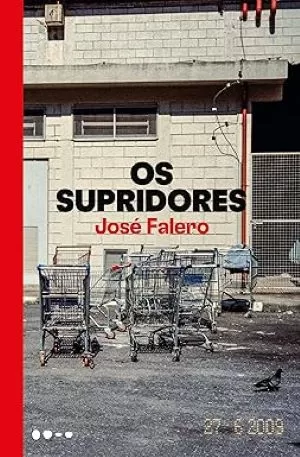
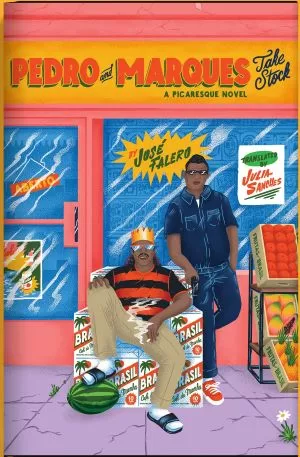
FALERO, José. Os supridores. São Paulo: Todavia, 2020.
Juliana Florentino Hampel
Illustrated by Dona Dora
Translated by Martha Denton
There is consensus among the critics of José Falero (Porto Alegre, RS, 1987) that the theme of systemic violence permeates his work. According to Ramiro Valdez (2022), in an article about Os supridores (The Suppliers) (2020), the novel can be categorized as a “violence novel” in which violence operates as a mediator of social relations. In this way, the author offers an “x-ray of contemporary social conflict” by writing from a place of belonging and rootedness. As scholar Andrea Kahmann (2021) argues, Falero writes by “being” and not merely living in the place from which and about which he writes.
Falero, by writing as an outsider from the margins of the city, in a way that is inseparable from his personal experience as a resident of the periphery and a blue-collar worker, circumvents the rules of the literary game. He writes from a sense of political duty that allows him to transcend hierarchy and innovate from a place of less prestige. Thus, he establishes himself as a writer who is a spectator and, simultaneously, a participant in the “outside game” of regions far from the center where everything is different. There, another language is spoken — there are different beliefs, perceptions and ambitions that, to be recreated fictionally, require a new type of language.
The novel Os supridores is the second work published by Falero, which was a finalist for the Jabuti and São Paulo Literature Awards in 2021, as well as the winner of the AGES Award in the same year. Before the novel, Falero published a book of short stories called Vila Sapo (2019), with the independent publisher Vienas Abiertas, and later Mas em que mundo tu vive? (2021), a collection of crônicas. The three works share the same setting — the periphery of Porto Alegre — and portray the day-to-day lives of its most scorned residents and workers, including cleaners, waiters, and stockers, and the daily prejudice they face.
The plot puts us in direct contact with the trajectory of two coworkers, Pedro and Marques, who work as stockers at the branch of a supermarket chain. Unable to change their social status, they decide to sell marijuana to the children of rich families, who use the drug as entertainment. Marijuana is chosen over other narcotics for a number of reasons elaborated by Pedro, who proposes the business venture. The first is that it is an undesirable drug for neighborhood gangs because it yields little profit, allowing the two to become self-employed and escape the violence perpetrated by these groups as they seek spatial control of distribution areas. The second reason is that it would allow them not to answer to a boss and share profits equally, inspired by Marxist teachings.
In debates with Marques, Pedro argues that he “never wanted to be a drug dealer in the first place.” However, he “also didn’t want what they were shoving down his throat: the fucked up life that [he] had. What [he] wanted was money.” When his coworker remains suspicious, Pedro delivers another of his sociopolitical monologues, which are present throughout the novel. He demonstrates the cultural framework acquired during endless bus trips between home and work, in which he “developed — with great difficulty — the enviable ability to read on the bus without getting sick,” allowing him to discover the works of authors like Karl Marx, Shakespeare, and Agatha Christie. Inspired by these thinkers, he makes the irreversible decision to “sell marijuana as a way to abandon the inglorious path that his pathetic life as a member of the working class was on,” and finally “crash the great party of carefree spending, to which he had never been and would never be invited.”
He attempts to make clear to his coworker that the ideas of meritocracy, based on the myth of individual effort and presented in the training video for new employees at the Fênix grocery store chain, are lies perpetrated by the ruling class. Such lies normalize the inequality and exploitation that underpin the working world under the aegis of the capitalist system, in which the laws of the state exist solely to protect the profits of the bosses which are produced by the labor of workers. “Take a look at this trip […] Imagine that you open your own business […] In reality, you deserve to keep all the profits from your business […] All the money that is the result of your personal effort, of the work you did, everything has to be yours.” But, he continues to explain to his friend, the so-called “entrepreneur” does not think like that, because his focus is profit: “They don’t care about the person. […] They only want to take advantage of the situation to make more and more money, without needing to work more and more themselves.”
These dialogues and thoughts are entangled in a plot that exposes the rise and fall of people on the periphery during a period of more or less two years — the records go from 2009 to 2011. During this time, the direct speech of the characters is contrasted, simulating on one side the language belonging to a specific social group at the time of its realization, full of linguistic choices intended to distance the speaker from normative grammar. And on the other side the narrator’s speech, in which language acquires more formal contours, for example the pluperfect, which does not belong to popular language.
The work with language is graceful in its alternation between formal and informal registers, with the presence of a narrator revealed unexpectedly in the final pages of the book, who gradually unveils a “geography of violence.” In various passages, he conveys to the reader the precarious conditions of the protagonist himself in his journey from the center to the periphery, “standing inside the bus, squeezed between tired workers, Pedro got lost in thought, contemplating the night through the window”, in addition to the inequality of urban space: “As the vehicle advanced in the direction of the eastern end of the city, the landscape became more hostile and miserable before his eyes.”
The narrator also explains to the reader the symbolic violence present in the narrative, materialized in the class division that prohibits residents from enjoying the cultural goods available to them. The “Vila Lupicínio Rodrigues was the undesirable backyard of an important cultural center of the same name” —however, despite this, it existed “only to prove that the distance between culture and poor people was not physical.” The residents of the village did not frequent the space, because “it was as if they knew, or felt, that it was not for them, as in fact it did not seem to be.”
Pedro’s speech is similar to that of the third-person narrator, however with a totally different register: “To them, we was only born in the conditions that we was born in because our parents was lazy; and we continue in the same conditions because we’re lazy also.” This results in Falero’s innovative writing, composed of a unique kind of linguistic experimentation, full of local slang, syntactic “diversions,” and a speech elaborated in the present tense by a speaker with a need for pungent, violent, nimble, and fierce expression. A type of expression capable of reflecting the reality of marginalized spaces made invisible: “we can’t want what they have, we can only show up at the castle, whether to clean the floor or prune the bushes, and after that we go back to the hole we came from.”
Despite the harshness and cruelty evident in the pages of Os supridores, its final message sounds like a question to the reader about whether the periphery is the exclusive producer of violence that plagues Brazil. By narrating the trajectory of young people from the peripheries, subjected to poorly paid formal employment, who instead opt to work in drug trafficking to achieve better living conditions for themselves and the people they love, Falero proposes a hypothesis that social inequality, the greatest violence that vulnerable populations are subjected to, is in fact top-down, from the center to the edges, when those in power seek to imprison so-called third-class citizens in subordinate positions.
The presence of a narrator who is born from these experiences and attempts to understand the reason for this cycle can be interpreted as an attempt by the author to find non-violent solutions to this reality. In other words, by providing individuals with knowledge about their condition, Falero equips them to escape or even eliminate the violence that prevails among us. Literature emerges as a rejection of dehumanization and of any process of exploitation that jeopardizes human dignity.
Further Reading
KAHMANN, Andrea Cristiane (2021). A literatura trânsfuga de José Falero. Aletria, Belo Horizonte, v. 31, n. 3, p. 97-118. Disponível em: https://periodicos.ufmg.br/index.php/aletria/article/view/29268. Acesso em: 20 jul. 2023.
LIMA, Alvaro Moreira (2022). Os “crias” do nosso Brasil: a relação entre ficção literária e realidade social em Os Supridores de José Falero. Lavrapalavra, São Paulo, 4 jul. Disponível em: https://lavrapalavra.com/2022/07/04/os-crias-do-nosso-brasil-a-relacao-entre-ficcao-literaria-e-realidade-social-em-os-supridores-de-jose-falero/. Acesso em: 15 jun. 2023.
VALDEZ, Ramiro (2022). Os Supridores, de José Falero: uma radiografia das violências no Brasil contemporâneo. Revista Contraponto, v. 9, n. 2, p. 132-151. Disponível em: https://seer.ufrgs.br/index.php/contraponto/article/view/129107. Acesso em: 15 jun. 2023.
Iconography